Making data available in an accessible and intelligent manner is one of modern science’s greatest challenges, says a scientific consultant to the Royal Society.
This special edition, the first dedicated to a single country, includes articles by 16 Brazilian researchers on topics ranging from cancer, agricultural pests, milk quality and biodiversity.
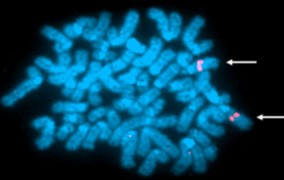
A faster, more efficient method developed by researchers at the NIH and the CTC makes treatment selection easier, especially for leukemia patients. The article was published in Blood.
Nature Reviews Neuroscience dedicated its cover to studies funded by FAPESP and conducted by the USP’s Biomedical Sciences Institute. Scientists showed that the neural processing of distinct types of fear involves different paths in the brain.
Difficulties found in the business sector are even greater in the technological segment; in large companies, the problem is regulatory uncertainty, says researcher.
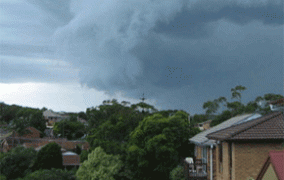
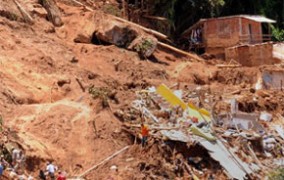
Socioeconomic and cultural factors increase the vulnerabilities of the female sex to disasters caused by extreme climate events, says Mexican researcher and IPCC member.
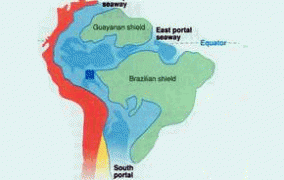
A study of the evolutionary process of diversification of marine organisms reinforces the geological theory that 10 million years ago an ocean extended across the continent from the Caribbean to Uruguay, covering the entire Amazon basin.
People with relatives who have had a melanoma have a 30 times greater risk of developing the disease and require continuous monitoring, warned doctors during the World Congress on Cancers of the Skin.
The Foundation offers opportunities with the InterAmerican Network of Academies of Sciences for young Latin American researchers and will launch a program to attract scientists from around the globe
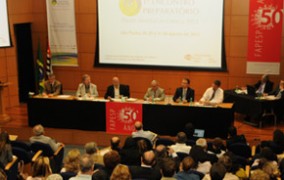
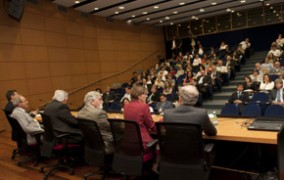
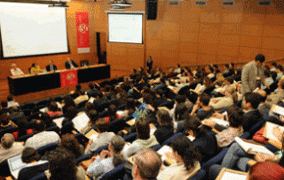
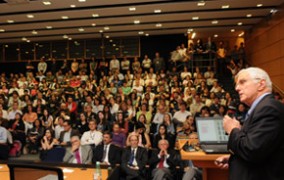
The dynamics and complexity of the scientific process and its relationships with culture, the economy and education were debated at the 1st Planning Meeting for the 2013 World Science Forum
“It is crucial that the voice of science be heard when dealing with global issues, as this is the most successful means of creating knowledge,” says Michael Clegg, president of IANAS
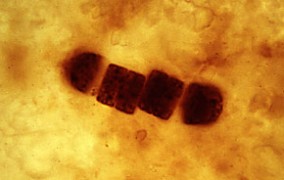
The evolution of microorganisms comprises 85% of biological history, according to Andrew Knoll during the São Paulo School of Advanced Sciences on Evolution
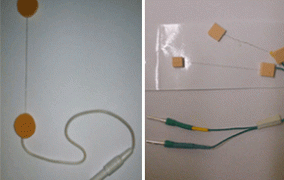
A device developed by researchers in São Paulo is approximately four times less expensive than imported equipment and can make electroretinography more accessible
Researchers affirm that the conference produced significant mobilization in the scientific community, but the final document caused frustration due to the exclusion of important topics.
Workshop brings together BIOEN-FAPESP researchers with projects focused on the production of second-generation ethanol, biodiesel and other chemical products from renewable sources
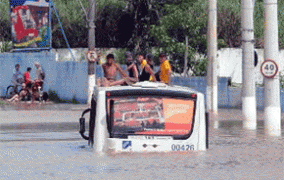
Specialists gathered in São Paulo to debate managing climate extremes express concern over the difficulties journalists face in dealing with this complex theme
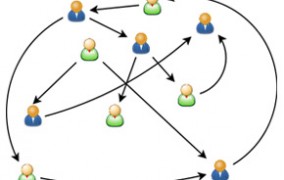
Study conducted at the Metropolitan Studies Center-FAPESP demonstrates how social networks influence poor people’s chances of obtaining better living conditions.
Brazilian researchers participate in the Double Chooz experiment in France, where neutrino oscillation measurements of unparalleled precision are made in flows produced by a nuclear reactor.
Work in the field reveals that the percentage of the nitrogen in fertilizers that is transformed into greenhouse gases is lower than expected. The study reinforces the environmental benefits of ethanol.
The risks of disasters caused by heat waves, record high temperatures and strong precipitation will depend on the level of vulnerability and exposure of populations, concludes the IPCC.
Estrogen stimulates the proliferation of cells responsible for the maintenance of spermatozoid production and can also be related to prostate cancer, say Brazilian researchers.
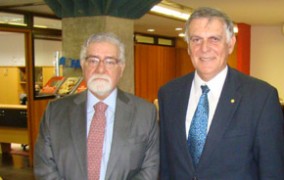
The 1982 discovery of these crystals sparked skepticism from the scientific community until they were finally accepted after more than a decade, says Israeli Daniel Shechtman.
The combined use of thalidomide and dexamethasone was more efficient in retarding the progression of the disease in transplant patients, indicates studies
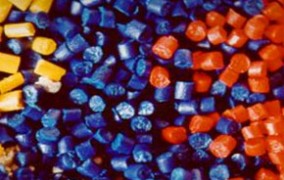
In a workshop at FAPESP, researchers sought interactions with industry to advance new alternatives for sugarcane bagasse use, including the manufacture of biodegradable plastic produced by bacteria from organic materials
A book produced by the Metropolis Studies Center and Minister of Cities shows that a third of municipalities do not have the structure to manage housing policies.
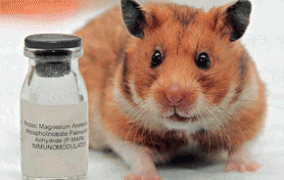
Scientists describe the potential mechanisms of action of P-MAPA, a drug that can activate immune system receptors, in an article in Infectious Agents and Cancer.
The São Paulo Advanced School of Comparative Oncology will present the most recent scientific advances in the area, which integrates naturally occurring cancer in domestic animals and humans.
An enzyme from a metabolic pathway of the parasite that causes the disease could be a target for new medications that would impede Leishmania growth and infection in humans.
Research project contributes to understanding of the relationship between foreigners and the transformations that have occurred in São Paulo city since the 19th century.
The objective of the study was to identify drugs that can modulate the liberation of coagulating substances inside organisms, preventing hemorrhage and thrombosis.
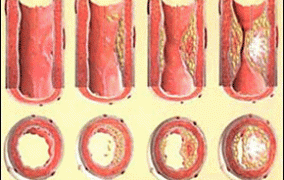
A study shows that mice exposed to São Paulo air during gestation and following birth developed 13 times more atheromatous plaques than the control group
Scientists participating in experiments at LHC announce discovery of a new subatomic particle that could be the Higgs boson particle, ending a half-century quest.
A study performed at the USP Polytechnic School indicates that changes to the treatment of sewage from the São Paulo coast’s oldest outfall will allow the system to maintain its current level of discharge.
A study tracks the international education of the Brazilian elite ruling class and identifies their strategies in competing for highly visible positions as spokespeople for word leaders.