




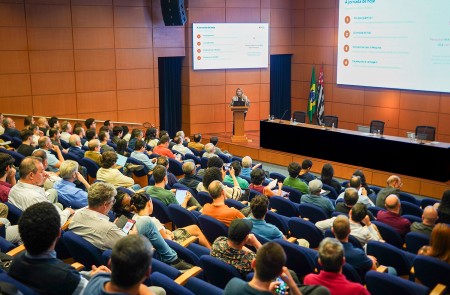
The event was held on August 28 in the FAPESP auditorium (Daniel Antônio/Agência FAPESP)
At the 6th FAPESP 2026 Conference, the quantum technologies coordinator at Brazil’s largest private bank demonstrated how current research can reveal applications, anticipate risks, and develop expertise in a technology that has yet to reach large-scale commercial use.
At the 6th FAPESP 2026 Conference, the quantum technologies coordinator at Brazil’s largest private bank demonstrated how current research can reveal applications, anticipate risks, and develop expertise in a technology that has yet to reach large-scale commercial use.
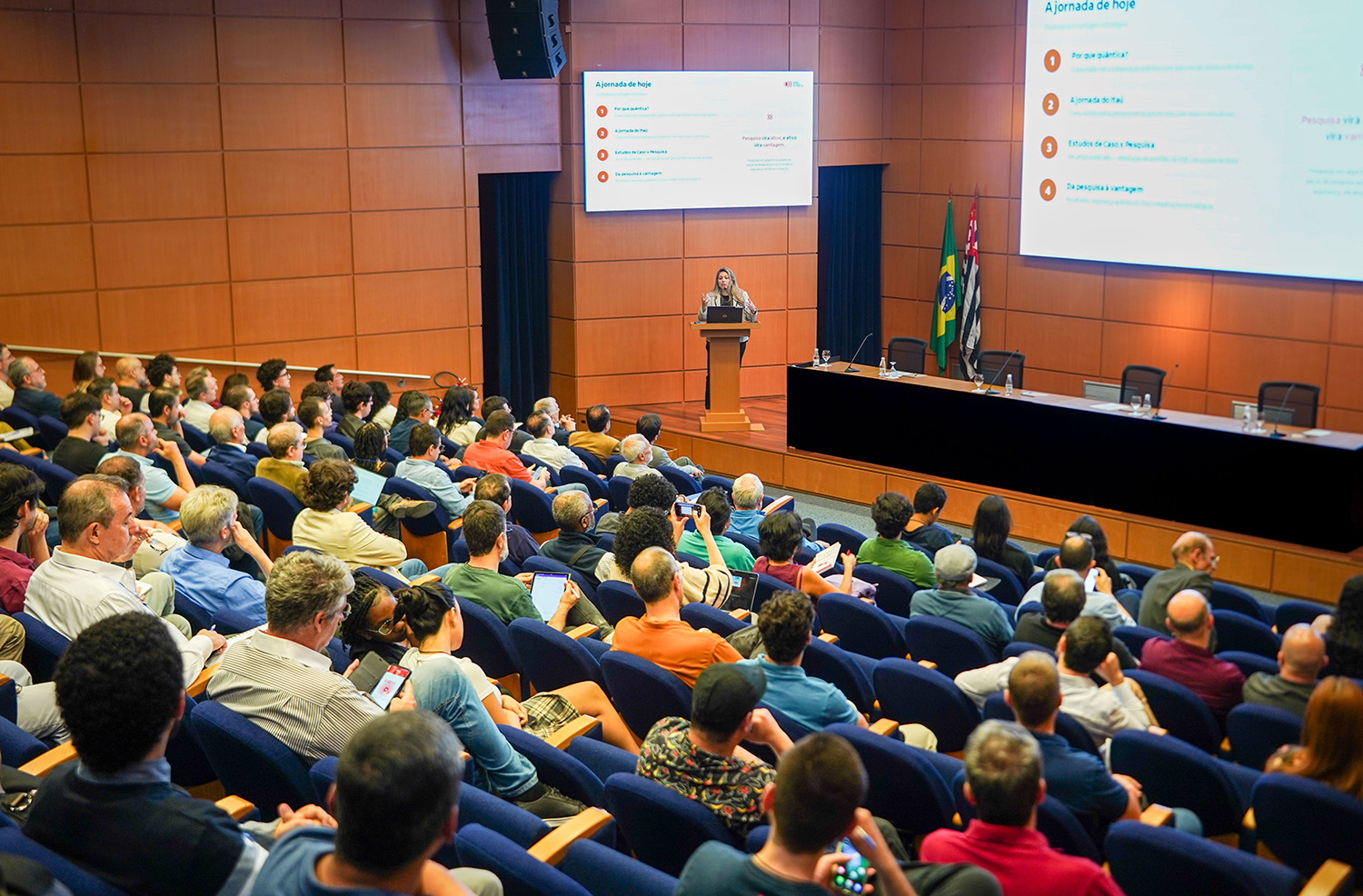
The event was held on August 28 in the FAPESP auditorium (Daniel Antônio/Agência FAPESP)
By José Tadeu Arantes | Agência FAPESP – Quantum computers are already being built and tested on an experimental scale. However, a machine capable of solving problems of interest to large companies in a commercially relevant way, with a clear advantage over the best conventional computers and algorithms, is not yet available. Nevertheless, waiting until this milestone is reached before beginning to address the subject may be too late. Preparations must begin now by identifying problems that quantum computing can solve, developing algorithms, preparing security systems to address new threats made possible by the technology, training specialized teams, and establishing partnerships.
These were the central themes of the 6th FAPESP 2026 Conference, “From Research to Strategic Advantage: Quantum Computing Applied to Business”, presented by Samuraí Gomes Aguiar Brito, the coordinator of quantum technologies and an executive manager of data science at Itaú Unibanco, Brazil’s largest private bank.
Brito has a Ph.D. in physics from the Federal University of Rio Grande do Norte (UFRN) and has conducted postdoctoral research in quantum information and computing. She is included on the “Quantum 100” list of the United Nations Educational, Scientific, and Cultural Organization (UNESCO), which brings together the 100 most influential professionals in the field.
“Quantum computers aren’t ready yet. We’ve managed to build them, test them, develop algorithms, and conduct small-scale experiments, but we still don’t have viable quantum computers for productive commercial use. However, that doesn’t mean you need a quantum machine to get started. Small systems can be simulated on conventional computers and used to develop algorithms and learn to think about problems in a different way. Quantum thinking is algorithmic thinking,” said Brito.
The strategy she presented reverses the common approach to emerging technologies. Rather than starting with the new tool and trying to figure out where to apply it, one begins with the problem. “Our main goal is to discover which problems quantum computing will make a difference in, so that we can invest quickly and effectively,” she said.
This will be especially important because the quantum computer is not expected to simply replace today’s computers. Brito compared the future QPU (quantum processing unit) to the various processing units already in use today. Just as a GPU (graphics processing unit), which performs many operations simultaneously, is well-suited for certain tasks, such as artificial intelligence, but not all, the QPU should be used only where its characteristics offer a real advantage. “I don’t need a GPU for everything. Nor will I need a QPU for everything. But where will I need it? That’s the question we’re pursuing,” she noted.
The search for these answers began at Itaú in 2019. Today, the Itaú Institute of Science and Technology (ICTi) has more than 50 research projects underway. Thirteen of these projects are related to quantum technologies and involve algorithms, post-quantum cryptography, random number generation, and communication. The institute collaborates with Brazilian and international universities and research centers.
“The problems being explored include optimizing investment portfolios and allocating capital, foreign exchange arbitrage, pricing derivatives using Monte Carlo methods [computational techniques that use repeated random sampling to estimate the outcomes of complex problems], assessing credit risk, predicting customer churn, detecting credit card fraud, and securing facial biometric systems,” the manager explained.
One particularly interesting outcome of the strategy was the discovery that researching quantum computing can yield benefits even when the optimal solution is classical rather than quantum. In a portfolio optimization problem, a conventional simulation took about 28 hours. Using a quantum computer from the Canadian company D-Wave, which searches for the best solution by gradually evolving the system toward lower-energy states, reduced the time to 74 minutes and produced a portfolio with a better risk-return ratio. The researchers then tested a classical technique inspired by the same approach. The result dropped to less than two seconds and was even better than that obtained with the quantum machine.
This episode illustrates a principle that Brito has emphasized repeatedly: the research is not a defense of quantum technology at any cost. Rather, it serves to determine where it is unnecessary. When asked what would remain of all this investment if large-scale quantum computers never achieved the necessary stability, Brito replied that the net benefit already exists. “We already have products that emerged because we approached the problem differently, even without using the technology,” she argued. “Knowing that a particular quantum solution doesn’t work is also a result,” she added.
A strategy for streamlining numbers
A paper published this year by her and her collaborators in the journal Scientific Reports illustrates the concept of starting with a concrete problem and investigating a quantum solution.
The problem they addressed was constructing diversified investment portfolios. Rather than simply selecting assets with the best expected performance, the study aimed to choose a certain number of products from various asset classes, such as stocks, bonds, funds, commodities, and ETFs (exchange-traded funds). In one of the scenarios studied, 820 assets yielded approximately 10²³ possible portfolios – a literally astronomical number, making it impractical to examine all possibilities one by one.
The researchers used a variational quantum algorithm, known as VQE (variational quantum eigensolver), and employed “Dicke states” – quantum states in which constraints can be incorporated into the preparation of qubits (quantum bits). Unlike a traditional bit, which can be only 0 or 1, a qubit can exist in a superposition of the states 0 and 1, a possibility arising from the laws of quantum mechanics. In practical terms, rather than letting the algorithm scan through a vast number of possible combinations and eliminate unsuitable ones with a “penalty term” (a mathematical technique that penalizes solutions that do not meet established conditions), the system searches only among admissible solutions from the beginning.
“This approach has drastically reduced the search space. This preparation, which hadn’t yet been proposed in the literature, eliminates that penalty term from our optimization problem, so we can now solve the problem on a quantum computer in a simpler, more natural way that takes advantage of the structure of quantum technology,” Brito emphasized.
This result does not mean that a quantum computer is ready to build the bank’s client portfolios. For the manager, its strategic importance lies in learning how to formulate this type of problem now so that, when sufficiently robust machines become available, the institution will already know how and where to use them. “We’re talking about strategic preparation for the future.”
The risk also begins sooner
There is a second reason not to wait. The same computational power that could solve currently insurmountable problems also threatens to compromise the cryptography used to protect transactions, identities, contracts, and data.
Public-key cryptography algorithms, which are widely used in banking transactions and other applications, rely on mathematical problems that are extremely difficult for conventional computers to solve. For example, it is estimated that factoring RSA-2048 cryptography using classical methods would take much longer than the age of the universe. However, a sufficiently powerful and fault-tolerant quantum computer running Shor’s algorithm (which is designed to efficiently perform mathematical operations such as the factorization of large numbers) could reduce this time to a matter of days or even hours.
This creates a threat known as “harvest now, decrypt later.” An attacker could intercept and store encrypted information that they cannot read today and hold onto it until they have sufficient quantum computing power in the future to break the encryption. “That’s why the risk associated with future quantum computers begins even before those machines exist,” Brito emphasized.
One solution is post-quantum cryptography (PQC), which is based on mathematical problems that are resistant to known quantum algorithms. However, according to Brito, the issue is not simply a matter of replacing one protocol with another. Since new vulnerabilities may emerge, it will be necessary to develop cryptographic agility, or the ability to quickly switch security algorithms and protocols without rebuilding entire systems. “The strategy has been to focus on cryptographic agility so that we have a quick-response mechanism and, whenever a threat arises, we can adapt rapidly rather than taking years to migrate,” she said.
This is a particularly relevant issue for ICTi because it is based at a major financial institution. For this reason, the institute conducts research in this area in partnership with universities. At the Fluminense Federal University (UFF), a project is studying the efficient implementation of Shor’s algorithm and the requirements necessary to attack RSA, one of the main classical public-key cryptosystems, using quantum hardware. Another research effort at UFRN is investigating the implementation of post-quantum cryptography and its effects on system performance, compatibility, and security.
The reasoning is forward-looking: a migration on this scale would take years and therefore cannot begin on “Q-Day” – the day quantum computers capable of compromising current cryptography become available.
National sovereignty and artificial intelligence
During the panel discussion, the issue of the existence of commercially available quantum computers was addressed, as well as the advisability of Brazil developing its own hardware for reasons of technological sovereignty. Brito acknowledged that quantum machines already exist, some with hundreds or even more than a thousand qubits. However, she distinguished between physical existence and commercial utility. The problem, she stated, is that their ability to solve commercially relevant problems in a beneficial way has yet to be demonstrated.
Another question broadened the discussion to include the training of researchers in an era marked by artificial intelligence (AI). Brito emphasized two attributes: critical thinking and interdisciplinarity. AI tools can assist with reading scientific literature, but they should not replace the ability to question results and formulate new ones. “What truly makes us innovative isn’t delegating that part to AI,” she said. She added that “complex problems can hardly continue to be tackled within rigid disciplinary boundaries.”
Interdisciplinarity is also evident in the composition of research teams. Depending on the problem, physicists and quantum information experts collaborate with optimization and data science researchers, as well as business sector professionals with in-depth knowledge. According to Brito, researchers with a theoretical background can develop an eye for practical applications at the institute.
The closing message of the conference returned to its starting point. In emerging technologies, strategic advantage does not mean being the first to possess the most powerful machine; rather, it means knowing beforehand what to do with it. “It isn’t a question of ‘if.’ It’s a question of when and how prepared we’ll be,” the speaker concluded.
The 6th FAPESP 2026 Conference featured Professor Oswaldo Baffa Filho, coordinator of the organizing committee for the FAPESP Interdisciplinary Conferences and Schools. Professor Gustavo Wiederhecker, an advisor to the general coordination office of the FAPESP QuTIa (Quantum Technologies Initiative) Program, also attended. The session was moderated by Anna Helena Reali Costa, director of the Engineering School at the University of São Paulo. Also in attendance was Carlos Graeff, the head of FAPESP’s Technical and Administrative Council.
The 6th FAPESP 2026 Conference, “From Research to Strategic Advantage: Quantum Computing Applied to Business,” is available in its entirety at youtu.be/enfPYfDDxyk.
 See more images related to this and other FAPESP-related stories on the following Flickr profiles: GCOM FAPESP and FAPESP Memory Center.
The Agency FAPESP licenses news via Creative Commons (CC-BY-NC-ND) so that they can be republished free of charge and in a simple way by other digital or printed vehicles. Agência FAPESP must be credited as the source of the content being republished and the name of the reporter (if any) must be attributed. Using the HMTL button below allows compliance with these rules, detailed in Digital Republishing Policy FAPESP.
