





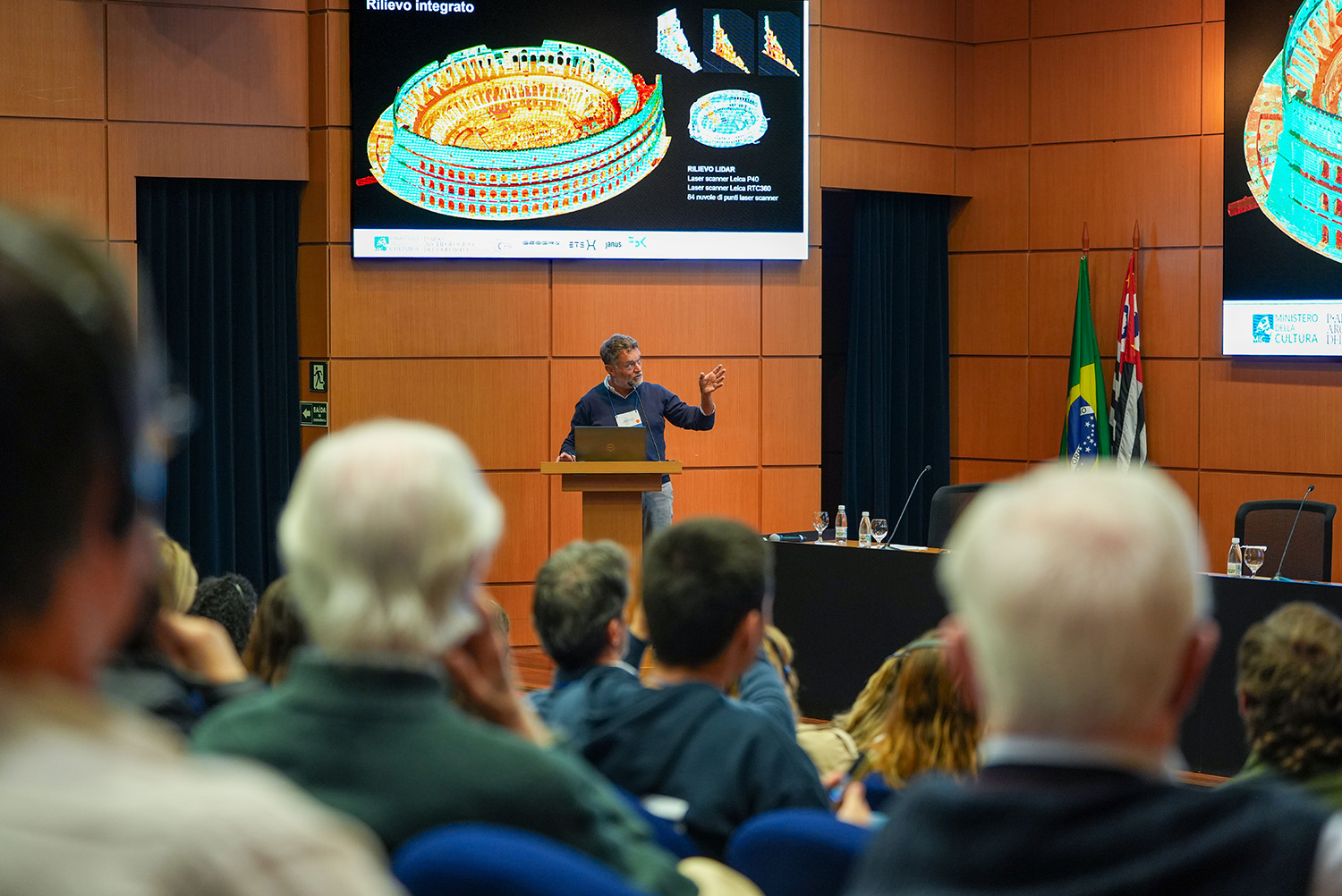
By José Tadeu Arantes | Agência FAPESP – On September 25, Italian architect Marcello Balzani, a professor at the University of Ferrara, presented a digital representation of the Roman Colosseum during the 7th FAPESP 2026 Conference. In addition to accurately reproducing the shape of the monument, the model functions as a large database that compiles detailed information on the materials used, construction techniques, historical transformations, state of preservation, and the vulnerability of the structure.
The project, developed by the team at the Colosseum Archaeological Park under Balzani’s coordination, combines 3D scans, thousands of photos (photogrammetry), and the HBIM (Historic Building Information Modeling) method. The result is a model that captures the detailed form of the monument and integrates knowledge from archaeology, architecture, restoration, and engineering. To give an idea of the level of detail, more than 120 categories of information were incorporated into the system.
The monumental scale of the project is evident in Balzani’s figures. Over 200,000 photographs were used in the photogrammetric documentation, and the laser survey produced approximately 109 billion points. This made it possible to reconstruct the Colosseum’s three-dimensional geometry with extreme precision. The resulting HBIM model contains approximately 27,000 digital objects – individual representations of elements of the monument, such as walls, arches, pillars, and vaults – to which different sets of information can be associated, such as materials, construction techniques, chronology, and state of preservation.
Balzani stated, “For the first time in its history, after nearly 2,000 years of existence, the Colosseum has a description – a complete image.” However, for him, this image should not be understood simply as a three-dimensional reproduction. The monument, he said, “isn’t just physical matter; it’s an extraordinary structure of human memory.”
A machine of death
Built in the 1st century CE, the Colosseum was the largest amphitheater of antiquity. It was conceived as an extraordinary circus for staging great Roman public spectacles and as a machine of death. During its operational period, it produced as many as 30,000 human and animal corpses per year. Gladiators, condemned prisoners, and animals used in the spectacles were part of a system in which death was transformed into mass entertainment.
The architecture itself served this function. It was not simply an arena surrounded by bleachers but rather a complex structure of corridors, staircases, galleries, underground passages, and mechanisms designed to control the movement of the audience, combatants, animals, and equipment simultaneously.
Beneath the arena was an infrastructure capable of sudden appearances and scene changes. Elevating systems transported animals and other elements from the underground structures up to the arena level. The space could also facilitate water-based spectacles, such as simulated naval battles, and featured systems for rapidly filling and draining floodable areas.
Construction of the Colosseum began during the reign of Emperor Vespasian of the Flavian dynasty around 70–72 CE. It was inaugurated in 80 CE by his son, Titus. Further expansions were made, particularly to the underground section, under Domitian, Titus’s brother and successor. At a time when Rome had between 750,000 and 1 million inhabitants, the building could accommodate around 50,000 spectators. Therefore, a considerable portion of the imperial capital’s population could gather there in a single session.
The Flavian Amphitheater, as it was called in reference to the dynasty that commissioned its construction, remained in use for more than four centuries. Gladiatorial combat appears to have ceased around 404–405, while animal fights continued until 523, the traditional date of the amphitheater’s final spectacles.
However, this gigantic structure outlived the society that created it. Over the course of nearly two millennia, the building lost its original function and was successively transformed, repurposed, partially destroyed, and restored. An earthquake in 1349 caused a significant portion of the structure to collapse. At other times, structural elements were removed and used in various buildings throughout Rome.
Therefore, the Colosseum as we know it today is the result not only of Roman engineering, but also of the accumulation of many histories. Each wall may contain traces of different eras, and interventions carried out centuries after its original construction have become part of the monument’s history themselves.

Balzani is a full professor in the Department of Architecture at the University of Ferrara and the founding director of the Center for the Development of Integrated Automated Procedures for the Restoration of Monuments (photo: Daniel Antônio/Agência FAPESP)
Historical knowledge and cutting-edge technology
At the opening of the conference, FAPESP President Marco Antonio Zago emphasized the interplay between technology and historical knowledge in this type of work. Laser scanning allows researchers to record a structure’s geometry with great precision and link it to photographs, material analyses, and other sources. However, Zago emphasized that technology does not replace interpretation. “A point cloud, no matter how detailed it may be, does not determine what should be preserved, nor does it replace the critical eye of someone who knows the building’s history. Its value lies in providing an objective and reliable basis for conservation decisions,” he said.
Gabriela Pellegrino Soares, a historian, professor at the University of São Paulo’s Faculty of Philosophy, Languages, and Literature, and Humanities (FFLCH-USP), and a member of the committee responsible for FAPESP’s Interdisciplinary Conferences and Schools, highlighted the existential dimension of experiencing a historic monument: “In the fast-paced world we live in, with its ephemeral and fragmented information, the experience of visiting and engaging with a space, a monument, or a museum can be transformative. It offers us, on the one hand, the emotion that comes from contemplation and, on the other, access to relevant, thoughtful, and surprising knowledge that sharpens our curiosity and interest and reshapes our imagination of the world, with its long, markedly diverse, and complex periods of time.”
The conference moderator, Paulo César Garcez Marins, director of the Ipiranga Museum (USP’s Paulista Museum), focused on the work carried out at the Colosseum from the perspective of historic heritage management. “It brings together data from different fields, such as archaeology, engineering, architecture, and restoration, expanding the possibilities for knowledge and conservation. The system also allows for the continuous updating of models and the integration of historical data with new surveys, contributing to preventive maintenance planning and long-term management,” he summarized.
Photographing, measuring, and correlating
This historical layering helps explain why the digitization project was so complex. Traditional methods of two-dimensional documentation, such as floor plans and cross-sections, are insufficient to fully represent a structure of this scale and degree of heterogeneity.
The survey had to be, in Balzani’s words, “multiscale and multidisciplinary.” It was not enough to record the external form of the amphitheater. It was also necessary to explore the galleries, corridors, elevated and underground chambers, walls, vaults, and columns analytically. Then, all these records had to be synthesized into a geometrically related structure.
A topographic reference grid made it possible to integrate surveys conducted in different locations and at different times. Each new set of measurements could be incorporated into the overall system and cross-referenced with the others, progressively forming a coherent, three-dimensional representation of the monument.
Photogrammetry was an essential part of the process. More than 200,000 photographs were processed to generate three-dimensional models. Some of the images were captured using drones, a task complicated by the seagulls that fly over the monument.
The work also had to coexist with the day-to-day operations of the archaeological complex. According to Balzani, the Colosseum remains open and welcomes approximately 30,000 visitors per day. During the survey, there were 20 active maintenance sites. This forced the teams to coordinate their measurement and photography operations with visitor traffic, safety requirements, and conservation work.
Much more than a 3D image
Producing a visually compelling representation was not the main objective, however. “Today, it’s possible to create a virtual model of the Colosseum online in just a few minutes. It’s not difficult. But that’s not the actual monument, and it’s of no use for conservation,” Balzani stated.
The fundamental difference lies in the information associated with the geometry. A section of wall, a vault, an arch, or a column does not merely appear in the model as a three-dimensional shape. Rather, they become individualized objects to which data on chronology, material, construction technique, physical condition, subsequent interventions, and other characteristics can be associated. As previously mentioned, the HBIM model brings together approximately 27,000 of these digital objects. This allows us to “interrogate” the monument and plan conservation strategies.
The temporal dimension has also been incorporated into the system. Researchers have organized the Colosseum’s long history into major phases so elements from different periods can be identified and compared. A seemingly insignificant hole in a wall illustrates this difficulty. It may have been created during the original construction, resulted from an earthquake, or occurred when a component was removed later on. It could also correspond to a medieval or modern intervention. The model links these material traces to different hypotheses and documentary sources.
Artificial intelligence is also being used, particularly for the recognition and classification of materials. However, Balzani emphasized that automation does not eliminate the need for experts. Archaeologists, historians, engineers, architects, and materials researchers are still needed to validate, interpret, and contextualize the information.
From diagnosis to prevention
A significant advantage of a database of this type is that it does not need to remain static as it was at the time of its creation. New surveys can be added, enabling comparison of the same element over time. A crack can be remeasured. Deformations can be tracked. Changes in a material’s surface can be compared with previous records. Thus, the model evolves from a documentation tool into a tool for monitoring and preventive maintenance.
This capability is particularly important for a nearly 2,000-year-old structure located in a geologically unstable region. Rome is associated with the tectonic context of the Central Apennines, one of Italy’s major seismic zones. The great earthquake of September 9, 1349 – actually a series of strong tremors in the Apennines – caused severe damage to the urban complex and the collapse of a significant portion of the Colosseum’s outer ring, especially on the south side. Since then, Rome has not experienced a seismic event of comparable magnitude. However, this does not mean that a new high-intensity earthquake cannot occur.
The three-dimensional survey also reveals the extraordinary sophistication of Roman engineering. The Colosseum combines travertine pillars (a porous limestone formed by the precipitation of calcium carbonate), walls, and vaults into a structure designed to distribute enormous loads. The fact that a substantial part of the building has survived for nearly two millennia is a testament to the effectiveness of these construction methods.
At the same time, the 1349 earthquake left deep marks on the monument. The digital model makes it possible to cross-reference the building’s precise geometry with information on materials, cracks, deformations, and other indicators of structural behavior. This provides a basis for seismic vulnerability studies.
A government policy
It was precisely this shift from documentation to prevention that prompted Professor Zago to pose two important questions to Balzani at the end of the conference.
The first concerned the political dimension of the project. Zago noted that the digitization and preservation of cultural heritage appear to have been adopted as an Italian state policy capable of surviving successive governments. “The Italian government has set a goal for a project of this scale that, in my view, moves forward regardless of who is currently in power. I think this is a very important example,” Zago emphasized.
In response, Balzani situated the Colosseum project within a broader movement to digitize Italy’s public heritage. He explained that adopting national standards has changed not only technical procedures, but also the organization of companies, the training of professionals, and the legal aspects involved in heritage management. In this context, the digital model is not merely a representation of the building; it is a continuously updated database whose creation, validation, and use involve clearly defined responsibilities.
Zago’s second question focused directly on the future of the Colosseum. He noted that contemporary engineering offers techniques to reduce the vulnerability of buildings to earthquakes, as demonstrated by structures in Japan and Chile, and asked whether the knowledge provided by the digital model could be combined with modern engineering solutions within the limits imposed by the preservation of a historic monument.
Balzani’s response was quite concrete. He explained that even while the Colosseum survey was underway, the Italian Ministry of Culture commissioned a team to develop a structural vulnerability model using the produced data. In other words, the enormous amount of information incorporated into the model is already being used to evaluate the structure’s behavior and identify risks.
The Italian expert emphasized that this type of analysis benefits from our highly detailed knowledge of the Colosseum’s construction logic. The monument combines design solutions that distribute loads and give the structure an extraordinary capacity for resistance over the centuries. The goal is not merely to apply contemporary construction techniques to the ancient building but also to use current knowledge to understand how the historic structure responds to stresses and where its vulnerabilities lie.
This is precisely where the Colosseum’s “digital renaissance” project takes on its primary practical dimension. The technology does not aim to virtually reconstruct an idealized Colosseum, erasing the marks accumulated over nearly 2,000 years. Instead, the goal is to record these marks with sufficient precision to understand how the building has survived to this day, track its ongoing transformation, and anticipate future risks.
Thus, the ancient Roman venue for spectacles and death is transformed into a gigantic knowledge base designed to ensure its continued survival.
The 7th FAPESP 2026 Conference, “The Digital Renaissance of the Colosseum: Integrated Documentation and Modeling of Historical Heritage,” can be viewed in its entirety at youtu.be/AYu_-L0ArY8.
 See more images related to this and other FAPESP-related stories on the following Flickr profiles: GCOM FAPESP and FAPESP Memory Center.
Republish
The Agency FAPESP licenses news via Creative Commons (CC-BY-NC-ND) so that they can be republished free of charge and in a simple way by other digital or printed vehicles. Agência FAPESP must be credited as the source of the content being republished and the name of the reporter (if any) must be attributed. Using the HMTL button below allows compliance with these rules, detailed in Digital Republishing Policy FAPESP.
