





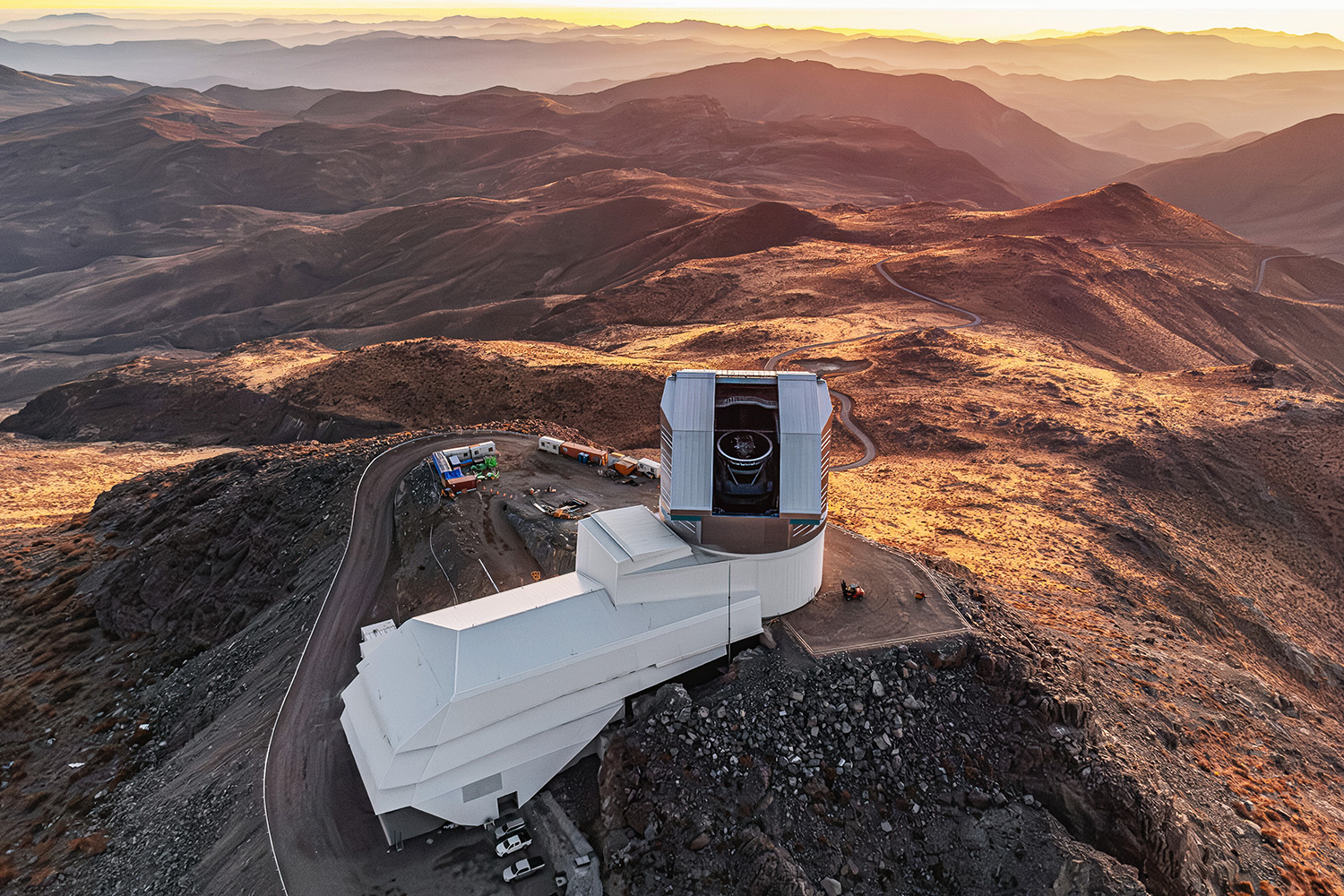
By José Tadeu Arantes | Agência FAPESP – A new agreement was signed between FAPESP and the Association of Universities for Research in Astronomy (AURA), a consortium of U.S. universities and other scientific institutions. This agreement will expand the participation of researchers from the state of São Paulo in the Legacy Survey of Space and Time (LSST), the largest astronomical survey ever conceived. Conducted by the Vera Rubin Observatory in Chile over ten years, the LSST will map the sky in the Southern Hemisphere night after night and produce an unprecedented record of the evolution of the universe. The survey is expected to gather information on over 20 billion galaxies and 17 billion stars. Its scope of investigation ranges from asteroids in the Solar System to the great cosmological mysteries of dark matter and dark energy.
Under the terms of the agreement, FAPESP will be able to appoint ten principal investigators, each accompanied by up to five early-career researchers – postdoctoral fellows and doctoral candidates – forming a potential contingent of 60 scientists with access to the massive dataset produced by the observatory.
“The agreement solidifies a collaboration that began well before the Vera Rubin Observatory became operational. In an earlier phase, FAPESP’s contribution to the data transmission infrastructure had granted the Foundation the right to appoint five principal investigators and their associates. Now that the observatory is operational and the LSST officially began on June 30, this participation has been expanded and formalized under the new institutional framework,” says Luiz Vitor de Souza Filho, a professor at the São Carlos Institute of Physics at the University of São Paulo (IFSC-USP) and an advisor to FAPESP’s Scientific Board for Major Research Infrastructures.
Over the past two years, FAPESP negotiators have worked intensively to formalize this participation, clearly establishing rights, duties, responsibilities, and conditions. According to Souza Filho, a new call for proposals is expected to select the researchers who will join the group of 60 São Paulo scientists with full access to Vera Rubin’s data. To this end, in addition to the investments already made during the previous period, the Foundation is expected to contribute USD 2.3 million annually to the astronomical megaproject.
FAPESP’s participation is directly linked to an essential component of the observatory’s operations: the ultra-high-performance telecommunications infrastructure that enables enormous volumes of data produced in Chile to be transmitted to processing centers in the United States in near real time.
“The telecommunications network is the project’s nervous system,” Souza Filho explains. And participating in it is a huge responsibility. According to the most recent estimates, approximately 10 terabytes (80 trillion bits) of data will be generated each night, and between 7 million and 10 million alerts will be triggered regarding objects that have changed position or brightness. The total time elapsed between capturing the image, processing the information, and triggering the alert should be no more than 60 seconds. The goal is to enable other astronomical instruments, distributed across the world, to be quickly notified and directed to monitor extremely short-lived phenomena. “It’s FAPESP’s responsibility to receive this data in the state of Rio Grande do Sul and deliver it to Miami, in the United States,” says Souza Filho.
Time is a crucial factor in this operation. The Research and Education Network in São Paulo (Rednesp), implemented and maintained by FAPESP, plays a strategic role in the process by providing extreme speed and precision in data transmission. “For the project’s objectives to be met, the large images obtained in Chile must reach the United States within seven seconds. This requires a network infrastructure with extremely high speed and low latency. A delay of 0.2 seconds along the route or a loss of 0.001% of data packets can significantly compromise the operation. Rednesp, the successor to the former ANSP Network, has the capacity to transmit up to 400 gigabits per second [Gbps],” says Ricardo Dahab, the current coordinator of Rednesp.
For comparison, the fastest residential internet networks rarely exceed a transmission speed of 1 Gbps. Even premium business internet, used by large corporations, does not exceed 10 Gbps. Rednesp can be up to 40 times faster. Connected to the National Education and Research Network (RNP) in Brazil and to international networks at both ends of the process, Rednesp is critical infrastructure for data flow between Chile and the United States.
“The LSST was designed to generate an enormous amount of data and trigger alerts about astronomical events every night for ten years. This requires an extremely reliable transmission network with high resilience, capable of withstanding tectonic or climatic disturbances. And the transmission must be extremely secure. That’s why the data is encrypted twice – first by hardware and then by software – upon transmission, and decrypted twice – first by software and then by hardware – upon arrival,” Dahab emphasizes.
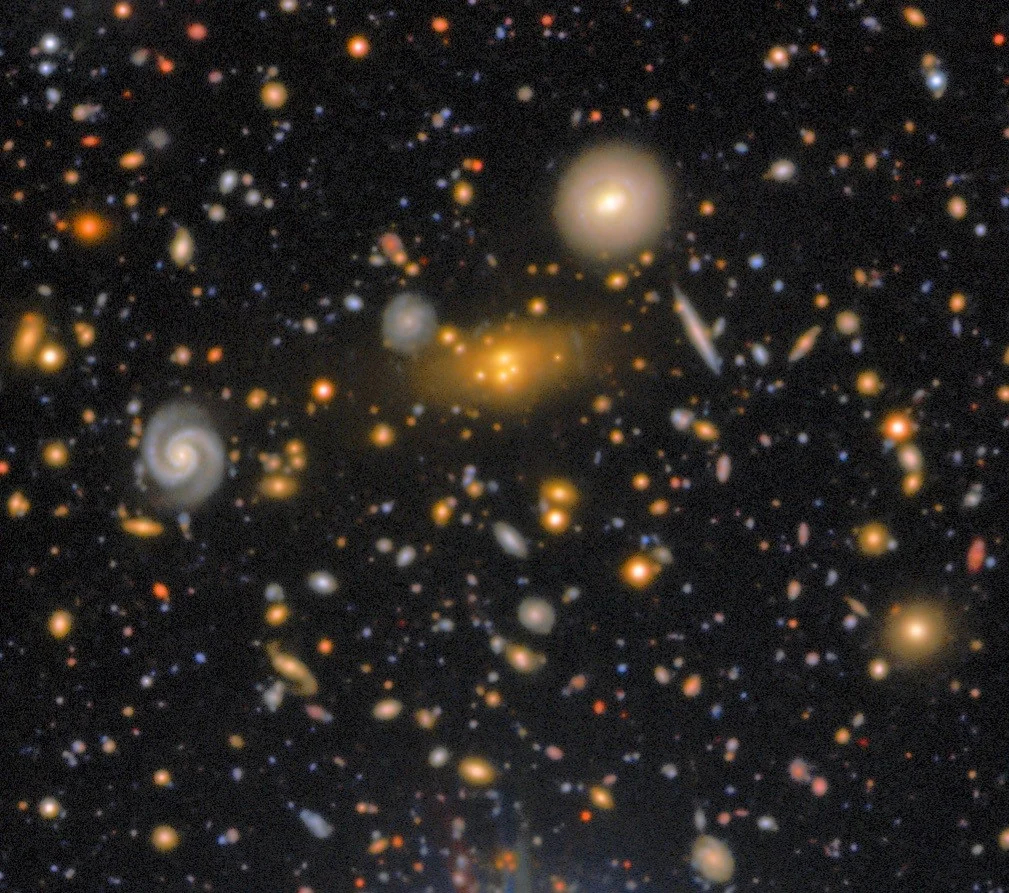
A close-up of a region of the sky captured by the Vera Rubin Observatory on July 11, 2026. Galaxies, stars, and other objects are visible (image: NSF-DOE Rubin Observatory/NOIRLab/SLAC/Aura)
A near-real-time movie of the sky
Located on Cerro Pachón in the Chilean Andes, the Vera Rubin Observatory was built to repeatedly observe large areas of the sky. Instead of focusing long observation periods on pre-selected objects, its Simonyi telescope repeatedly scans vast regions of the sky, recording what appears, disappears, moves, or changes in brightness. This combination of a wide field of view, speed, and repeated observations will make it possible to produce something comparable to a gigantic movie of the sky over the course of ten years.
It is estimated that by the end of the decade-long survey, the LSST will have generated approximately 60 petabytes of raw image data, and processing this data could yield a total volume of up to 500 petabytes. This figure – astronomical in both the literal and figurative senses – corresponds to 4 quintillion bits. A bit is the smallest conventional unit of digital information, which can take on two values: 0 or 1.
The LSST covers an area of approximately 18,000 square degrees, equivalent to 44% of the entire celestial sphere. This encompasses most of the visible sky in the Southern Hemisphere and a small strip in the Northern Hemisphere. The 3.2-billion-pixel digital camera installed on the telescope is the largest ever built for astronomy. Under normal survey conditions, each exposure lasts about 30 seconds, and the observatory conducts an average of 700 observations of different areas of the sky per night. The result is a continuous stream of information.
“One of the main focuses of the Vera Rubin Observatory is precisely what changes in the sky – what’s transient, what’s happening today that wasn’t there yesterday,” says Souza Filho. “The images need to reach the United States within a few seconds, be processed, and generate the information that something new is underway, so that other observatories, capable of measuring other properties, can quickly point their equipment toward that location.”
According to the researcher, that is why the transmission network can be compared to the “nervous system” of the entire project. Data leaves the observatory via fiber-optic cables and arrives in Santiago, the capital of Chile. From there, it travels to Porto Alegre in southern Brazil and enters the Brazilian academic network infrastructure. The data passes through São Paulo, reaches Fortaleza – already on the equatorial coast – and crosses the Atlantic toward Miami. A U.S. domestic network then distributes the information to various processing units, primarily to the Fermi National Accelerator Laboratory (Fermilab) in Batavia, Illinois.
Rednesp, integrated with national and international academic networks, is a key component in this circuit. “The contribution isn’t limited to fiber-optic cables. There is a physical infrastructure, consisting of equipment and traffic exchange points, but also a logical layer, made up of the computer systems and software that manage data flow. This capacity has been built up by FAPESP over decades, initially through the former ANSP Network and, currently, through Rednesp,” Souza Filho explains.
Thousands of new asteroids
The recent history of the Vera Rubin Observatory has been marked by three decisive moments. The first occurred on June 23, 2025, with the public release of its first images. A few months later, on October 25, the facility officially transitioned from the construction phase to the operational phase, though preparation and refinement activities continued. Finally, on June 29, 2026, the LSST, a ten-year scientific survey, effectively began, with a public announcement the following day.
In February 2026, alerts began to be transmitted in near real time to specialized distribution and classification systems. These systems, known as brokers, receive the alerts, cross-reference them with other catalogs, classify the events, and enable researchers to swiftly identify those warranting further investigation.
The initial results demonstrate the capabilities of the new observatory. In images released to the public in June of last year, obtained during just over ten hours of test observations, the Vera Rubin Observatory detected millions of stars and galaxies. More than 2,000 previously unknown asteroids were also identified at that time. The scale expanded rapidly. During about a month and a half of preliminary surveys, more than 11,000 new asteroids were discovered, including 33 near-Earth objects and 380 trans-Neptunian objects in the outer regions of the solar system.
However, searching for objects in the solar system is only one of the LSST’s four major scientific priorities. The others are studying dark matter and dark energy, mapping the Milky Way, and exploring the transient sky – a category that includes phenomena that appear, disappear, or vary over relatively short timescales. This category includes supernova explosions, variable stars, and events associated with black holes and neutron stars.
The speed of the survey is particularly important for multimessenger astronomy, in which a single phenomenon is investigated using different signals, such as electromagnetic radiation (in descending order of wavelength: radio, microwave, infrared, visible light, ultraviolet, X-rays, and gamma rays), gravitational waves, and cosmic rays. Once an event is detected by an instrument, the alert allows other observatories to quickly mobilize and examine it through different “windows.” Souza Filho points out: “This isn’t simply a telescope that’s better than previous ones. It does something no other telescope has done on this scale: rapidly map the sky to show what’s changing.”
Cutting-edge science
“The five principal investigators who had access to the project through FAPESP in the phase prior to the new agreement are: Luis Raul Weber Abramo, Riccardo Sturani, Claudia Lucia Mendes de Oliveira, Eduardo Serra Cypriano, and Alex Cavaliéri Carciofi. A new call for proposals will be issued shortly to complete the team of ten principal investigators, each accompanied by up to five early-career researchers, for a total of 60,” says Souza Filho.
Participation in the Vera Rubin Project is part of FAPESP’s broader strategy to ensure São Paulo’s scientific community has access to major international research infrastructures, including the Large Hadron Collider (LHC), which investigates fundamental particles; the Deep Underground Neutrino Experiment (DUNE), which studies neutrinos and their properties; and the Giant Magellan Telescope (GMT), which observes the universe at an extremely high resolution.
“In the specific case of Vera Rubin, Rednesp is Brazil’s main contribution to the project. In the other major collaborations supported by FAPESP, researchers and institutions from the state are also participating in the development of detectors and other components, as well as in data processing,” Souza Filho explains.
Republish
The Agency FAPESP licenses news via Creative Commons (CC-BY-NC-ND) so that they can be republished free of charge and in a simple way by other digital or printed vehicles. Agência FAPESP must be credited as the source of the content being republished and the name of the reporter (if any) must be attributed. Using the HMTL button below allows compliance with these rules, detailed in Digital Republishing Policy FAPESP.
