





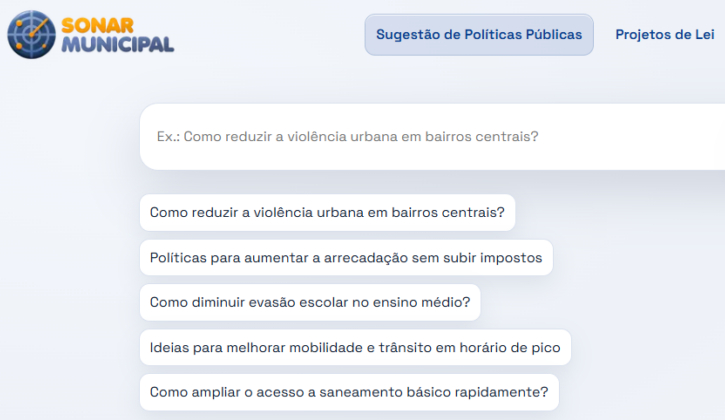
Agência FAPESP – With the goal of helping municipal officials identify successful public policies implemented in other cities, Thiago Ambiel, an undergraduate student at the Institute of Mathematical and Computer Sciences at the University of São Paulo’s São Carlos campus in Brazil, created Sonar Municipal, a web platform offering a practical tool to support the management and development of evidence-based public policies.
Users simply need to type in a question or click on suggestions such as: “How can we reduce high school dropout rates?” or “How can we reduce urban violence in inner-city neighborhoods?” Sonar Municipal then searches its database for semantically similar texts, groups them, and makes recommendations for action.
According to Ambiel, the tool functions like a “Google for municipal laws,” with the added benefit of presenting common legal terms found in legislative texts to the user as clear, actionable phrases, such as: “Create a program to combat graffiti” or “Install lighting in high-risk areas.” “That makes it easier for people looking for solutions to specific problems or issues in their city to understand,” Ambiel told the ICMC-USP Press Office.
The development of the platform is linked to Ambiel’s undergraduate research project, funded by an FAPESP scholarship and supervised by André Carlos Ponce de Leon Ferreira de Carvalho, a professor at the institute.
The tool allows users to filter actions by state or municipality, as well as select different time periods (six to 36 months) to observe when more consistent results were achieved after the implementation of the measure.
Additionally, the system incorporates two indicators: the homicide rate per 100,000 inhabitants, based on data from the National Public Security Information System (SINESP) of the Brazilian Ministry of Justice; and the enrollment rate in regular secondary education per 100,000 inhabitants, calculated using microdata from the School Census of the National Institute for Educational Studies and Research (INEP).
According to Ambiel, comparing these indicators with real-world data measures the effectiveness and impact of public policies after their implementation. “The platform uses these indicators to define what constitutes a positive effect. If the homicide rate has fallen or the enrollment rate has risen, the algorithm concludes that the policy was effective and raises the score for that suggestion,” he explained.
However, Ambiel emphasizes that it is not possible to definitively establish a causal relationship between the adopted project and a decrease in crime, for example. “The system can identify trends. If several municipalities have implemented a similar policy and seen an improvement in the indicator, that becomes a relevant signal for those seeking solutions,” he said.
For students, the platform fills an important gap in Brazilian municipal management. “Currently, there’s no unified platform where you can research what other municipalities have done to solve a particular problem. Often, the solution has already been tested elsewhere, but it isn’t easily found,” he notes.
How the project was developed
Sonar Municipal was created within the Center for Artificial Intelligence in the Remaking of Urban Environments (IARA), an Applied Research Center (ARC) funded by FAPESP and headquartered at the ICMC. The initiative is part of the international project “Artificial Intelligence for Pandemic and Epidemic Preparedness and Response” (“AI4PEP”), which funds research focused on using artificial intelligence (AI) to address relevant social challenges in the field of health.
The undergraduate student spent approximately four months developing the project using a technique called data scraping. This allowed him to extract information from over 220,000 bills available on municipal government websites. Next, he used an AI model to transform the data into a recommendation for action, linking it to real-world indicators.
“For example, on March 10, 2024, a bill was proposed to install lighting at a municipal bus station. I cross-referenced that information with the local crime rate and noted how many crimes were reported per month before implementation. If the crime rate drops by 20% after six months, the system records that association,” Ambiel explained.
According to the student, it was not possible to include data from all municipalities because some use their own systems, i.e., adapted versions of software such as the Legislative Process Support System (SAPL), where bills are published. Technical variations in these systems make automated data extraction difficult. Nevertheless, Sonar Municipal currently compiles standardized information from over 300 Brazilian municipalities.
“The more data we can include, the better the system becomes. But even with this dataset, it’s already possible to identify interesting patterns," Ambiel said.
The Sonar Municipal platform can be accessed at sonar-municipal.vercel.app/.
Republish
The Agency FAPESP licenses news via Creative Commons (CC-BY-NC-ND) so that they can be republished free of charge and in a simple way by other digital or printed vehicles. Agência FAPESP must be credited as the source of the content being republished and the name of the reporter (if any) must be attributed. Using the HMTL button below allows compliance with these rules, detailed in Digital Republishing Policy FAPESP.
