





By Elton Alisson | Agência FAPESP – On April 15, the Offshore Technology Innovation Center (OTIC) – an Applied Research Center (ARC) funded by FAPESP in partnership with Shell Brasil, USP, and the Institute for Technological Research (IPT), affiliated with the São Paulo State Department of Science, Technology, and Innovation – opened its headquarters and four new laboratories at the Engineering School of the University of São Paulo (POLI-USP) in São Paulo, Brazil.
OTIC was launched in June 2024 with the mission of developing technologies that generate more energy from the ocean with lower greenhouse gas emissions to ensure more efficient and safer operations. With a projected investment of BRL 165 million over its first five years of operation, the center brings together over 250 researchers from universities and research institutions in Brazil and abroad. It began its activities with a portfolio of 24 research and development projects.
Eleven of these projects are in the discovery stage, focused on generating fundamental knowledge. Another six projects are in the technology development phase, and four projects are at an even more advanced stage with prototype demonstrations. These technologies are poised to enter the market.

Carlos Graeff (third from right in photo), CEO of FAPESP’s Technical-Administrative Council: OTIC is yet another example of the success of the ARC model, which aims to foster collaboration between academia and the business sector to conduct applied research (photo: Daniel Antônio/Agência FAPESP)
“The Brazilian offshore sector will play a leading role in the energy transition. But only if Brazil manages to integrate the onshore and offshore industrial sectors will we have a chance to achieve carbon neutrality. But that requires a vision that goes far beyond research and development, involving national planning for industrial sectors. That’s why OTIC brings together industry, government, and academia," stated Gustavo Assi, a professor at POLI-USP and executive director of OTIC.
In his opening remarks at the event, Assi emphasized that the country has a highly developed offshore sector, which is the result of four decades of significant investment in science and technology. These investments enabled the exploration of the pre-salt layer, which began in 2010 and has since become Brazil’s primary source of oil and natural gas production. Today, it accounts for more than 80% of the national total.
“We’re a country that extracts its fossil fuels from the ocean. Therefore, if we need to carry out the energy transition and our energy comes from the ocean, there’s no way the offshore sector can avoid participating in that process and undergoing transformations,” he noted.
Strategic partnership
According to Carlos Graeff, the CEO of FAPESP’s Technical-Administrative Council (CTA), OTIC is yet another successful example of the ARC model. The ARC model aims to foster collaboration between academia and the business sector to conduct applied research.
“Brazil is in a comfortable geopolitical position today amid the conflict and blockade [in the Strait of Hormuz in Iran] of 20% of the world’s oil production, thanks to decades of investment in research to make deepwater offshore operations viable. OTIC is the next step in that evolution,” the CEO stated at the event’s opening.
IPT CEO Anderson Ribeiro Correia emphasized that Brazil’s success in offshore oil production was only possible due to the strategic partnership between academia, government, and industry, mirroring models adopted in the creation of Petrobras and Embraer. “When the idea of exploring the pre-salt layer was first proposed, many doubted the possibility of extracting oil at a depth of 7,000 meters. That challenge was only overcome thanks to the vision of all those involved. We’ll need to replicate that partnership now to tackle the sector’s new challenges,” he noted.
Manuela Lopes, director of technology and innovation at Shell Brasil, emphasized that this multisectoral collaboration is at the heart of the center: “OTIC was founded with the clear mission of connecting academia, government, and industry to develop sustainable technological solutions based on Brazilian science, which has incredible potential.”
USP Rector Aluísio Segurado stated that the center is fully aligned with the university’s institutional mission “to produce, disseminate, and translate innovative knowledge into technologies that inform policies capable of promoting the economic and social development of São Paulo and the country.”
Laboratory ecosystem
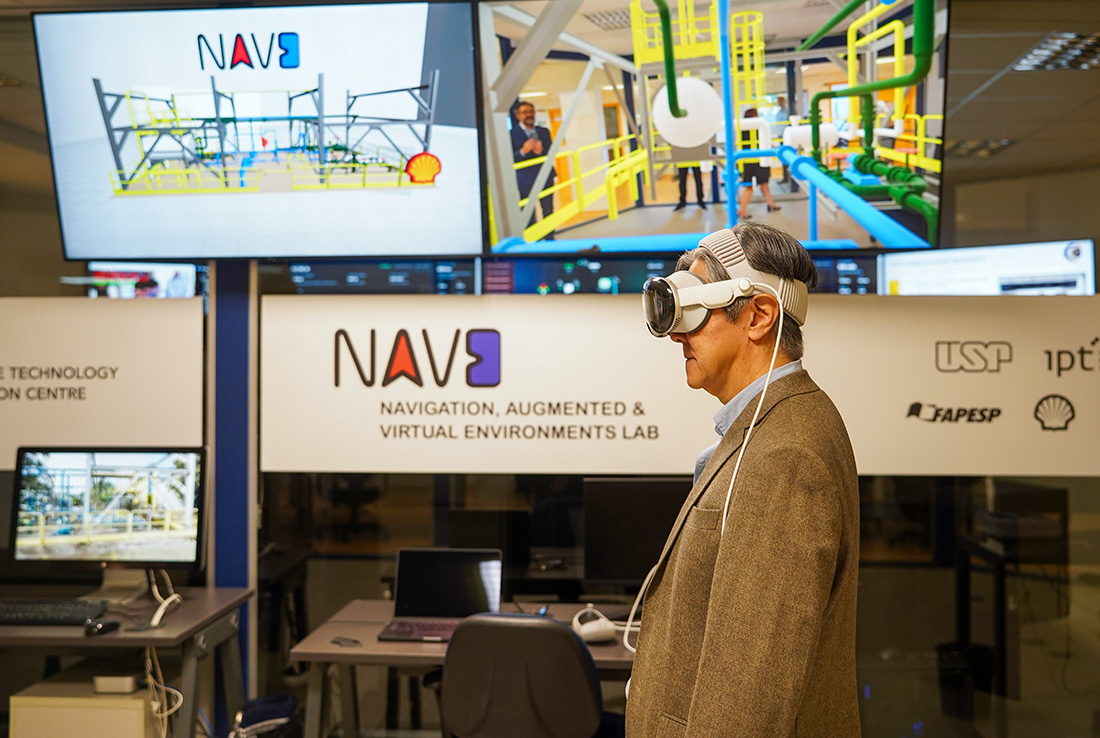
During the event, four new OTIC laboratories were presented. These laboratories use cutting-edge technologies to simulate and prepare for operations in the ocean environment. One of them is NavLab, which focuses on augmented and virtual reality for training and assessing human risk in complex operations.

The Digital Ocean Lab processes data in real time from thousands of sensors installed at sea. The facility features a high-fidelity docking maneuver simulator capable of reproducing the navigation conditions of all ports in the country (image: Daniel Antônio/Agência FAPESP)
The second laboratory, Cosmos, is designed to simulate remote operations, which are essential for unmanned platform projects. SpotLab, the third laboratory, is dedicated to the social perception of technology and uses cognitive sciences to align technical development with societal values.
The Digital Ocean Lab, located at USP’s Oceanographic Institute (IO), creates a “digital ocean” by processing real-time data from thousands of sensors installed at sea. The laboratory has a high-fidelity docking maneuver simulator that can reproduce the navigational conditions of all the country’s ports. This enables advanced training for captains and pilots.

Numerical test tank at the USP Oceanographic Institute (image: Daniel Antônio/Agência FAPESP)
Republish
The Agency FAPESP licenses news via Creative Commons (CC-BY-NC-ND) so that they can be republished free of charge and in a simple way by other digital or printed vehicles. Agência FAPESP must be credited as the source of the content being republished and the name of the reporter (if any) must be attributed. Using the HMTL button below allows compliance with these rules, detailed in Digital Republishing Policy FAPESP.
