





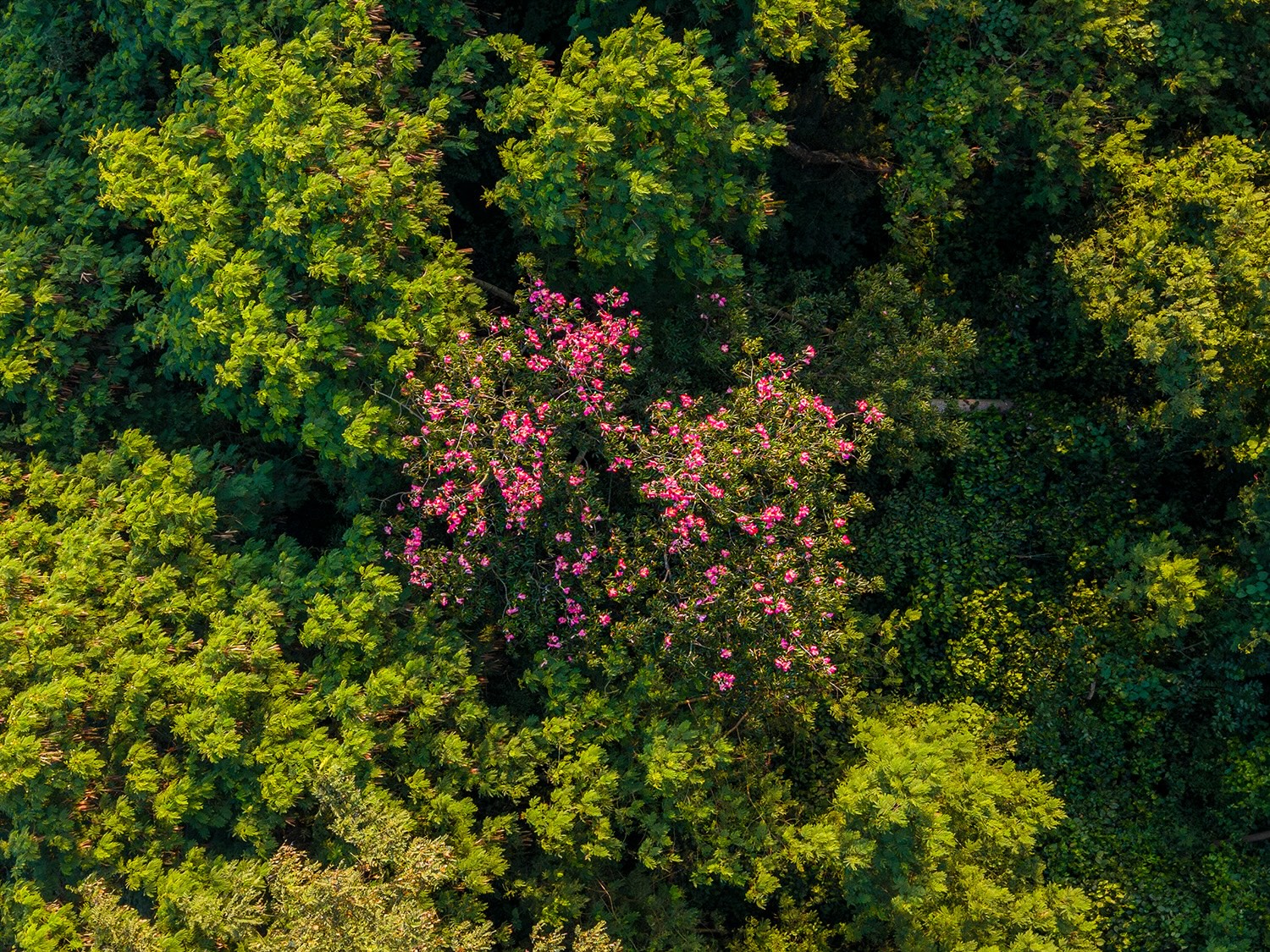
By André Julião | Agência FAPESP – The presence of non-native trees is often seen as an obstacle to the recovery of tropical forests regrowing in previously deforested areas. To better understand the behavior of these plants over time in both humid and dry forests, researchers from approximately 60 institutions analyzed data from over 1,500 areas of forest regeneration across the Americas. The results, published in the journal Nature Plants, indicate that the initial dominance of exotic species is temporary. They multiply easily during the first 10 to 20 years, taking advantage of abundant sunlight in open areas. However, they decline as native trees grow and shade the forest.
According to the first author of the article, Angelica Faria de Resende, the initial concern about these plants is justified because “by replacing the role of one or more native species and altering natural processes, invasive species can modify food webs and functional, structural, and biological diversity in the forest.”
Resende conducted the study during her postdoctoral research at the Luiz de Queiroz College of Agriculture at the University of São Paulo (ESALQ-USP) in southeastern Brazil. She received a fellowship from FAPESP and completed an internship at the University of Stirling in Scotland. The team’s data show that this interference is more pronounced in humid forests, where exotic trees accounted for 28% of the tree trunks and 22% of the total species in the first two decades, than in dry forests, where they reached 9% for both indicators.
According to the researcher, the impact tends to be partial or temporary. “It caught our attention that both species diversity and the number of individuals decreased significantly shortly after that initial peak,” says Resende, pointing out that although some non-native trees remain in the mature stage of the forest, their presence decreases as the forest matures.
This decline occurs because the exotic trees in these areas tend to resemble native “pioneer” species in that they grow rapidly and require abundant light to thrive, as is found in recently abandoned pastures. Initially, both compete for space, but eventually, they give way to slow-growing native trees that germinate in the shade and gradually dominate the landscape.
“Non-native species are opportunistic and take advantage when conditions are favorable,” Resende summarizes. According to the researcher, as the forest canopy closes and the environment becomes less suitable for species that depend on full sunlight, these species persist only at low densities.
Some of the areas monitored in this study are part of the “Understanding Restored Forests for the Benefit of People and Nature – NewFor” project, supported by FAPESP through its Research Program on Biodiversity Characterization, Conservation, Restoration and Sustainable Use Program (BIOTA-FAPESP) and by the Dutch Research Council (NWO).
Invasive or not, that is the question
Of the 3,735 species sampled, 131 were considered non-native/non-invasive, 14 were considered non-native/potentially invasive (reported as invasive in another country), and 11 were considered non-native/invasive. Non-native species were present in 18% of the dry forest plots studied and 41% of the humid forest plots.
Two examples from Brazil illustrate the difference between non-native/invasive and non-native/non-invasive species. Pine (Pinus elliottii) is native to the Northern Hemisphere and is used in Brazil for its wood and resin. Because it disperses seeds through the air and sprouts without human intervention, it dominates landscapes and is considered invasive. Eucalyptus (Eucalyptus spp.), on the other hand, is an example of a non-native, non-invasive species. Although it is native to Oceania, it does not spread on its own here, occurring only where it is planted, typically for timber, paper, and pulp production.
“In some countries, scientific criteria aren’t always sufficient, and the decision to classify a species as invasive ends up being political since government agencies are responsible for issuing official lists of invasive species. Some species are widely used in agriculture, are perceived as beneficial to the economy, and are therefore not considered invasive,” Resende explains.
The study found that many species listed as non-native/non-invasive accounted for over 25% of the tree trunks sampled in some areas. These species included Croton glabellus and Leucaena leucocephala in Colombia, Piper colonense in Costa Rica, Hovenia dulcis in Brazil, and Lagerstroemia speciosa in Panama.
To arrive at these results, the researchers analyzed data from 1,561 representative plots of secondary forests in ten Neotropical countries: Bolivia, Brazil, Colombia, Costa Rica, French Guiana, Mexico, Panama, Peru, Puerto Rico, and Venezuela. Because forests take decades to grow, the researchers used the following strategy: rather than monitoring the same area over time, they analyzed plots of different ages within the same region (ranging from recently abandoned to mature). In these sample plots, all trees above a certain diameter were identified and measured. This allowed the researchers to reconstruct how vegetation evolves over time.
Among their findings, they observed that the species richness of non-native species increases as the Human Development Index (HDI) rises. Conversely, both density and abundance decreased as surrounding forest cover, proximity to agricultural areas, and precipitation increased.
“Our findings suggest that natural forest regeneration and relatively intact landscapes provide a nature-based solution for controlling non-native species while protecting biodiversity, ecosystem integrity, and local ways of life,” the researcher concludes.
The study also received funding from FAPESP through a Postdoctoral Fellowship for Fabio Matos at ESALQ-USP, who is currently completing an internship at the University of Cambridge in England.
The article “Non-native and invasive tree species are abundant in Neotropical secondary forest but decline over time” can be read at nature.com/articles/s41477-026-02327-3.
Republish
The Agency FAPESP licenses news via Creative Commons (CC-BY-NC-ND) so that they can be republished free of charge and in a simple way by other digital or printed vehicles. Agência FAPESP must be credited as the source of the content being republished and the name of the reporter (if any) must be attributed. Using the HMTL button below allows compliance with these rules, detailed in Digital Republishing Policy FAPESP.
