




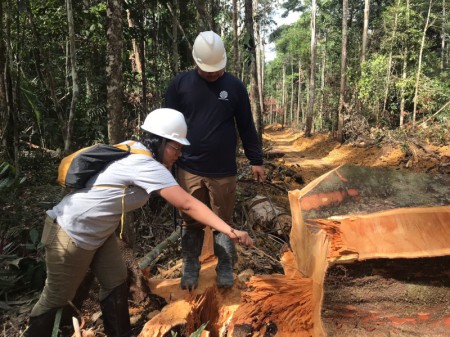
Wood samples being collected for cellulose isotope analysis (image: researchers’ collection)
University of São Paulo researchers are mapping the distribution of different isotopes of oxygen, carbon and other elements in the composition of Amazon trees that can be used to track the origin of seized material.
University of São Paulo researchers are mapping the distribution of different isotopes of oxygen, carbon and other elements in the composition of Amazon trees that can be used to track the origin of seized material.
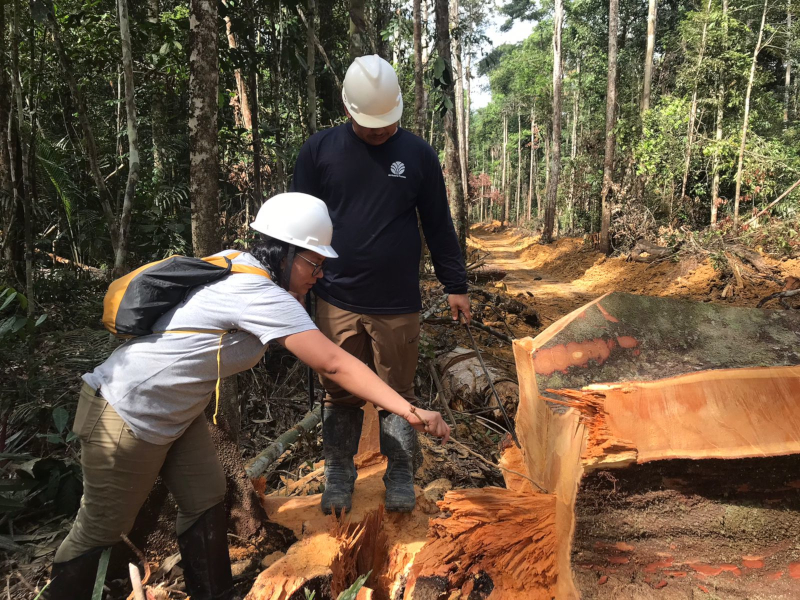
Wood samples being collected for cellulose isotope analysis (image: researchers’ collection)
By Sophia La Banca | Agência FAPESP – A map showing the distribution of isotopes in Amazonian tree wood can help identify illegally harvested timber. By analyzing the ratio of different isotopes of elements such as oxygen, carbon, nitrogen, and strontium, researchers can pinpoint the region where the wood was harvested more precisely. This helps combat the illegal timber trade.
Illegal logging is one of the main causes of deforestation in the Amazon. Environmental agencies and law enforcement in Brazil use various tools to determine the origin of timber, including analyzing plant anatomy and species distribution and consulting official records, such as the Forest Origin Document (DOF). However, these methods are not always sufficient to guarantee the legal origin of the timber.
A research group led by Professor Luiz Antonio Martinelli, a full professor at the Center for Nuclear Energy in Agriculture at the University of São Paulo (CENA-USP), is developing a new tool to assist with this task. The tool relies on the use of isotopes – forms of a chemical element that have the same atomic number but different masses – to narrow down the area from which the wood was harvested. The group is creating a map of the distribution of these atomic forms in wood from Amazonian trees, which police can use to compare the composition of wood under investigation.
“Our goal is to provide the Federal Police with a tamper-proof method. You can’t falsify stable isotopes,” says Martinelli. Furthermore, once the isoscape is ready, experts outside of research laboratories will be able to easily apply the methodology.
The methodology is based on calculating the ratio of two different isotopes of the same atom, such as oxygen-18 and oxygen-16, in the cellulose that makes up the wood. In an article published in May in the journal Molecules, the team demonstrates that there is a southwest-to-northwest gradient in the ratio of the two isotopes, with the lighter isotope predominating in the west. In other words, wood from the western part of the forest contains more oxygen-16 and less oxygen-18 than wood from the eastern part.
This difference can be explained by the gradual loss of the heavier form of oxygen that makes up water when moisture from the Atlantic Ocean moves over the continent. Since the water reaching the western Amazon has lost some oxygen-18 along the way, smaller amounts of this isotope are incorporated into the wood of regional plants.
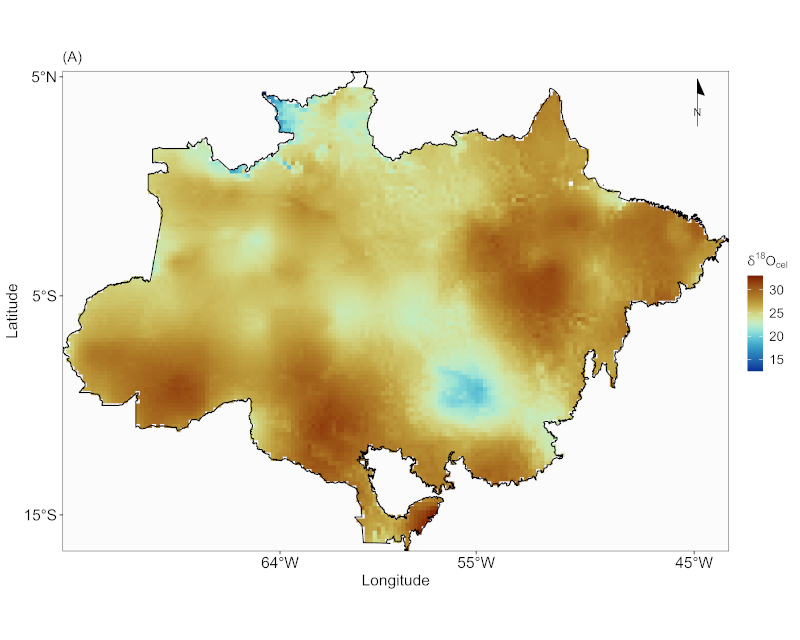
Map showing differences in the occurrence of oxygen-18 in trees from different regions of the Amazon Rainforest (image: Luiz Antonio Martinelli)
Limitations and next steps
However, oxygen cannot be used in isolation for this task. “Since the Amazon is so complex – a very large area – it isn’t possible to use just one isotope,” Martinelli explains. An ongoing doctoral project, developed by PhD student Isabela Maria Souza Silva with support from FAPESP, is mapping the isotopes of two other atoms, carbon and nitrogen. The group also plans to add strontium to the model.
Currently, the tool has some limitations. “Our best model can exclude 92% of the Amazon’s forest area, which amounts to three million square kilometers. The problem is that 8% is still too much. To give you an idea, that’s roughly 240,000 square kilometers,” Martinelli explains.
Another challenge is the greater variability in results for trees from the deforestation arc, the geographical band marking the frontier of the biome’s destruction. This makes it difficult to apply the method to wood sourced precisely from regions where logging is most intense.
Martinelli and his team aim to reduce these limitations by increasing the number of isotopes and samples used. “We’ve collected samples from 800 trees at 63 sites across the Amazon and found that if we want a more accurate model, we’ll need to collect from more trees in more locations,” he explains. The team is also studying the possibility of using new chemical approaches beyond isotope measurement. One approach would be to create maps showing differences in the concentration of certain chemical elements in the wood, known as an “elementalscape.” By combining these approaches, the group hopes to create a more precise tool to combat deforestation.
The article “Isoscape of oxygen stable isotopes in woods of the Amazon” can be read at www.mdpi.com/1420-3049/31/9/1542.
The Agency FAPESP licenses news via Creative Commons (CC-BY-NC-ND) so that they can be republished free of charge and in a simple way by other digital or printed vehicles. Agência FAPESP must be credited as the source of the content being republished and the name of the reporter (if any) must be attributed. Using the HMTL button below allows compliance with these rules, detailed in Digital Republishing Policy FAPESP.
