





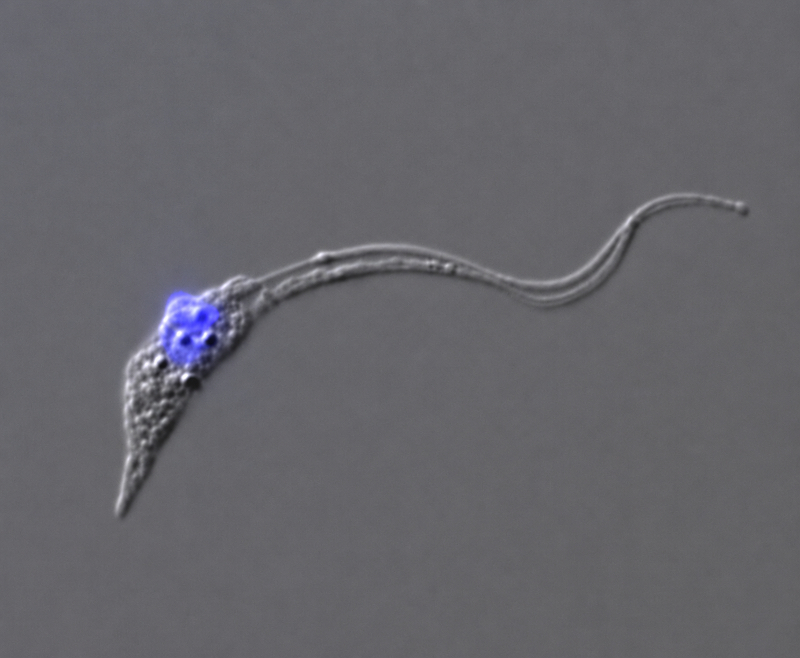
By Thabata Oliveira | Agência FAPESP* – The Chagas disease parasite (Trypanosoma cruzi) undergoes a major transformation throughout its life cycle in order to infect humans and other mammals. It alters the types and amounts of proteins in its body to adapt. The factors that drive this transformation are still poorly understood. In May, a study was published in the journal PLOS Pathogens revealing that part of this process involves chemical changes in transfer RNA (tRNA). This molecule acts as a cellular “delivery person,” transporting amino acids to the site where proteins are synthesized.
“tRNAs function as ingredient delivery agents. They transport the amino acids used to assemble proteins, which are essential molecules for cellular function. The tRNA modifications we studied can facilitate or hinder this delivery and consequently influence protein production,” explains the first author of the study, Herbert Guimarães de Sousa Silva, who conducted the research during his Ph.D. program at the Federal University of São Paulo’s Medical School (EPM-UNIFESP) and the Butantan Institute in São Paulo, Brazil, with support from FAPESP.
Currently a postdoctoral fellow at Cornell University in the United States, Silva explains that the team identified 170 sites of modification in tRNA molecules and observed that these sites vary between the infectious and non-infectious forms of T. cruzi. “We’ve shown that tRNA modifications change throughout the parasite’s life cycle and that those changes are important for facilitating its transformation from a non-infective to an infectious phase,” he states.
The researchers used tRNA sequencing, mass spectrometry, and bioinformatics analyses to map the chemical alterations present in these molecules and to investigate their role. Then, they used the CRISPR gene-editing tool to evaluate the impact of the absence of one of these modifications on the transition between phases of the T. cruzi life cycle.
The study was also supported by FAPESP through projects 13/07467-1, 18/15553-9, 21/12938-0, and 24/16633-7 and was coordinated by Satoshi Kimura of Cornell University and Julia Pinheiro Chagas da Cunha of the Butantan Institute. It included researchers from the University of São Paulo (USP) and Harvard University.
The study was only possible thanks to recent methodological advances. “For a long time, no one could sequence tRNAs efficiently because the very modifications in these molecules made the process difficult,” says Cunha. According to the researcher, protocols developed in recent years have made it possible to determine the types and abundance of modifications present in these molecules.
A neglected disease, limited treatment options
Chagas disease affects approximately seven million people worldwide and is classified by the World Health Organization (WHO) as one of the major neglected tropical diseases. It is primarily transmitted through insects commonly known as kissing bugs, which excrete T. cruzi in their feces while feeding. Infection can also occur through ingesting food contaminated by infected kissing bugs, mother-to-child transmission during pregnancy, and, more rarely, blood transfusions or organ transplants.
Throughout its life cycle, the parasite takes on different forms. “The epimastigote is a non-infective form that replicates inside the kissing bug. It then differentiates into a metacyclic trypomastigote, the infectious form that the insect excretes in its feces and that invades the mammalian host,” explains Janaina de Freitas Nascimento, a professor at the Institute of Chemistry at USP and co-author of the study.
Although Chagas disease was first described over a century ago, it still lacks a vaccine, and only two drugs are approved for its treatment: benznidazole and nifurtimox. According to Nascimento, the effectiveness of these drugs depends on the stage at which the infection is diagnosed. “The acute phase usually presents with very nonspecific symptoms and is often mistaken for other diseases. It’s precisely during that phase that the medication is most effective,” she says.
After this period, the parasite can remain in the body for decades without causing symptoms. “Often, people only discover they have Chagas disease 30 years later when they’re experiencing heart problems or changes in their digestive tract. In the chronic phase, however, treatment tends to be less effective,” says the researcher. For this reason, new therapeutic options are needed.
However, the authors are cautious when discussing the immediate therapeutic applications of the research findings. They emphasize the importance of basic research in developing new strategies to combat the disease. “We want to understand how T. cruzi works. To develop a therapy, you first need to understand the parasite’s biology,” says Nascimento. “By understanding the mechanisms, we know where to target the parasite, but that still requires a great deal of research.”
Cunha points out that this field already shows translational potential in other organisms. For example, modifications to tRNAs are being investigated as possible targets for developing antimicrobials against multidrug-resistant bacteria. This suggests that similar mechanisms may have future applications. “It isn’t the focus of this study, but it isn’t far off either,” Cunha concludes.
The article “Remodeling of tRNA modification in Trypanosoma cruzi life forms” can be read at journals.plos.org/plospathogens/article?id=10.1371/journal.ppat.1014249.
* Thabata Oliveira is a FAPESP Scientific Journalism fellow affiliated with IQ-USP.
Republish
The Agency FAPESP licenses news via Creative Commons (CC-BY-NC-ND) so that they can be republished free of charge and in a simple way by other digital or printed vehicles. Agência FAPESP must be credited as the source of the content being republished and the name of the reporter (if any) must be attributed. Using the HMTL button below allows compliance with these rules, detailed in Digital Republishing Policy FAPESP.
