





By José Tadeu Arantes | Agência FAPESP – In recent years, the so-called “anomalous magnetic moment of the muon,” represented by the formula g-2, has sparked intense debate in particle physics. Differences between the value measured in the laboratory and the value calculated by the Standard Model were interpreted as possible signs of unknown phenomena not accounted for by the theory. Now, an international review that brought together hundreds of researchers from around the world has concluded that the discrepancy has virtually disappeared based on current calculations and experiments, falling within the margin of error. An article on the subject was published in the journal Physics Reports.
“The most important message of the review, which reflects the current consensus, is that the large discrepancy observed in the past apparently doesn’t exist according to the most recent data and calculations. There are still some discrepancies that need to be investigated, but the results point to agreement between theory and experiment,” says Diogo Boito of the São Carlos Institute of Physics at the University of São Paulo (IFSC-USP) in Brazil. Boito and his student, Cristiane Yumi Mise London, a Ph.D. candidate at IFSC-USP, participated in the review and were authors of Chapter 4 of the article.
The muon is an elementary particle that belongs to the lepton class. This class includes three electrically charged particles with a charge of “-1” (the electron, the muon, and the tau particle) and three neutral particles (the electron neutrino, the muon neutrino, and the tau neutrino particle). In a terrestrial context, muons primarily arise when cosmic rays collide with atomic nuclei in the atmosphere or in artificial collisions produced by large particle accelerators in laboratories. The muon is unstable because it has a mass about 207 times greater than that of the electron and decays into an electron via the weak interaction. Its intrinsic lifetime is approximately 2.2 microseconds. However, because it travels close to the speed of light, it is subject to the time dilation effect described by the Special Theory of Relativity. Thus, to an external observer, its lifetime can appear extended to tens or even hundreds of microseconds – enough time for a large number of muons to pass through the entire atmosphere and reach the Earth’s surface.
Because muons have an electric charge and spin, they behave like small magnets. In other words, they possess a magnetic moment, which quantifies their interaction with an external magnetic field through a constant known as “g.” The theoretical value of the magnetic moment in a relativistic context is derived from the Dirac equation, formulated by English physicist Paul Dirac (1902–1984), winner of the 1933 Nobel Prize in Physics and one of the founders of quantum mechanics and quantum electrodynamics. The result is g = 2. However, the actual magnetic moment is never exactly 2 because the muon is always surrounded by quantum fields in which other particles can manifest.
“The magnetic field doesn’t only ‘see’ the isolated particle. It sees the entire cloud in which the particle is immersed. And that cloud contains everything,” Boito states. “For that reason, g-2, the anomalous magnetic moment of the muon, is an extraordinary tool for testing the Standard Model. If the experimentally measured g-2 and the value calculated from theory coincide, that would be an important validation of the Standard Model. But if there’s a discrepancy between the two values, as seems to be the case, then the conclusion would be that something not predicted by the Standard Model could be occurring,” he explains.
The “something not predicted” to which Boito refers could be dark matter, other forms of the Higgs boson, or forces other than the four known forces: gravitational, electromagnetic, strong, and weak. In short, it could be “things” that are not accounted for by the Standard Model. “Hence the importance of measuring and calculating that number with extreme precision,” Boito comments.
The most recent experimental measurements were conducted at the Fermi National Accelerator Laboratory (Fermilab), one of the world’s leading particle physics laboratories located in Illinois, following up on previous measurements made at the Brookhaven National Laboratory in New York State.
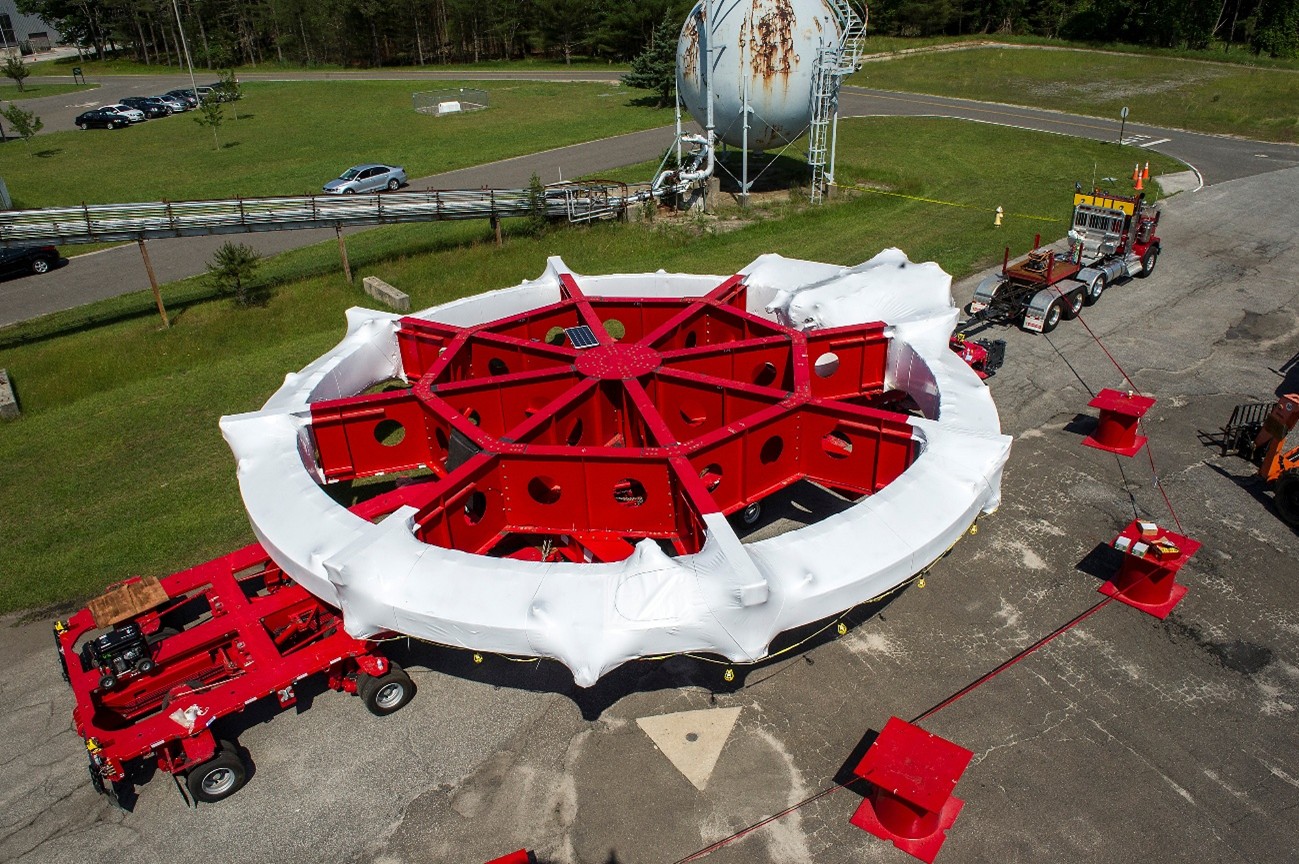
The experiment primarily uses positive muons, which are produced and made to circulate in an extremely uniform, 14.2-meter-diameter magnetic ring. Circulating at speeds close to the speed of light, the muons decay via the weak interaction, producing positrons (positive electrons) that escape the orbit of the beam and strike detectors installed around the ring. The positrons are most likely emitted in the direction of the spin. If the magnetic moment of the muon were exactly 2, as theory predicts, the impacts on the detectors would form a continuous line of constant height. However, since the actual value differs from 2 – that is, g-2 – spin precession occurs, causing the impacts to rise and fall periodically, similar to a spinning top. This up-and-down motion allows the value of g-2 to be measured with extreme precision.
The Fermilab experiment did not start from scratch; it used the existing magnetic ring at Brookhaven. An operation involving extraordinary logistics was set up to transport the entire ring from one laboratory to the other without dismantling it. The transport was not carried out directly from New York to Illinois by highway. Instead, the ring traveled approximately 5,100 kilometers over the course of about 35 days. It traveled by special trucks at night from Brookhaven to Fermilab and by barge along the U.S. East Coast, skirting Florida, and through the river system to Illinois.
The initial results from Fermilab in 2021 and 2023 confirmed the values obtained at Brookhaven. The 2025 results concluded the experimental cycle and achieved much greater precision, though they did not substantially alter the previous figures. It became clear that the experimental values were very robust. Any discrepancy with the theoretical results was due to a shortcoming in the latter. This is what the new review demonstrated. Taking into account the updated experimental data and significant advances in theoretical calculations, the review concluded that the differences between theory and experiment were now statistically insignificant. In other words, based on the current data, there is no evidence to suggest that new physics beyond the Standard Model is necessary.
“The difficulty of the theoretical calculations stems from the fact that the muon’s interaction with the magnetic field is influenced by all the particles predicted by the Standard Model. Some of those contributions, associated with the electron, photon, and electroweak bosons, can be calculated using highly precise analytical methods. In other words, it can be done with pen and paper,” Boito emphasizes.
“However, even for contributions that can be treated analytically, such as those determined by quantum electrodynamics, the calculation of g-2 requires considering successive corrections. The first-order correction, associated with the virtual exchange of a photon, was calculated by Julian Schwinger in 1948. Higher-order corrections involve more complex processes, such as photons temporarily transforming into electron-positron pairs before being reabsorbed. As higher orders are considered, diagrams with multiple virtual pairs emerge. But each new term contributes less to the final result and can be omitted. Nevertheless, achieving the current level of precision – calculated up to the fifth order – required an effort that took more than half a century to complete.”
“Today, the greatest challenge lies in an area governed by the strong force, involving quarks and gluons – the constituents of protons and neutrons. That interaction is described by quantum chromodynamics [QCD], a mathematically complex theory,” says Boito. For quite some time, the main strategy for estimating the contribution of quarks to g-2 was indirect. Rather than calculating it directly from QCD, physicists relied on a rigorous method based on experimental measurements obtained at accelerators where electrons and positrons collide and transform into hadrons. The collision data is then plugged into mathematical equations that reconstruct the hadronic contribution to g-2 without the need for fundamental QCD calculations, which would be impractical. This is the so-called “data-driven method,” which circumvents the mathematical difficulties of QCD but has led to large discrepancies with the experimental g-2 data.
A new theoretical strategy and much more robust computational resources have paved the way for resolving this conflict. In recent years, an approach known as “lattice QCD,” has emerged. In this method, spacetime is not treated as continuous but as a set of discrete points forming a lattice, analogous to the crystal lattice of a solid. This transformation of the theoretical problem into a numerical one allows us to address the infinite possibilities of continuous spacetime by performing calculations within a finite volume with minimal spacing between points. This makes it feasible to simulate the dynamics of quarks and gluons on a supercomputer. The goal is to bring the lattice closer to real spacetime by reducing the spacing between points and increasing the simulated volume until the results can be extrapolated to the physical world,” the researcher explains.
In lattice QCD, the final result is not obtained by solving an analytical equation directly. Instead, the intensity of the fundamental interactions between quarks and gluons is defined, and then these particles are distributed across the lattice. The system is then allowed to evolve numerically according to the rules of the theory using a statistical technique known as the Monte Carlo method, named after the famous casinos in Monte Carlo.
It is worth noting that the popular description, according to which the muon is surrounded by a “cloud of virtual particles,” is not the starting point for calculations but rather a subsequent interpretation of the results. Physicists begin with the rigorous, quantitative expressions provided by quantum field theory, seeking to translate them into intuitive images only later. Therefore, the notion of a cloud is a pedagogical metaphor representing a series of term-by-term calculated corrections, not a fixed number of particles directly surrounding the muon.
For comparison, Fermilab obtained the best experimental value for (g-2)/2 of 0.001165920705 ± 0.000000000148. Using the lattice QCD method, the value 0.00116592033 ± 0.00000000062 was obtained. The difference between these two values, on the order of 3.8×10^(−10), is not statistically significant.
New measurements of electron-positron collisions conducted by the CMD-3 experiment in 2023 at the VEPP-2000 accelerator in Novosibirsk, Siberia, using the “data-driven method,” yield results that are very close to those obtained with lattice QCD and in good agreement with the g-2 experiments. These results differ from previous findings obtained using this method, suggesting that some older electron-positron collision measurements may be flawed or underestimate uncertainties. The previous measurements are being carefully investigated to reach a final conclusion. New experiments, such as BES-III in China, continue to measure electron-positron collisions. According to the authors of the review, calculations using lattice QCD have currently reached a level of precision sufficient to replace the previous method in the most critical part of the calculation. However, the results obtained with the data-driven method require further analysis to reach a final verdict.
The review is the result of a coordinated international effort stemming from the Muon g-2 Theory Initiative, which was established in 2017 to unify the research community in this field. The group organizes regular workshops and publishes consensus reports, known as white papers, which compile the best available results at any given time. This new edition incorporates hundreds of recent studies, methodological reviews, and experimental updates, as well as advances in computational tools. Institutions from Europe, Asia, North America, and Latin America are participating in the work. Brazil is represented by researchers affiliated with IFSC-USP.
Participation by researchers from Brazil was supported by FAPESP through the Young Investigators Grant – Phase 2, which was awarded to Boito, as well as through Doctoral Scholarships and Research Internships Abroad, which were awarded to London.
The article “The anomalous magnetic moment of the muon in the Standard Model: an update” can be read at sciencedirect.com/science/article/pii/S0370157325002157.