





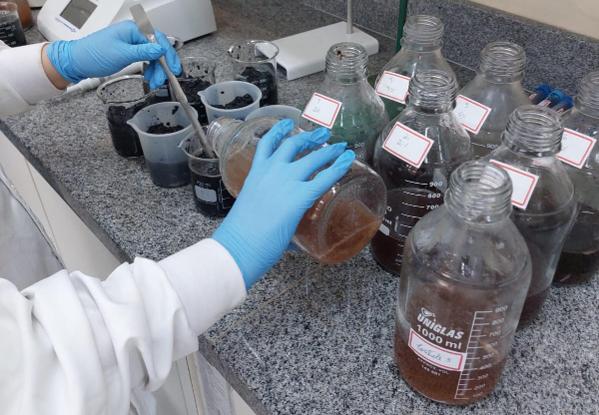
By José Tadeu Arantes | Agência FAPESP – Low concentrations of caustic soda (sodium hydroxide, NaOH) are more efficient than high doses for preparing organic waste for biogas production. This finding increases methane production, reduces reagent consumption and, consequently, diminishes process costs and minimizes the risk of inhibiting the microorganisms responsible for the process.
The raw material for the study that reached such a conclusion was the banana – its peels and parts unfit for sale collected from wholesale markets. Despite their high organic matter content, the energy potential of these waste materials is “locked” within a kind of “plant-made armor” composed primarily of substances like cellulose and lignin. This hinders the access of microorganisms to fermentable sugars and limits the efficiency of anaerobic digestion – the decomposition of organic matter by microorganisms that live in the absence of oxygen.
Throughout the process, complex molecules are broken down into simpler compounds until methane (CH₄), the main energy component of biogas, is formed.
“To increase the efficiency of biogas production, a pretreatment is necessary. We opted for thermo-alkaline pretreatment [which combines heat and chemical products]. The biomass was heated in the presence of sodium hydroxide at different concentrations, ranging from 0.2% to 3%. The goal was to partially break down the lignin barrier, making the carbohydrates more accessible to microorganisms,” reports Sandra Imaculada Maintinguer, a member of the Bioenergy Research Institute (IPBEN) at São Paulo State University (UNESP) who coordinated the study.
The result contradicted the intuitive expectation that more reagent would yield better performance. Maximum efficiency was achieved with the lowest concentrations tested.
Specifically, a concentration of 0.2% NaOH promoted the greatest solubilization of carbohydrates, reaching 12,110 milligrams of methane per liter (mg/L) compared to the 4,785 mg/L observed in the untreated material. A slight increase in concentration to 0.4% yielded the highest cumulative methane production; however, the 0.2% concentration exhibited the highest rate of gas production.
“This is important because, in addition to increasing production costs, high sodium hydroxide use inhibits the activity of the microorganisms responsible for methane production and can have a greater environmental impact,” highlights Larissa Ayumi Yamamoto, a graduate at IPBEN-UNESP and first author of the article that describes the finding, published in May in the journal BioEnergy Research.
Less is more
In small quantities, caustic soda partially breaks down plant structure and releases sugars that feed microorganisms. However, in excess, it begins to attack the microorganisms themselves, reducing or even halting the process. “There’s no point in using 20%. It’s inhibitory,” Maintinguer summarizes. In addition to increasing methane production, reducing the amount of reagent improves the prospects for industry because it facilitates subsequent effluent treatment. “For industry, the lower the sodium hydroxide concentration, the better,” she comments.
The researcher notes that the state of São Paulo offers particularly favorable conditions for this type of technology. As a major fruit producer, the state generates enormous amounts of waste throughout the production chain, from fruit discarded on farms to byproducts from processing and marketing. “The idea is to close that cycle. Instead of sending scraps and fruit that don’t meet commercial standards to landfills, this waste can feed bioreactors capable of producing energy, thus transforming an environmental liability into a renewable energy source,” he explains.
The results showed that the performance of the system depends not only on the amount of available organic matter, but also on which bacteria are acting on the process and the paths they take to digest the material. The reactor that underwent pretreatment with 0.4% sodium hydroxide was found to have bacteria of the genera Paraclostridium and Clostridium, as well as methanogenic archaea (methane-producing unicellular organisms) of the genera Methanothrix and Methanoregula, as the predominant species. “We evaluated the microbial consortium present in the reactor. We were able to track how that system evolved and which metabolic pathways the microorganisms followed throughout the process,” emphasizes Ana Gabriela Janas, a doctoral student at IBPEN-UNESP. “That’s the kind of information that research can provide to industry.”
Microbial work shifts
Maintinguer explains that anaerobic digestion functions as a succession of stages performed by different groups of microorganisms. “We introduce the raw organic matter, and then the microorganisms break it down into increasingly simpler compounds. These intermediates are eventually consumed by other microorganisms until the process leads to the formation of methane. A more detailed understanding of how the reactors function biologically could guide strategies to further increase the efficiency of biogas production.”
This study is part of a broader program developed by the UNESP group to transform agroindustrial waste into energy sources and other valuable products. In addition to banana waste, the researchers have studied orange and guava waste, as well as wastewater from fruit processing and different strategies for anaerobic digestion and co-digestion. Anaerobic co-digestion consists in mixing different kinds of waste in the same reactor to enhance energy production.
Depending on the operating conditions and the microbial community present, these systems can be directed toward producing not only biogas but also other compounds of industrial interest. In another study currently under peer review, Janas and colleagues investigated anaerobic co-digestion to produce biohydrogen.
The study was funded by FAPESP through two projects (22/15706-5 and 24/10977-6).
The article “Agroindustrial banana wastes applied in biogas production: Evaluation of thermal pretreatment on alkaline hydrolysis” can be read at link.springer.com/article/10.1007/s12155-026-11024-0.
Republish
The Agency FAPESP licenses news via Creative Commons (CC-BY-NC-ND) so that they can be republished free of charge and in a simple way by other digital or printed vehicles. Agência FAPESP must be credited as the source of the content being republished and the name of the reporter (if any) must be attributed. Using the HMTL button below allows compliance with these rules, detailed in Digital Republishing Policy FAPESP.
