





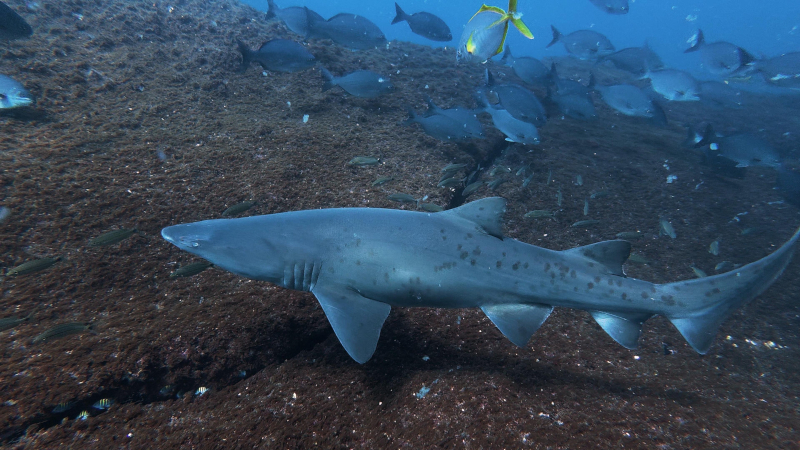
By André Julião | Agência FAPESP – The critically endangered sand tiger shark (Carcharias taurus) appears to have found a refuge off the northern coast of the state of São Paulo, Brazil, for mating and reproduction. This was revealed in a study conducted by scientists and divers in the Alcatrazes Archipelago, a protected marine area located 35 kilometers off the coast of São Sebastião.
The results were published in the Journal of Fish Biology by researchers from the Federal University of São Paulo (UNIFESP), São Paulo State University (UNESP) in São Vicente, and the Fisheries Institute of the São Paulo Agency for Agribusiness Technology (IP/APTA).
With support from FAPESP and Petrobras, the researchers observed a female with recent mating marks in the summer and a pregnant female in the winter. Previous studies had reported that sand tiger sharks mated in Argentina, Uruguay, and southern Brazil, then migrated to warmer waters off the southeastern Brazilian coast to gestate and give birth.
“We’ve shown that they’re here not only in the winter as previously thought, but also in the summer, completing their entire reproductive cycle in Brazilian waters,” says Ana Clara Athayde, the study’s first author and a FAPESP scholarship holder at UNIFESP’s Institute of Marine Science (IMar).
The observations were made at the Alcatrazes Archipelago Wildlife Refuge and underscore the importance of protected marine areas for the species and for ecosystem services such as providing food for fishing communities. The protected area, established in 2016, is managed by the Chico Mendes Institute for Biodiversity Conservation (ICMBio), which is affiliated with the Ministry of the Environment and Climate Change.
“There are historical records of sand tiger sharks being caught as bycatch off the São Paulo coast, but there were no scientific records until the one we compiled in Alcatrazes in the winter of 2022,” says Fábio Motta, a professor at IMar-UNIFESP and coordinator of a project supported by FAPESP under the Research Program on Biodiversity Characterization, Conservation, and Sustainable Use (BIOTA-FAPESP).
Most of the records were obtained using BRUVs (baited remote underwater video systems). In this technique, a mount with two cameras and an arm with bait is kept submerged for about an hour. After images are captured at various locations, they are analyzed to identify the species recorded by the equipment.
Citizen science
For this study, BRUVs were deployed 315 times at 38 locations throughout the archipelago at depths ranging from two to 50 meters. Sampling was conducted in winter and summer from 2022 to 2025 as part of the Mar de Alcatrazes program, which is dedicated to monitoring the archipelago’s biodiversity and is sponsored by Petrobras.
The sharks were counted and measured using the images. In addition to the researchers’ records, the study relied on recreational divers’ contributions as part of a citizen science initiative. Guilherme Bertuzo, a biologist, dive guide, and author of the article, managed to film nine sand tiger sharks in the summer of 2024 at depths ranging from five to ten meters.
“Sand tiger sharks have a very distinctive morphology, with fin size and position that set them apart from other coastal species in the southwest Atlantic. That’s why we were able to identify them even when visibility wasn’t ideal,” Motta reports.
The researchers also identified the sex and stage of maturity (juvenile or adult) of the sharks, as well as their distinctive body markings, whenever possible. Pregnancy was inferred based on the distension of the ventral region of the females’ bodies.
Additionally, a method published shortly before in the United States allowed the researchers to estimate when the females had mated, based on bite marks left by males during copulation, as well as the gestation period.
“By observing the healing of those wounds in captive females and comparing them with those in the wild based on citizen science records, those researchers were able to estimate when copulation occurred and consequently, the gestation period. Using this method, we showed that females on Alcatrazes are copulating,” says Athayde.
Critically endangered
The sand tiger shark has a highly specialized and unique reproductive mode. This species was the first in which intrauterine cannibalism was described. In this phenomenon, the pups feed on the eggs – sometimes already fertilized – and even on their younger siblings while still in the mother’s womb.
As a result, females typically give birth to only two pups per pregnancy, which usually lasts nine to twelve months and can occur every two years. The pups are born large, measuring about 90 centimeters. Low fertility is one vulnerability of this and other shark species, which are unable to withstand overfishing and other impacts, such as marine pollution and habitat loss.
According to the researchers, the Alcatrazes Archipelago and other nearby protected marine areas, such as Santos Reef and Queimada Grande Island, can form an important ecological corridor for conservation because the sand tiger shark is a migratory species.
In 2025, the Alcatrazes Archipelago was designated an Important Shark and Ray Area (ISRA) as part of a program by the International Union for Conservation of Nature (IUCN) that identified such areas worldwide.
“Our findings underscore the importance of this particular conservation area, as well as other areas where fishing is regulated, for protecting coastal sharks. Furthermore, by revealing the spatial and temporal dynamics of the species, the study can inform conservation strategies,” Motta concludes.
The article “Subtropical marine reserves as key habitats for the critically endangered sand tiger shark (Carcharias taurus) in the Southwestern Atlantic” can be read at onlinelibrary.wiley.com/doi/10.1111/jfb.70479.
Republish
The Agency FAPESP licenses news via Creative Commons (CC-BY-NC-ND) so that they can be republished free of charge and in a simple way by other digital or printed vehicles. Agência FAPESP must be credited as the source of the content being republished and the name of the reporter (if any) must be attributed. Using the HMTL button below allows compliance with these rules, detailed in Digital Republishing Policy FAPESP.
