





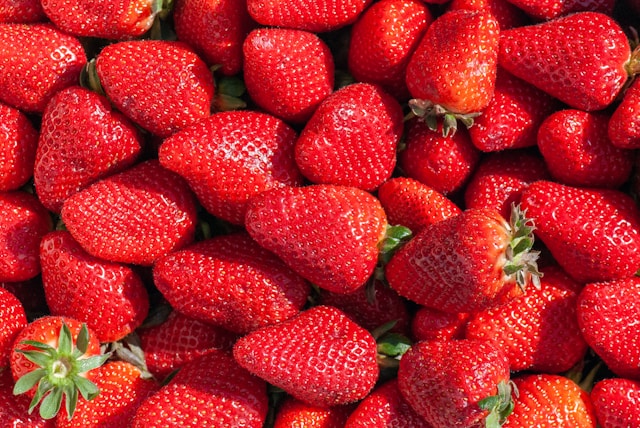
By Karina Ninni | Agência FAPESP – Five minutes. That was the amount of time that Oso Grande strawberries remained in contact with the Ctx(Ile21)-Ha peptide – a molecule isolated from a frog native to the Brazilian Cerrado – in experiments conducted in Brazil by scientists at the Tupã campus of São Paulo State University (UNESP). It was enough to demonstrate the molecule’s potential to extend the shelf life of the fruit, which is highly perishable.
“The peptide alone, without any other components, maintained the characteristics of ripe fruit after five days – which, for a strawberry, is a long storage period. We didn’t expect that much,” describes Eduardo Festozo Vicente, who coordinates the Multi-User Equipment Laboratory at the UNESP School of Engineering and Sciences (LEMU-FCE), where the study was conducted with funding from FAPESP.
Peptides are molecules resembling proteins (albeit simpler and smaller) that execute various functions inside the organism. Vicente has been studying the peptide since his master’s degree nearly twenty years ago. He notes that the team has not yet conducted microbiological studies to understand the mechanism of action of the molecule, which is antimicrobial.
In an article published in the journal Applied Food Research, the team focused solely on the physicochemical parameters of the fruit treated with the molecule. They found that the peptide treatments did not interfere with the fruit’s flavor and did not significantly affect the phenolic compounds or total soluble solids. This indicates that the molecule preserved the fruit’s chemical composition.
“When strawberries are stored in the refrigerator for a while, they degrade naturally. The study shows that the peptide slows that degradation, relatively extending the shelf life and maintaining the strawberries’ physicochemical characteristics. Analysis of the experiment showed that the soluble solids, which are sugars highly degradable by microorganisms, were preserved in the fruits that came into contact with the peptide. The texture was also preserved,” said Vicente to Agência FAPESP. “We can’t yet speak in microbiological terms, because we didn’t conduct those tests. But one hypothesis the group is exploring for future work is that there may have been a reduction in microorganisms [based on the peptide’s antimicrobial properties].”
For the experiment, the team dissolved the peptide in water at three different concentrations. Then, they immersed 300 grams of strawberries in the solutions for five minutes. They established a control group in which the strawberries were immersed in water alone. “Then, we let the strawberries dry and stored them in sanitized PET trays covered with plastic wrap at 5 °C in an incubator with precise temperature control. We simulated what a strawberry vendor would do when storing them in a refrigerator.”
The samples were kept in the incubator for six days. Physicochemical parameters (pH, soluble solids, texture, and respiratory rate) and biochemical parameters (ascorbic acid, total phenols, sugars, and enzymatic activity) were evaluated on days 0, 1, 2, 3, 4, and 5. The experiments were conducted in triplicate, which reduces variability and the margin of error, in collaboration with Professor Angela Vacaro de Souza, also from FCE-UNESP.
Professors Luís Roberto Almeida Gabriel Filho and Camila Pires Cremasco, from the statistics and predictive modeling area at FCE, also collaborated on the study.
Defense
Vicente explains that the Ctx(Ile21)-Ha peptide was isolated and extracted in 2006 from a frog native to the Brazilian Cerrado (Boana albopunctata) by the group led by Professor Mariana de Souza Castro at the University of Brasília (UnB). “This substance is part of the amphibian’s range of defenses. Since it breathes through its skin, it possesses an arsenal of molecules that form an efficient defense system because it’s in direct contact with pathogens in the environment. Ctx(Ile21)-Ha is just one of the molecules isolated for study. And it’s highly active from an antimicrobial standpoint.”
According to him, the group initially planned to use the peptide as a zootechnical additive in animal feed to replace conventional antibiotics, the overuse of which has led to widespread antimicrobial resistance. “The initial project had three main strands: first, to study the peptide biophysically, producing analogs more potent than the original molecule itself; second, to attempt to apply it – or its analogs – in animal nutrition, including ruminants, dairy cattle [for treating mastitis], laying hens, broiler chickens, and pigs. The final component was to apply it to food, with the goal of extending its shelf life.”
Vicente highlights the support provided by FAPESP, including assistance in obtaining the peptide. “We’re one of the few laboratories in Brazil capable of synthesizing, purifying, and characterizing this peptide and any other of biological interest.” The Foundation supported the work through projects 21/06706-9, 22/05319-4, 19/07438-8, and 16/00446-7.
“We achieved a purity level exceeding 95% in the synthesis of the molecule, which is composed of amino acids. It can be ingested, as it’ll be broken down normally by the stomach, since it is a protein derivative. Of course, we’re still in the proof-of-concept phase, including for use as an animal feed additive. But we now know that the peptide has great potential for use as a postharvest treatment for highly perishable fruits, such as strawberries.”
Next steps
Ctx(Ile21)-Ha is not yet regulated for use in Brazil. However, Vicente believes that the regulatory process would not be problematic, as other commercial peptides are already approved and in use in the country. The group has already filed a patent application for its use in laying hens and has another pending for use in ruminants.
“We still need to work on the microbiological aspects and conduct the necessary tests, and that’ll certainly be the next step,” Vicente explains. “In addition, we aim to produce the peptide on a large scale using models well-established in the literature, such as yeast. Another avenue would be the creation of a film or coating to wrap fruits with skins, since current regulations prohibit fruits that are consumed without their skins from being wrapped in edible films.”
The researcher is referring to Normative Instruction No. 211/2023 issued by the Brazilian Health Regulatory Agency (ANVISA), which establishes the maximum limits and conditions of use for food additives and processing aids authorized for use in food.
The article “Effects of the antimicrobial peptide Ctx(Ile21)-Ha on the physicochemical and biochemical quality of organic strawberries during post-harvest storage” can be read at doi.org/10.1016/j.afres.2026.102073.
Republish
The Agency FAPESP licenses news via Creative Commons (CC-BY-NC-ND) so that they can be republished free of charge and in a simple way by other digital or printed vehicles. Agência FAPESP must be credited as the source of the content being republished and the name of the reporter (if any) must be attributed. Using the HMTL button below allows compliance with these rules, detailed in Digital Republishing Policy FAPESP.
