




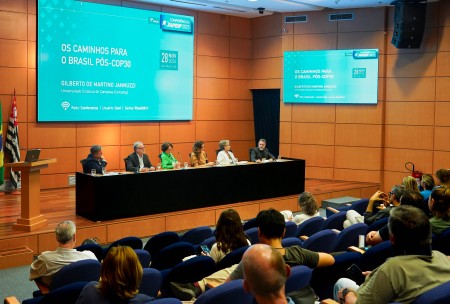
Debating post-COP30: recognition of multilateralism is a “key source of hope” (Daniel Antônio/Agência FAPESP)
São Paulo needs to drive the process of gradually replacing fossil fuels with renewable energy sources in Brazil, said Gilberto Jannuzzi at a conference organized by FAPESP to discuss the path forward for the country after COP30.
São Paulo needs to drive the process of gradually replacing fossil fuels with renewable energy sources in Brazil, said Gilberto Jannuzzi at a conference organized by FAPESP to discuss the path forward for the country after COP30.
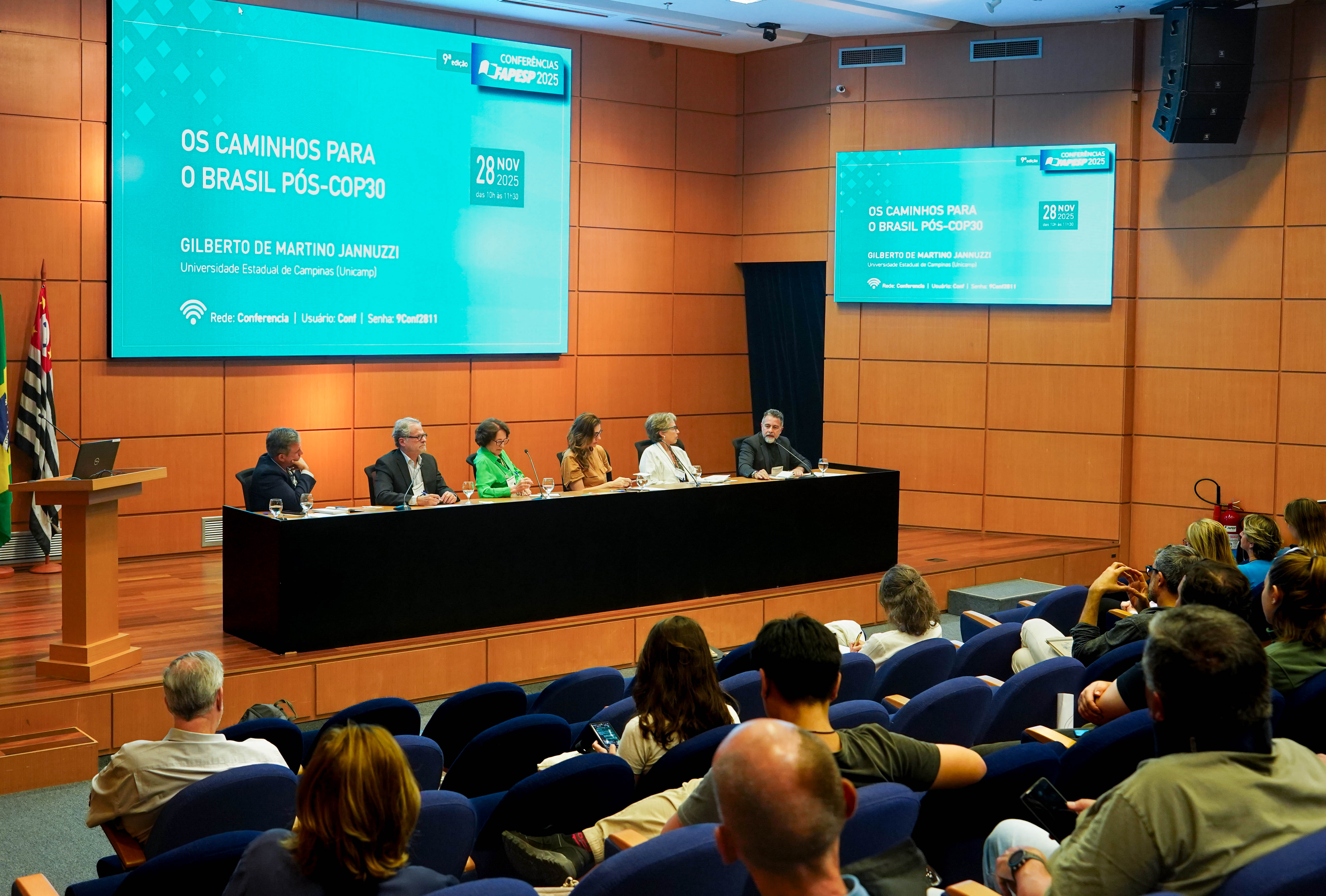
Debating post-COP30: recognition of multilateralism is a “key source of hope” (Daniel Antônio/Agência FAPESP)
By Elton Alisson | Agência FAPESP – One of the central themes of the 30th United Nations Climate Change Conference (COP30), the energy transition will depend on overcoming a series of challenges to be implemented in Brazil and several other countries whose economies are still heavily based on oil.
This assessment was made by researchers participating in a conference organized by FAPESP on November 28 to discuss the path forward for Brazil after COP30.
During the event, participants discussed ways to accelerate decarbonization, including mobilizing USD 1.3 trillion per year by 2035 and creating financial mechanisms to support developing countries in their energy transitions.
“The energy transition isn’t a simple thing. One of the mentions in the documents published at COP30 is that it can bring both opportunities and socioeconomic risks. Countries that are totally dependent on oil and gas production and exports have asked to join the loss and damage pact, pointing out that they will lose a lot and questioning who will pay for the energy transition,” said Thelma Krug. Krug is the president of the Scientific Council composed of 11 renowned experts (six from Brazil and the rest from South Africa, the United States, Germany, China, and England) and established as an advisory body by the COP30 presidency (read more at agencia.fapesp.br/55937).
Krug believes that one of the main achievements of the event in Belém was to reinforce the role of multilateralism at a complicated geopolitical moment. “The recognition of multilateralism, based on the principles and rules of the United Nations [UN], represented, for me, a key source of hope that, despite the political situation we’re going through, we’re still united around the cause of combating climate change.”
Luiz Aragão of the National Institute for Space Research (INPE) and member of the coordination team for the FAPESP Research Program on Global Climate Change (RPGCC) said that despite the lack of consensus on approving the roadmap for eliminating the use of fossil fuels, COP30 made progress with the launch of the Global Carbon Budget 2025.
The document points out that greenhouse gas (GHG) emissions from burning fossil fuels continue to increase worldwide. “We only have a limit of 170 billion tons of CO₂ to prevent global warming from reaching 1.5 °C, which could be reached in four years if we continue with the emission rates recorded this year,” said Aragão.
According to Marcio Astrini, director of the civil society network Observatório do Clima (Climate Observatory), another revelation brought by COP30 was the lack of action by governments in relation to the results presented by science.
“For a month and a half, practically, scientists conducted a continuous campaign, releasing data and reports with compelling conclusions to the governments participating in COP30. Science did its part, delivering easy-to-understand studies with a diagnosis of the situation,” Astrini said.
Jussara de Lima Carvalho, a technical advisor at the Environmental Research Institute of the São Paulo State Department for the Environment, Infrastructure, and Logistics (SEMIL), emphasized that there can be no COP without science. “The UN Climate Convention was created on the basis of science. It was science that brought about the need for the convention,” she said.
Starting in São Paulo
The country’s energy transition plans should begin in São Paulo, according to Gilberto Jannuzzi, professor of Energy Systems at the Faculty of Mechanical Engineering of the State University of Campinas (FEM-UNICAMP). Jannuzzi moderated a roundtable discussion organized by FAPESP at COP30. The discussion brought together experts from South Africa, Brazil, China, and India to talk about the challenges and opportunities of South-South cooperation in decarbonizing the global economy by 2050 (read more at agencia.fapesp.br/56542).
Although São Paulo has the cleanest energy matrix in the country, with 60% of its energy coming from renewable sources compared to 50% in Brazil and 15% in Organization for Economic Cooperation and Development (OECD) countries, the state is the largest national emitter of GHGs in the transportation, energy, waste, and sanitation sectors, the researcher noted.
“The energy transition in Brazil must begin in São Paulo, whose greenhouse gas emissions are diluted throughout the country but are equal to those of an industrialized country. For that reason, many of our solutions will have to be discussed with countries such as Germany. We have a lot of homework to do,” said the researcher.
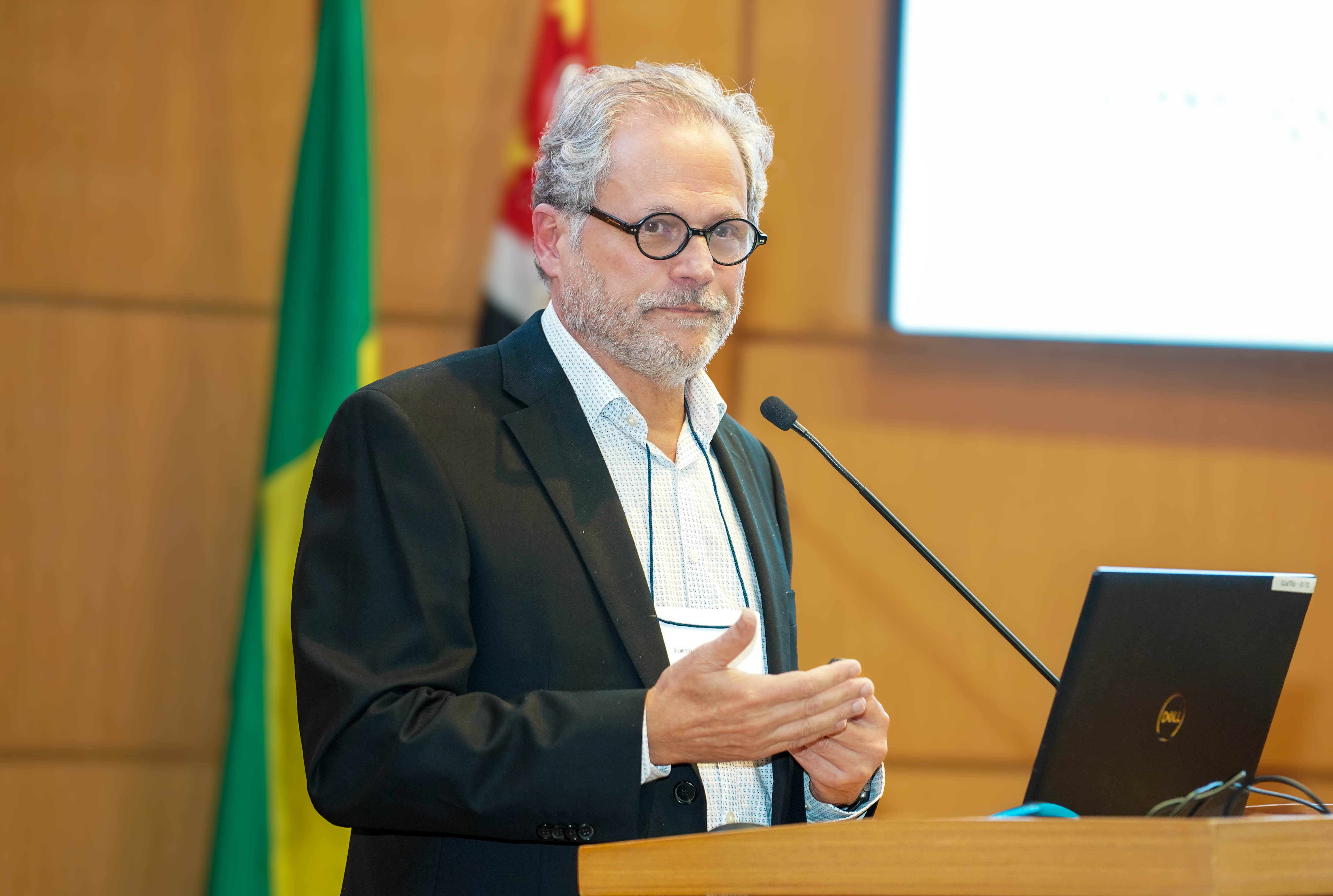
Jannuzzi: estimates indicate that the state of São Paulo can cover less than 30% of the costs outlined in its climate action plan, so it will be necessary to involve the private sector through attractive co-financing options
(photo: Daniel Antônio/Agência FAPESP)
Jannuzzi noted that São Paulo already has a Climate Action Plan (PAC 2050), which aims to reduce the state’s GHG emissions to zero by 2050. The state also has plans for climate adaptation and resilience that target the logistics, transportation, waste, and water resources sectors. However, the problem is that these plans are not yet coordinated, the researcher noted.
“The Climate Action Plan, which I helped to draft, proposed the creation of a council on climate change to help bring together elements of the logistics, transportation, and other plans, and we’re now discussing with SEMIL a second stage of PAC 2050 that incorporates elements of the climate adaptation and energy plans,” he said.
According to PAC 2050 data, the transportation sector is the largest source of GHG emissions in the state of São Paulo, accounting for 29% of total emissions inventoried in 2022, compared to 12% nationwide. Activities related to agriculture, forestry, and land use lead the national scenario with 62% of contributions but correspond to only 28% in São Paulo.
“The sources of greenhouse gas emissions in the state of São Paulo aren’t very widespread. Therefore, it’s possible to resolve this with a certain homogeneity of actions within the climate plan,” Jannuzzi said.
The good news from PAC 2050 is that the state of São Paulo can achieve neutrality in GHG emissions in the energy sector by 2050. This will require increased energy efficiency in electricity and fuel use, as well as actions such as introducing advanced fuels from biomass and using hydrogen, according to the researcher.
The main bottleneck, however, is in the agriculture, forestry, and land use sector, Jannuzzi emphasized. “Projections indicate that, in 2050, the state of São Paulo will still be a net global emitter of GHGs, due to methane emitted by cattle, in addition to carbon from agriculture itself and land use,” he said.
“With reforestation, it’s possible to reduce a portion, but it isn’t possible to eliminate emissions entirely,” he said.
Financing the energy transition
According to Jannuzzi, another weakness in promoting the energy transition in São Paulo is financing. This will be much more important than developing technologies for achieving the goals. According to PAC 2050 estimates, the public funds that the state will be able to contribute to promote the plan’s actions do not correspond to 30% of the amount needed.
“Most of the resources will have to come from the private sector. And for that to happen, we’ll need to create attractive ways to finance the state’s climate action plan. That’s already happening. There are already several very interesting schemes at the federal and international levels for co-financing climate actions,” he said.
Jannuzzi pointed out that some sources that could finance the energy transition in São Paulo and the country are oil and gas royalties, which are financial compensations paid for exploiting non-renewable natural resources, and the R&D&I clause, which is a contractual obligation requiring oil companies to invest a percentage of their gross revenue in research, development, and innovation.
“We have a fantastic ecosystem for financing energy research, development, and innovation in the state of São Paulo, in which FAPESP plays a role. We need to encourage this research to converge toward the energy transition.”
The Agency FAPESP licenses news via Creative Commons (CC-BY-NC-ND) so that they can be republished free of charge and in a simple way by other digital or printed vehicles. Agência FAPESP must be credited as the source of the content being republished and the name of the reporter (if any) must be attributed. Using the HMTL button below allows compliance with these rules, detailed in Digital Republishing Policy FAPESP.
