





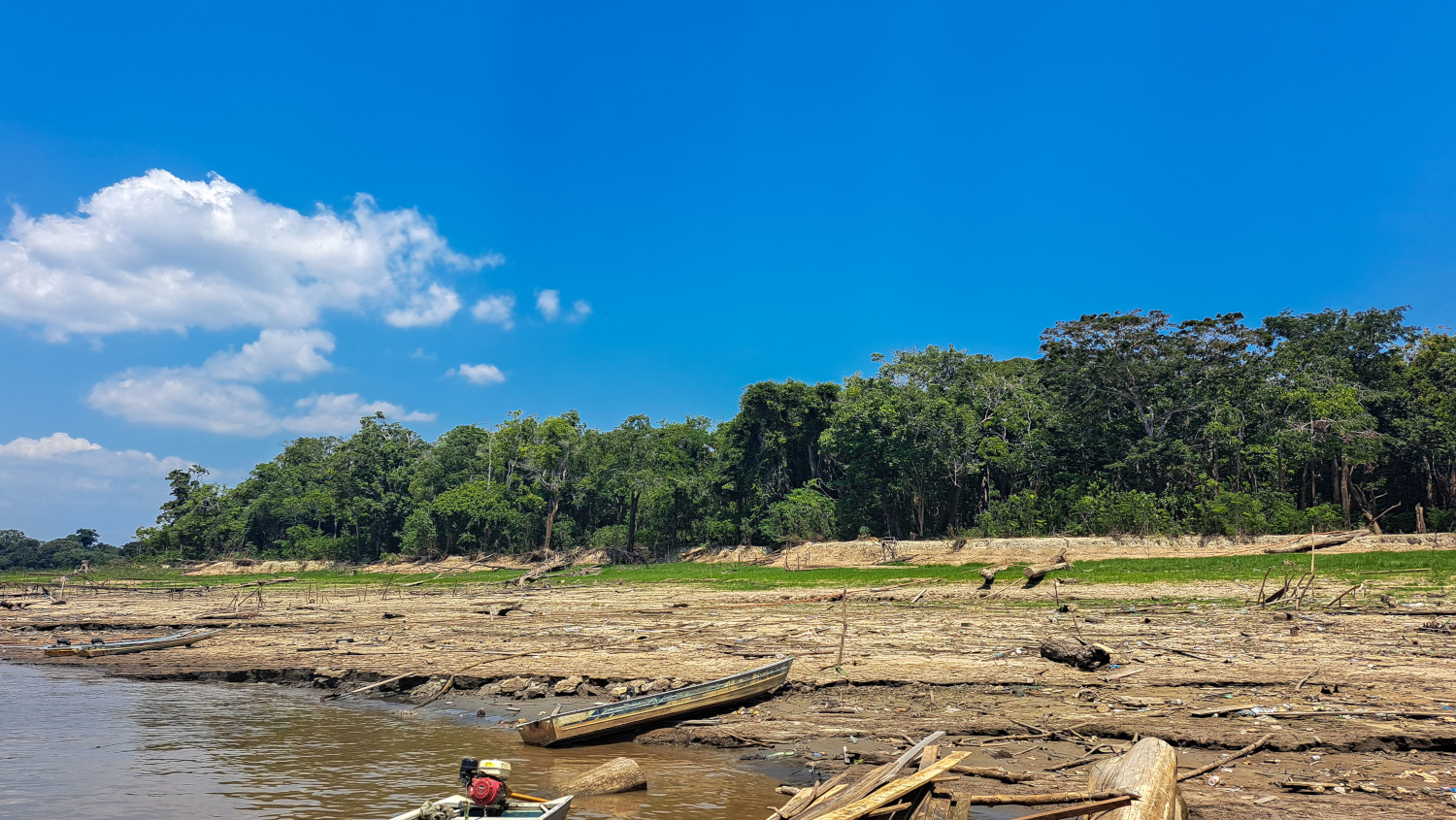
By Igor Zolnerkevic | Agência FAPESP – The historic droughts of 2023 and 2024 in the Amazon reduced river flows and altered the composition of rainfall in the region. Daily monitoring in Manaus, the capital of the Brazilian state of Amazonas, revealed this through the use of isotopes, which act as a kind of water “fingerprint.” This method demonstrated how El Niño and the warming of the North Atlantic affected the origin of moisture and the dynamics of precipitation.
Led by researchers from São Paulo State University (UNESP) in Brazil, the study suggests that isotopes can provide an early warning of prolonged droughts. This study is one of the first in over 30 years to utilize isotopic techniques in Amazonian hydroclimatic research.
Isotopes are lighter or heavier versions of atoms of the same chemical element. Water molecules (H₂O) are composed of hydrogen and oxygen atoms. Most hydrogen atoms have an atomic nucleus consisting of just one proton. However, the nuclei of a small fraction of them are twice as heavy and are composed of one proton and one neutron. Similarly, most oxygen nuclei have eight protons and eight neutrons, though some have nine or ten neutrons. Therefore, some water molecules are lighter and evaporate more easily, while heavier molecules condense first.
“The ratios between light and heavy isotopes are altered by the evaporation and condensation of water throughout the hydrological cycle,” explains Rafaela Rodrigues Gomes, a geographer and doctoral candidate at the Institute of Geosciences and Exact Sciences (IGCE) at UNESP in Rio Claro. Gomes is the first author of a paper published in June in the journal Hydrological Processes, based on her master’s thesis. Her work was supported by a scholarship from FAPESP.
Her advisor for both her master’s and doctoral degrees is the coordinator of UNESP’s Laboratory of Water Resources and Environmental Isotopes (LARHIA), geologist Didier Gastmans. “Each combination of temperature, humidity, and other meteorological variables produces differences in the isotope ratios, which can be used as a water ‘fingerprint’,” Gastmans explains.
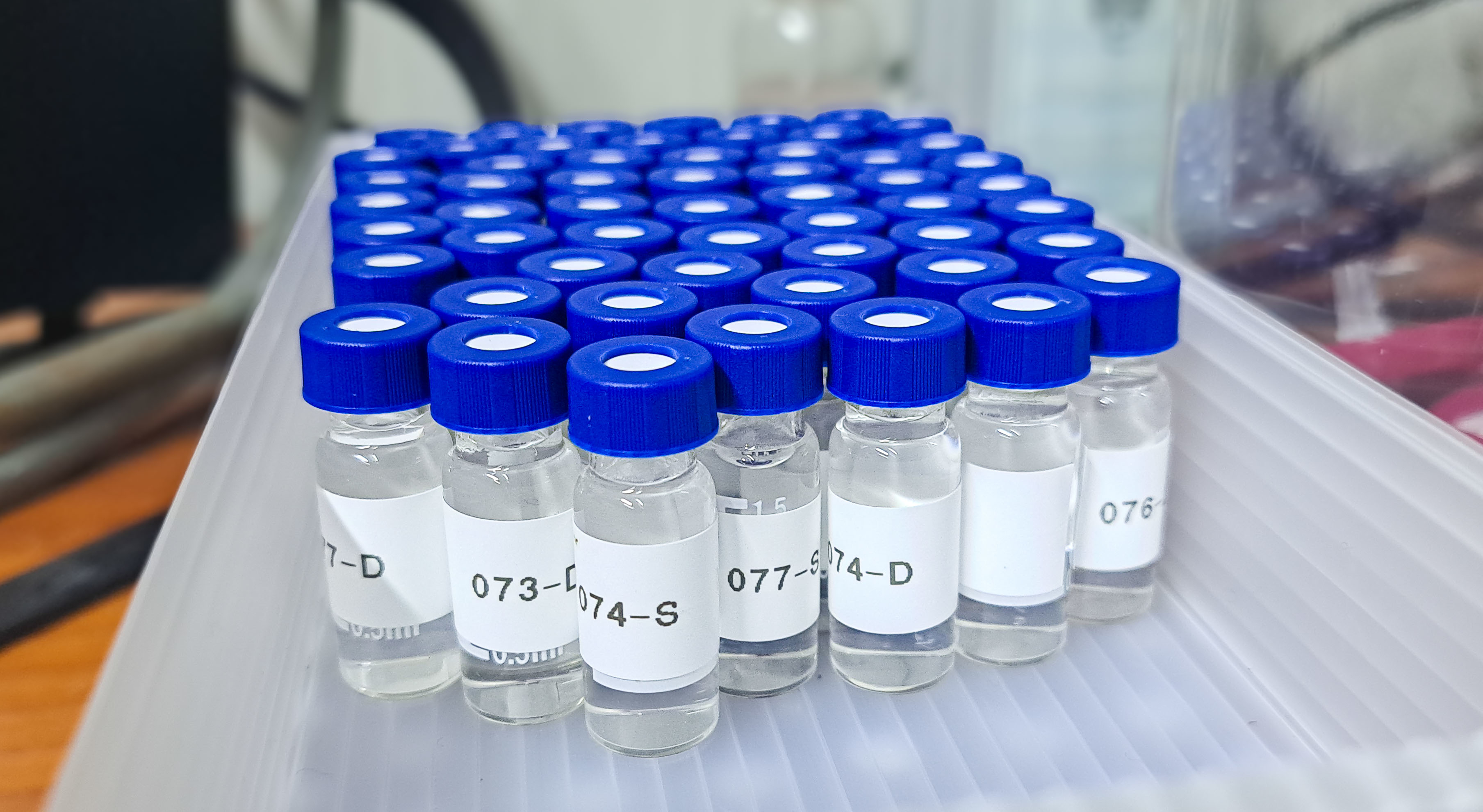
Daily rain samples stored in 2-mL vials for later laboratory analysis (photo: Rafaela Rogrigues Gomes)
A decade-long gap
Studies on the variation of rainfall isotopes in the Central Amazon began in the 1960s. These studies were primarily conducted by researchers at the Center for Nuclear Energy in Agriculture at the University of São Paulo (CENA-USP), in partnership with the International Atomic Energy Agency (IAEA). Between 1965 and 1990, monthly samples of rainwater were collected in Manaus, albeit with interruptions in some years. A lack of funding brought the program to an end.
“Only now, starting in 2020, thanks to the efforts of our group, the National Institute for Amazonian Research [INPA], the Geological Survey of Brazil [SGB], and other institutions, we’re implementing a new monitoring network in the region,” says Gastmans. Part of the network’s funding comes from a project jointly funded by the Amazonas State Research Foundation (FAEPAM) and FAPESP.
For the new study, INPA researchers collected 207 daily rain samples in Manaus between March 2023 and February 2025. The samples were divided for analysis at several laboratories: the LARHIA; the Center for Stable Isotopes at the Institute of Biosciences at UNESP, located on its Botucatu campus; and the Tracer Hydrology Group at the University of Texas at Arlington, in the United States.
To understand their relationship with atmospheric phenomena, Gomes compared the isotopic data with measurements of local weather variables obtained by a weather station installed next to the rain collector. She also cross-referenced this information with global meteorological data and models provided by the European Centre for Medium-Range Weather Forecasts (ECMWF) and the U.S. National Oceanic and Atmospheric Administration (NOAA).
What drives the rain
The researcher concluded that during the rainy months of March, April, and May, the Intertropical Convergence Zone (ITCZ) controls the isotopic ratios. The ITCZ is a broad band of clouds encircling the Earth near the equator and is responsible for 30% of the world’s precipitation. During this period, the ITCZ shifts southward, favoring moist air masses from the North Atlantic. These air masses produce successive episodes of rain along their path from the ocean to Manaus, increasing the proportion of light isotopes.
From June to August, the ITCZ retreats northward, giving way to drier weather in the Amazon. The study showed that, during this season, the proportion of heavy isotopes begins to rise again. This is controlled by another atmospheric system: the South Atlantic Subtropical High (SASH). This high-pressure system favors the influx of drier air masses, resulting in less rainfall.
In the following months, moist air masses come from both the northern and southern Atlantic. Thus, isotopic variations depend mainly on local meteorological conditions, such as rainfall volume, rather than large-scale systems. Water from less intense rainfall events contains more heavy isotopes because these are the first to precipitate. Conversely, more intense storms dilute the concentration of heavy isotopes. Additionally, the high humidity of Amazonian air reduces evaporation, which would otherwise remove light isotopes from raindrops. Meanwhile, the rapid cycle of evaporation and condensation in summer storms favors the concentration of heavy isotopes. These processes cause isotopic concentrations to vary greatly at this time of year.
“Studies from the 1970s and 1990s already suggested the influence of the ITCZ and local conditions on rain isotopes in Manaus, but with the technological limitations of the time and the monthly sampling frequency, which ends up mixing various atmospheric processes,” Gomes explains. “The innovation in our work was the daily monitoring, which allowed us to distinguish not only the effect of the ITCZ but also, for the first time, that of the ASAS.”

Rafaela Rodrigues Gomes and Didier Gastmans installing a rain collector on the ATTO experiment tower in the Uatumã Reserve, 150 kilometers from Manaus (photo: Didier Gastmans)
Anticipating droughts
Gomes compared his recent data with data collected between 1965 and 1990. He found changes in the isotopic composition, which are linked to current warmer and drier conditions. In fact, the Amazon experienced the worst heat waves and prolonged droughts on record between 2023 and 2024 since 1902.
One of the main causes of these extreme droughts was the above-average warming of surface waters in the Pacific Ocean, known as El Niño. This natural phenomenon occurs on average every two to seven years, altering wind and rainfall patterns in various regions of the planet. Its intensity varies, but global warming has increased the frequency of extreme events.
In the Central Amazon, El Niño increases the tendency for moist air to sink, hindering cloud formation. In 2023 and 2024, this effect combined with abnormal warming in the North Atlantic, which shifts the ITCZ northward and reduces the inflow of moisture into the region.
“We also observed, even during the rainy season, an early appearance of the isotopic signature typical of the dry season,” says Gomes. In warmer, drier conditions, raindrops evaporate more readily, concentrating heavier isotopes. In 2024, when a drought worse than the previous year’s occurred, this signal appeared in May, despite historically appearing only in June. “This finding reinforces the potential of stable isotopes as early warning indicators for prolonged droughts, especially in the context of climate change,” the researchers wrote in their article.
“It could be another easy-to-obtain, relatively low-cost early warning indicator,” says Gastmans. However, he emphasizes the need for further observations to confirm the recurrence of the signal. “When it comes to the hydrological cycle, we need long time series spanning 20 or 30 years.”
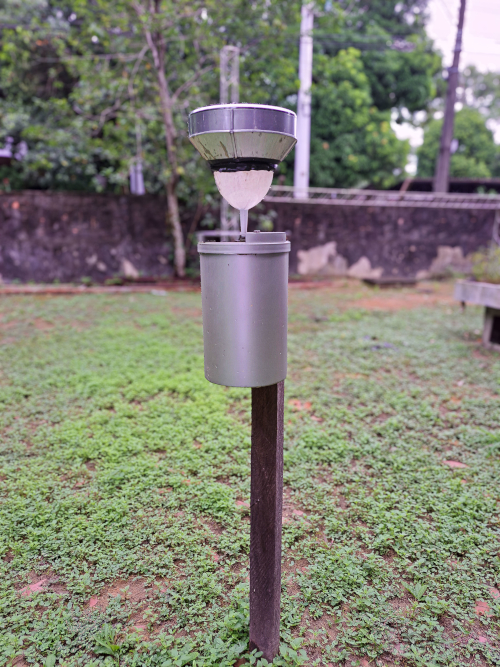
Rain collector installed at the National Institute for Amazonian Research (INPA) (photo: Rafaela Rogrigues Gomes)
In his doctoral research, which began in February and is funded by the Coordination for the Improvement of Higher Education Personnel (CAPES), Gomes plans to expand his study of the influence of the ITCZ and other atmospheric processes on isotopes beyond Manaus. He is collecting rain samples at 19 stations throughout the Amazon and neighboring regions. One objective is to better understand the origins of water vapor from the Atlantic that reaches the Amazon, recirculates through the forest several times, encounters the Andes mountain range, and continues to the country’s Central-West, Southeast, and South regions. This contributes a considerable portion of their rainfall and is known as “flying rivers” (read more at revistapesquisa.fapesp.br/en/rain-dance/).
The article “Large-scale and local atmospheric controls on rainfall isotopic variability in an urban area of the Central Amazon” can be found at onlinelibrary.wiley.com/doi/abs/10.1002/hyp.70606.
Republish
The Agency FAPESP licenses news via Creative Commons (CC-BY-NC-ND) so that they can be republished free of charge and in a simple way by other digital or printed vehicles. Agência FAPESP must be credited as the source of the content being republished and the name of the reporter (if any) must be attributed. Using the HMTL button below allows compliance with these rules, detailed in Digital Republishing Policy FAPESP.
