





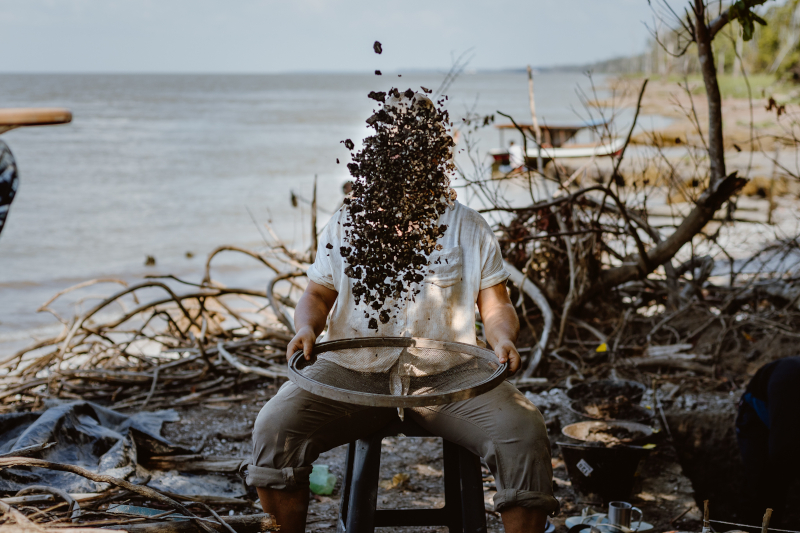
By Elton Alisson | Agência FAPESP – In recent years, monuments made of shells and earth, built by indigenous hunter-gatherer and fishing populations thousands of years ago, have been identified in the Amazon. By excavating and studying these sites, known as sambaquis, Brazilian and French researchers have discovered evidence of changes in biodiversity and dietary practices among the peoples who inhabited the forest.
Some initial findings from the Franco-Brazilian archaeological mission, led by researchers from the National Museum of Natural History (MNHN) in Paris, France, were presented at the Brazil-France Forum, “Forests, Biodiversity, and Human Societies,” held October 1–2, 2025, at the FAPESP auditorium.
The MNHN organized the event in partnership with the University of São Paulo (USP) and FAPESP to discuss forest biodiversity, ecosystems, and their relationships with human societies, both past and present.
“Typically, sambaquis are sites of memory that were visited, rebuilt, and reoccupied over thousands of years, starting about 3,000 years ago. That long duration of occupation allows us to study the transformations in the biodiversity and dietary practices of the indigenous peoples who lived in their vicinity over time,” Gabriela Prestes Carneiro, a researcher at the MNHN and project coordinator, told Agência FAPESP. The archaeologist is one of the researchers associated with an FAPESP-funded project on indigenous peoples and the environment in the ancient Amazon. The project revealed that the biome was densely populated in the past, and human activity shaped the forest that exists today (read more at agencia.fapesp.br/39627).

Gabriela Prestes Carneiro, a researcher at the National Museum of Natural History in France, during the Brazil-France Forum at FAPESP: Sambaquis are sites of memory that were visited, rebuilt, and reoccupied starting about 3,000 years ago (photo: Daniel Antônio/Agência FAPESP)
According to Carneiro, Brazil’s best-known sambaquis are predominantly located in coastal areas, especially in the South and Southeast. However, they are also found in other regions of the country, such as the Ribeira Valley in southern São Paulo state and eastern Paraná state, as well as in other parts of the world.
Recently, sambaquis have been identified in the Amazon region, including the Salgado coast at the mouth of the Amazon River and the southwest of the state of Amazonas, as well as the Lower Amazon – the lowest portion of the river in the region bordering the state of Pará.
With initial support from the Serrapilheira Institute and current support from the Ministry for Europe and Foreign Affairs (the body responsible for France’s foreign relations), Carneiro and a group of Brazilian researchers began studying sambaquis at the Munguba archaeological site. This site is located in a floodplain area between the Tapajós and Xingu rivers.
“That archaeological site was discovered by a fisherman, and since 2022, we’ve begun establishing contact with the families living in the surrounding area. The earliest sambaquis date back about 3,500 years, and it’s still unclear what their functions were. Some are cemeteries, and others are dwelling sites,” said Carneiro.
The dimensions of the sambaquis in the Lower Amazon are also quite distinct. Some are just a few centimeters above the water level, while others are one or two meters, the researcher described.
“We don’t know these sites very well, but what we do know from the initial dating is that they were continuously occupied over time and were built primarily from shells. The shells were likely a food source, but they were also used as a building material for these monuments,” Carneiro stated.
Reconstruction of the microfauna
As the shells that make up the sambaquis degrade over time, they release calcium carbonate. This chemical compound, commonly known as calcite, preserves the organic remains of animals and plants that were also present at the archaeological site, the researcher explained.
“That enables us to study seeds, grains, fish scales, and the remains of amphibians, snakes, mammals, bats, and rodents found in the sediments. Analyzing that microfauna at the archaeological site gives us an idea of how the environment has changed over time,” said Carneiro.
The researchers have identified some traces of foods consumed in the past in the sambaquis of the Lower Amazon, including various species of mollusks that are no longer consumed today. One of these species is the uruá (Sultana sultana), which traditional populations consumed after chopping and cooking it, and using it to make flour.
“We identified several species of mollusks, many of which aren’t consumed today. But when we talked with traditional populations in the Lower Amazon region, many of them still remembered those species,” said Carneiro.
The researchers also found the jawbone and vertebrae of a manatee (Trichechus spp.) for the first time at an archaeological site, although reports of manatee meat consumption in the region are quite recent.
Other animal remains found by the researchers included the stone catfish (Oxydoras niger) and the tamoatá (Hoplosternum littorale), two species of fish. These fish species share the common trait of having many bones.
“Today, we rarely find these species in the fish markets of the region, but they’re very common at archaeological sites,” said Carneiro.
Reintroduction of dietary practices
According to the archaeologist, who is responsible for the fish collection at the MNHN, many of the dietary practices of traditional Amazonian peoples have changed due to social and environmental changes. For example, fish has been replaced by frozen chicken and processed foods.
Using data from archaeological studies, such as one conducted in the Lower Amazon, researchers from other fields, such as ethnobiology (the study of relationships between people and biota) and nutrition, have developed projects to promote reintroducing plants consumed in the past into school lunches in public schools in the municipality of Tefé in Amazonas, for example.
“We can use this data to reintroduce not only foods, but also dietary practices from the past,” she noted.
However, the researchers are racing against time because the archaeological sites where they conduct excavations are threatened by cargo ships carrying mainly soybeans that pass very close to the riverbanks where the sambaquis are located.
“The passage of these ships also ends up destroying the equipment of riverine fishermen who set their traps near these archaeological sites,” the researcher explained.
Republish
The Agency FAPESP licenses news via Creative Commons (CC-BY-NC-ND) so that they can be republished free of charge and in a simple way by other digital or printed vehicles. Agência FAPESP must be credited as the source of the content being republished and the name of the reporter (if any) must be attributed. Using the HMTL button below allows compliance with these rules, detailed in Digital Republishing Policy FAPESP.
