





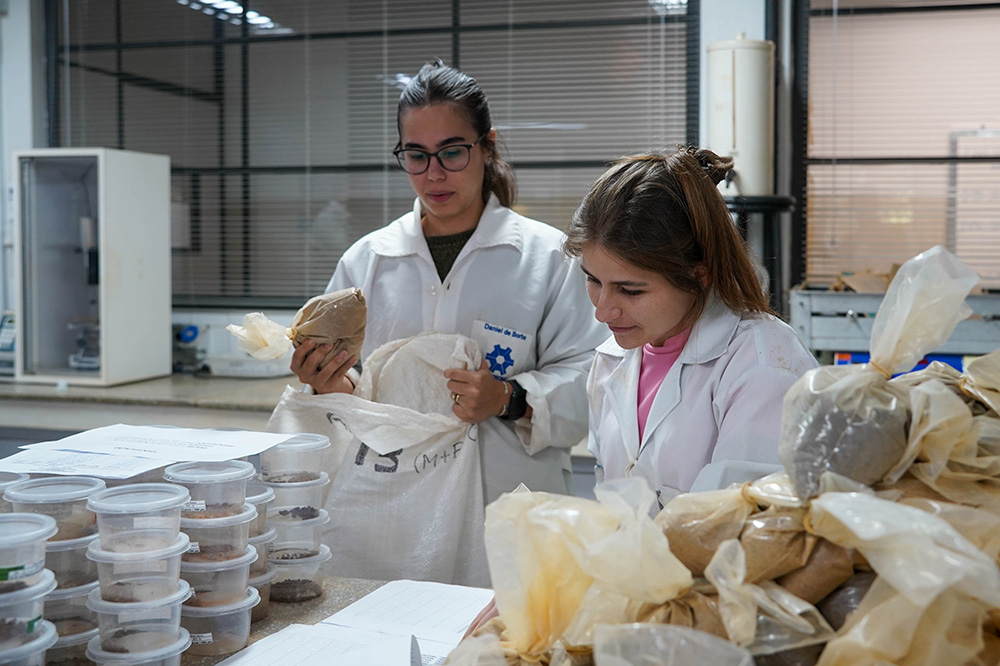
By Elton Alisson | Agência FAPESP – Over the next few months, researchers from various Brazilian universities and research institutions will travel across the country to collect soil and vegetation samples from around 6,500 locations. The team aims to quantify the carbon stocks of all Brazilian biomes – the Amazon, Cerrado, Caatinga, Atlantic Forest, Pantanal, and Pampa – for the first time by analyzing these materials.
The goal is to create a public database that will establish a baseline for soil and vegetation carbon across the entire country. Using inventories backed by robust and reliable data, it will be possible to better position the country in the carbon market. Additionally, the initiative will enable more precise evaluations of soil carbon losses due to land use conversion and reforestation project gains, according to the creators of the initiative.
The project, entitled “Carbon Countdown,” will be conducted under the auspices of the Center for Carbon Research in Tropical Agriculture (CCARBON), a Research, Innovation, and Dissemination Center (RIDC) funded by FAPESP. It will be carried out in partnership with Shell and Petrobras.
The project will receive approximately BRL 100 million in investments made possible by the Research, Development, and Innovation (R&D&I) Clause of the National Agency of Petroleum, Natural Gas, and Biofuels (ANP). This contractual obligation requires oil companies operating high-volume production fields to invest 1% of their gross revenue in research, technology, and innovation projects within the sector.
“Carbon Countdown is one of the largest projects ever conducted at the University of São Paulo [USP] and one of the largest initiatives on this topic in the world today. The goal is to fill the gap in primary data and provide field-based evidence to support the country’s carbon market and science-based energy transition policies,” Maurício Cherubin, deputy director of CCARBON and one of the coordinators of the project, tells Agência FAPESP.
Continental logistics
To meet the challenge of covering a territory the size of a continent, Carbon Countdown will operate through central coordination linked to various regional hubs. This strategy involves forming partnerships with universities, federal institutes, and a unit of the Brazilian Agricultural Research Corporation (EMBRAPA) to empower local researchers who understand the complexities of each biome.
“We’ve established partnerships to build a team of local researchers in each biome, which is essential for carrying out the activities. It would be impossible to gain an accurate understanding of the country as a whole while based solely in Piracicaba [where ESALQ-USP is located],” says Cherubin.
In the first phase, the researchers will develop specific protocols to establish the work strategy for each biome. This phase is crucial since each biome has unique characteristics regarding topography, temperature, vegetation, and soil type.
“We’ll consider these local variations and different land uses to define sampling points that truly represent the biomes,” the coordinator explains. “Brazil is also characterized by different soil types, all of which need to be represented in the database.”
IPCC-grade methodology
At the heart of the project is the collection of primary data in the field, which is expected to yield 250,000 soil samples for carbon quantification and over 400,000 samples to determine indicators of density, texture, and chemical properties. Additionally, the researchers estimate that tens of thousands of vegetation samples will be collected to determine biomass and carbon content, as well as to identify species.
After collection, the soil samples will be sent to regional laboratories for processing, which includes grinding and drying. Then, the samples will be analyzed using a dry combustion elemental analyzer to determine carbon content, which is the central focus of the project.
In this equipment, soil and vegetation samples are incinerated at temperatures exceeding 1,000 °C. In this process, all organic elements in the material are converted into CO₂ and quantified.
Cross-referencing these measurements with climate, topography, and vegetation variables from the sampling sites and using modeling systems and machine learning techniques makes it possible to extrapolate the measurements and estimate carbon stocks across large areas. “This methodology strictly follows the standard set by the IPCC [Intergovernmental Panel on Climate Change],” Cherubin emphasizes.
In addition to traditional methods, the project will test cutting-edge technologies. Spectroscopic analyses will be employed for the soil, and LiDAR (Light Detection and Ranging) technology will be used for vegetation. LiDAR is a remote sensing system that uses laser pulses to create precise 3D maps.
“The sensor generates a three-dimensional ‘point cloud,’ which allows us to obtain a precise estimate of forest biomass volume,” Cherubin explains. In the future, the researchers intend to use the generated database to validate technologies developed by Brazilian startups that have not yet gained international recognition.
“Our idea is to eventually provide startups with a dataset obtained through the project so they can test and verify how their technology for soil and vegetation carbon analysis performs,” he says.
Carbon market
According to the researcher, establishing a carbon baseline for soil and vegetation is the most costly aspect of projects aimed at building carbon credit markets.
This baseline will make it easier to monitor, verify, and report carbon information with a higher level of confidence. Additionally, it will reduce the cost of future assessments.
“We also hope that this baseline will be useful for mapping regions with the greatest carbon sequestration potential in the country,” Cherubin notes.
Republish
The Agency FAPESP licenses news via Creative Commons (CC-BY-NC-ND) so that they can be republished free of charge and in a simple way by other digital or printed vehicles. Agência FAPESP must be credited as the source of the content being republished and the name of the reporter (if any) must be attributed. Using the HMTL button below allows compliance with these rules, detailed in Digital Republishing Policy FAPESP.
