





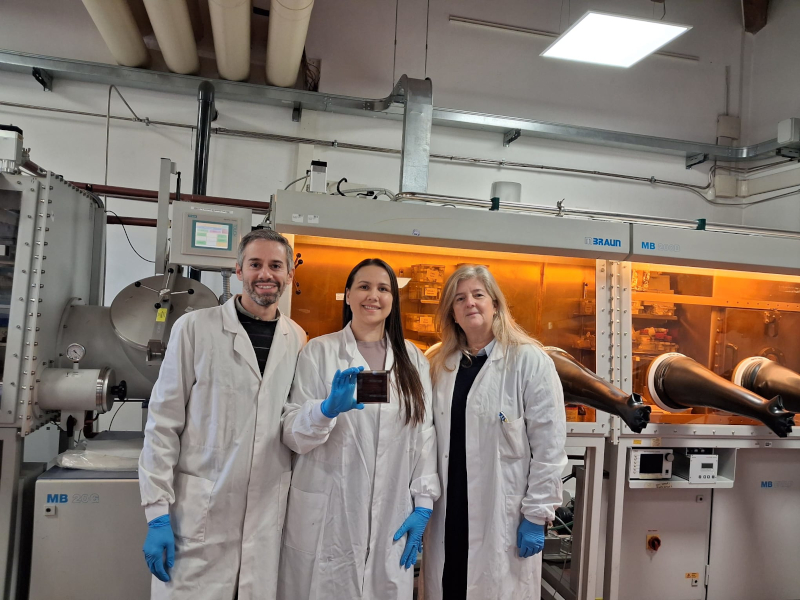
Agência FAPESP* – In collaboration with scientists from Italy, researchers at the Center for Innovation in New Energies (CINE) in Brazil have developed perovskite solar cells that demonstrate excellent performance in converting artificial light into electricity in indoor environments. These devices could provide clean, renewable energy for appliances in homes, businesses, and industries without the need for batteries.
CINE is an Applied Research Center (ARC) established by FAPESP and Shell in 2018. It is headquartered at the State University of Campinas (UNICAMP), the University of São Paulo (USP), and the Federal University of São Carlos (UFSCar), with eight other Brazilian institutions participating.
The indoor photovoltaics market was estimated at approximately USD 1.2 trillion in 2023. However, indoor environments with low light levels pose a challenge to conventional photovoltaic technologies because they result in a sharp drop in device efficiency.
In this study, published in the scientific journal Nano Energy, the authors addressed this issue by developing an innovative surface treatment for the main layer of solar cells composed of a perovskite material. “Under indoor lighting conditions (1,000 lux, 500 lux, and 200 lux), our treatment substantially reduces interfacial trap states, enabling performance of around 34% for low-bandgap perovskite modules,” says Francineide Lopes de Araújo, a postdoctoral researcher at CINE with a fellowship from FAPESP and lead author of the study. “This performance ranks among the highest efficiency records reported in the literature.”
The treatment consists of depositing a mixture of the organic salt PEAI and the additive DIO onto the perovskite layer. As a result, a two-dimensional layer of perovskite spontaneously forms over the three-dimensional perovskite, neutralizing its surface defects and improving its performance. “The PEAI:DIO mixture improves defect passivation, optimizes interfacial dipole alignment, and enhances charge transport. For this reason, it was possible to obtain high-performance devices,” explains Araújo. One advantage of the process is that it does not require thermal treatment and therefore occurs at room temperature.
The authors of the study used this approach to fabricate devices on different scales, including small-area solar cells and modules up to 121 cm² in size consisting of up to 15 subcells connected in series.
“The strategy demonstrates strong competitive potential compared to other methodologies for producing perovskite solar cells and modules, especially in terms of manufacturing simplicity and low cost impact,” says the researcher, who conducted the work under the supervision of Ana Flávia Nogueira of UNICAMP and Aldo Di Carlo, founder and researcher at the Center for Hybrid and Organic Solar Energy (CHOSE) at Tor Vergata University of Rome in Italy.
CHOSE is one of the world’s leading research centers for perovskite photovoltaic devices and has complete infrastructure for fabricating and characterizing cells, modules, and panels.
The collaboration took place while Araújo was completing a postdoctoral research internship in Rome between 2022 and 2023 with a fellowship from FAPESP. According to Araújo, the center’s infrastructure was essential for conducting advanced experiments and validating the developed devices.
The research results reinforce the applicability of perovskite-based photovoltaic technology by enabling its use in low-power electronic devices for indoor environments. “The technological advances achieved in this work contribute to making perovskite solar cells more viable for commercial-scale application,” Araújo concludes.
The article “Empowering perovskite modules for solar and indoor lighting applications by 1,8-diiodooctane/phenethylammonium iodide 2D perovskite passivation strategy” can be read at sciencedirect.com/science/article/pii/S221128552500638X.
* With information from Verónica Savignano from CINE
Republish
The Agency FAPESP licenses news via Creative Commons (CC-BY-NC-ND) so that they can be republished free of charge and in a simple way by other digital or printed vehicles. Agência FAPESP must be credited as the source of the content being republished and the name of the reporter (if any) must be attributed. Using the HMTL button below allows compliance with these rules, detailed in Digital Republishing Policy FAPESP.
