





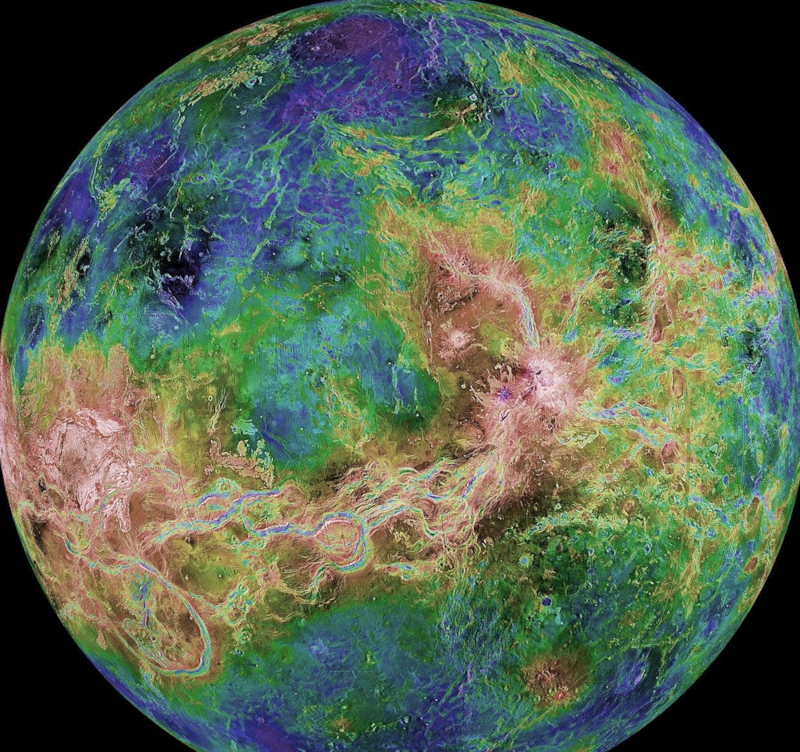
By José Tadeu Arantes | Agência FAPESP – Brazilian scientists may have finally discovered why Venus rotates in the opposite direction from Earth, a phenomenon known as retrograde rotation. According to a study conducted by researchers at the Institute of Astronomy, Geophysics, and Atmospheric Sciences at the University of São Paulo (IAG-USP) in Brazil, the cause may be a combination of gravitational and atmospheric factors inherent to the planet itself, without the need for collisions between celestial bodies or other external catastrophic events.
Most planets in the solar system, including Earth, rotate from west to east around their own axis. However, Venus and Uranus rotate from east to west, and the origin of this retrograde rotation has never been satisfactorily explained. The IAG-USP study shows that, in the case of Venus, a rocky planet, the reversal of the direction of rotation can naturally arise from the interaction between gravitational tides and thermal effects in the atmosphere.
“It was a serendipitous discovery. I wasn’t working on that topic. My focus is on tidal effects on exoplanets. But while studying the problem, motivated by questions in my area of interest, I realized there was a key point regarding the dynamics of Venus that had gone unnoticed,” says Sylvio Ferraz Mello, a professor at IAG-USP and lead author of the study. It was published in The Astronomical Journal and supported by FAPESP.
In the early 1960s, Venus’s rotation was determined when radar observations managed to penetrate its thick cloud cover. More recent measurements indicate a period of approximately 243 days in the opposite direction of the planet’s orbit. It has since been known that this state results from the balance between two opposing physical mechanisms. Gravitational tides, generated mainly by the Sun’s gravitational pull, tend to slow the planet’s rotation and synchronize it with its orbital motion. Conversely, Venus’s extremely dense atmosphere – about 90 times more massive than Earth’s – is heated unevenly by solar radiation. This produces thermal deformations that generate an atmospheric torque capable of accelerating rotation in the opposite direction of the tides. “The Sun’s gravitational pull on the planet’s solid part and on the atmosphere acts in opposite directions. One tends to slow the rotation; the other accelerates it in the opposite direction. Ultimately, the atmosphere prevails,” Ferraz Mello explains.
This competition between the two mechanisms explains why Venus rotates backward today. However, this does not answer a fundamental question: How did the planet reach this state?
The study shows that the atmosphere not only maintains the planet’s retrograde rotation, but is also essential to its existence. Simulations indicate that, without its atmosphere, the isolated action of gravitational tides would cause Venus to revert to prograde rotation in less than one million years. In this scenario, the planet would synchronize with its orbital period, or the time it takes to complete a full orbit around another celestial body, as is the case with the Moon relative to Earth. “If the reversal were caused by a sudden event, such as a collision, the planet would eventually start rotating in the correct direction again. Therefore, it can’t be an instantaneous effect; it must be a continuous process,” Ferraz Mello argues. This means that retrograde rotation is not a robust state in and of itself; it depends on the continuous presence and properties of the atmosphere.
To understand the origin of this behavior, the study analyzes the equations describing the evolution of rotation under the combined action of the two torques. The result reveals a structure typical of dynamical systems: a pitchfork bifurcation. Without a significant atmosphere, the system has a single stable state: synchronous rotation, when the time it takes a celestial body to complete one rotation around its own axis is exactly equal to the time it takes to complete one orbit around another body. As atmospheric influence increases, the system loses stability and splits into two new stable states, both of which are asynchronous: one with rotation slower than the orbit (subsynchronous), and the other with rotation faster than the orbit (supersynchronous). One of these states can evolve into retrograde rotation. “There’s a point at which the system bifurcates: either the planet begins to spin faster or slower. Both possibilities exist. In the case of Venus, it followed the slower path until it reversed direction,” the researcher summarizes.
The model enables us to reconstruct a potential evolutionary scenario for Venus. Initially, the planet, with its poorly developed atmosphere, was mainly subject to gravitational tides and evolved toward synchronization. “At first, Venus must have rotated like Earth, with the sun rising in the east and setting in the west. The tides gradually slowed that rotation until it reached a synchronous state,” Ferraz Mello explains. Over time, outgassing from the planet’s interior – the process by which gases are released to the surface – led to the formation of a dense atmosphere. This increased atmospheric torque progressively until the system reached a bifurcation point. From that point on, the rotation could have evolved into one of two possible states with comparable probabilities. Depending on the conditions at the time of the transition, the planet moved toward a retrograde regime. “It’s a simple process from a physical standpoint. The theory doesn’t require exceptional conditions – it’s a natural consequence of planetary evolution,” the researcher comments.
The study also shows that Venus’s current state may be close to a stability threshold. Small variations in parameters such as surface temperature or atmospheric properties tend to alter the balance between torques. Under certain conditions, the system would lose stable steady states, resulting in continuous rotation changes. Available observations are not yet precise enough to rule out the possibility of slow changes in the rotation period.
From catastrophic to predictable
One of the most significant findings of this study is its potential applicability to other planetary systems. The model suggests that a reversal in the direction of rotation is not rare or exceptional. Rocky planets located in the habitable zone of Sun-like stars – a region where temperatures allow for liquid water to exist – can develop dense enough atmospheres to generate torques comparable to those of Venus. In such cases, the same dynamics can lead to retrograde rotation. “It isn’t a rare phenomenon. That type of evolution may have occurred many times on the exoplanets we know of,” Ferraz Mello notes. Exoplanets are planets that orbit stars outside of our solar system.
By replacing catastrophic scenarios with a continuous and predictable mechanism, the study offers a new perspective on the evolution of planetary rotation. It does more than explain a particular case; it points to a behavior that may be common throughout the universe and broadens the theoretical framework needed to interpret the diversity of already-observed planets.
The study received support from FAPESP through the project “Brazil in Space: Astrophysics and Engineering”, which is coordinated by Eduardo Janot Pacheco and has Ferraz Mello as one of the principal investigators.
The article “Exoplanet synchronization in the habitable zone: Learning from Venus’ retrograde rotation” can be read at iopscience.iop.org/article/10.3847/1538-3881/ae43e4.
Republish
The Agency FAPESP licenses news via Creative Commons (CC-BY-NC-ND) so that they can be republished free of charge and in a simple way by other digital or printed vehicles. Agência FAPESP must be credited as the source of the content being republished and the name of the reporter (if any) must be attributed. Using the HMTL button below allows compliance with these rules, detailed in Digital Republishing Policy FAPESP.
