






By José Tadeu Arantes | Agência FAPESP – For the first time in Brazil, researchers at the São Carlos Institute of Physics at the University of São Paulo (IFSC-USP) have succeeded in trapping cold ions using only electric fields to confine electrically charged atoms within a very small region of space. The experiment, which was conducted with strontium ions, is an initial step toward developing one of the main platforms used in quantum computing in Brazil.
Amilson Rogelso Fritsch, a Young Investigator supported by FAPESP as part of the QuTIa Program – which stands for Quantum Technologies Initiative – led the experiment. The results were obtained just 18 months after the project began.
“Since ions have an electric charge, they can be pulled or pushed by electric fields. Our trap generates forces capable of preventing them from escaping in any direction. That was achieved using an electric field that oscillates at approximately 18 megahertz – that is, 18 million times per second. The oscillation is so rapid that the ions simply can’t keep up with the successive changes in the field. The net effect of those forces keeps the particles confined and aligned along the central axis of the trap,” Fritsch explains.
The system is called the “Paul trap.” It is named after the German physicist Wolfgang Paul (1913–1993), who should not be confused with the Austrian physicist Wolfgang Pauli (1900–1958), one of the pioneers of quantum theory. In the 1950s, Paul developed the technique of confining charged particles using oscillating electric fields. For this work, he was awarded the Nobel Prize in Physics in 1989.
Another strategy also used for trapping ions is the “Penning trap,” which has been used by Claudio Lenz Cesar's group at the Federal University of Rio de Janeiro (UFRJ). Unlike the Paul trap, the Penning trap relies on a static electric field combined with a magnetic field rather than oscillating electric fields.
“Our experiment, based on the Paul trap, begins with neutral strontium atoms, from each of which an electron is stripped away using laser beams, producing positive ions. These are placed in an ultra-high-vacuum chamber. This is essential because collisions with air molecules could eject them from the trap or disrupt the delicate quantum states we aim to control. The electrodes that form the trap are located inside the chamber, although the entire system operates at room temperature,” Fritsch explains.
The trap was built entirely in Brazil and installed in a laboratory at IFSC-USP. The goal is to progress from capturing ions to manipulating them as quantum bits, or qubits, and perform the first quantum processing operations within the next few months. “Now, with the successful trapping of ions, Brazilian research is on the map. That’s one of the hardware components needed for the development of quantum computing,” enthuses physicist Vanderlei Bagnato, a full professor at IFSC-USP and coordinator of the Center for Research in Optics and Photonics (CePOF), which until June was a Research, Innovation, and Dissemination Center (RIDC) supported by FAPESP.
Quantum computing can be implemented using different physical platforms. The most advanced are superconducting circuits and trapped ions. In the latter case, the ionized atom itself serves as the physical carrier of information. The well-defined internal states of the ion can represent the values 0 and 1, as well as the possible superpositions of these two states, thanks to the properties of quantum mechanics. Multiple ions can also be entangled, enabling operations that have no direct equivalent in conventional computers.
Entanglement causes two or more qubits to share a single quantum state such that operations performed on one qubit alter the configuration of the entire set of qubits. This feature can be used to build logic gates, which are fundamental elements in any computational process.
“That superior capability doesn’t mean that quantum computers will simply replace current ones or be faster for every task. Their great potential lies in certain classes of problems for which phenomena such as superposition and entanglement can be computationally exploited. A particularly important example is simulating atoms and molecules, which has potential applications in developing new materials and drugs,” Bagnato explains.
However, to reach this point, we must first solve an elementary problem: keeping a single atom stationary and isolated long enough to write, process, and read information on it. “If it isn’t kept that way, there’s no way to use it as a unit for storing and processing information,” Bagnato summarizes.
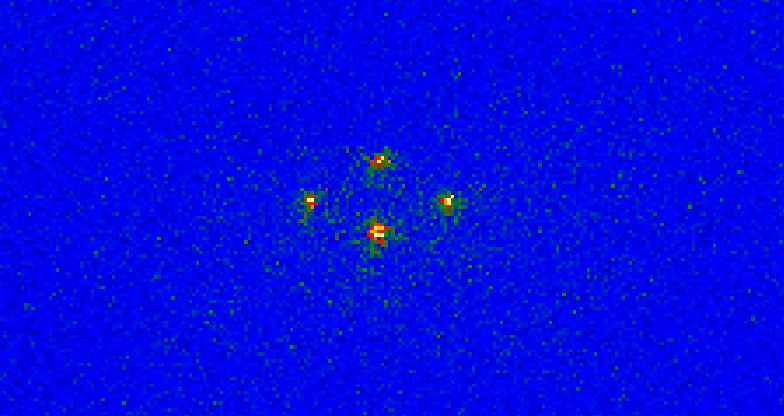
Actual image of the trapped ions (photo: Amilson Rogelso Fritsch)
A cage made of electric fields
The Brazilian team successfully accomplished this step with their version of the Paul trap. In the transverse direction, ions are confined by an electric field that oscillates at a high frequency. Since the field changes direction quickly, the ions cannot follow it and escape; their average motion is restricted to the central region of the trap. Another static electric field comes into play in the longitudinal, or axial, direction, preventing the particles from escaping through the ends. When several ions are captured, this confinement keeps them in the central region while their positive charges cause them to repel one another. The result is a small chain of aligned ions separated by just a few micrometers.
“In the images we obtained, each bright spot corresponds to a single trapped strontium ion. What we see isn’t a graphical representation of the experiment, but actual ions,” Fritsch notes. He adds that the number of particles can be controlled depending on the experiment. “For certain applications, it’s advantageous to work with a single ion. For quantum computing, chains consisting of several ions can be formed. Since the ions repel each other electrically and remain isolated, it’s possible to manipulate each one separately with laser beams, performing operations on specific ions without directly affecting the others.”
With this level of control, a trapped particle can function as an information-processing unit. “In a simplified description, two internal states of the ion represent the values 0 and 1; the ground state corresponds to 0 and an excited state to 1. A laser with a precisely tuned frequency enables transition between the two. If it were only possible to set each ion to 0 or 1, there would be nothing specifically quantum about this from a computational standpoint. The breakthrough occurs because the laser also allows the ion to be prepared in a superposition of the two states," Fritsch explains.
A common way to explain the difference between classical and quantum computing in popular science articles is to compare a classical bit to a coin that has landed on a table, showing either heads or tails. The qubit, however, is more like a spinning, wobbling coin before it lands. The caveat is that quantum superposition does not simply correspond to a definite state that we do not yet know. Its state simultaneously contains components corresponding to 0 and 1, in proportions that determine the probability of each outcome.
However, when a measurement is made, one never obtains a mixture of the two; the result is always 0 or 1. According to the conventional description of quantum mechanics, the superposition “collapses” into one of these two states at the moment of measurement. If the same state is prepared and measured many times, 0 or 1 will sometimes be obtained. The frequency with which each result appears allows us to determine the probabilities that characterized the superposition before the measurement. For example, if a given state has a 70% probability of yielding a 0 and a 30% probability of yielding a 1, a single measurement will produce only a 0 or a 1. However, by preparing and measuring the same state a thousand times, we would expect to obtain approximately 700 0s and 300 1s.
With multiple qubits, another essential property comes into play: entanglement, which creates quantum correlations between them. This allows the computer to stop treating each qubit as an independent unit and begin operating on the set as a single quantum system. Superposition causes this system to contain several possible combinations of 0 and 1, and entanglement establishes relationships between these combinations so that they no longer vary independently of one another. The algorithm manipulates these correlated possibilities, causing their quantum amplitudes to interfere. Some amplitudes reinforce each other, while others cancel each other out. The calculation is designed so that, ultimately, it increases the probability of obtaining the desired information and decreases the probability of obtaining other results. When the system is measured, the superposition collapses, yielding a result. For certain problems, this method of organizing and filtering possibilities provides a significant advantage over classical computing.
However, before that...
The ions must be cooled to extremely low temperatures. In the system developed at IFSC-USP, lasers reduce the motion of the ions to levels corresponding to temperatures below one millikelvin – that is, near absolute zero. “What’s more important than the temperature itself,” Fritsch notes, “is bringing the motion of the ions very close to their fundamental quantum state. That allows the laser pulses used to write and manipulate information to act in a controlled manner without the thermal motion of the particles disrupting the process.”
Strontium is particularly suitable because it exhibits different electronic transitions that are useful for these tasks. A relatively broad transition enables the ions to absorb and re-emit many photons, an important property for cooling and detection. Another transition, which is extremely narrow, can function as a kind of memory because the excited state persists long enough for the information to be manipulated and subsequently read.
All of this control is achieved using focused lasers, a well-established technology at CePOF. Since the ions in a chain are separated by a few micrometers, it is possible to direct a beam at one of them without performing the same operation on its neighbors. Pulses of controlled duration change the quantum state of each particle, and more elaborate sequences allow for the creation of superpositions and subsequently, the entanglement of the qubits.
A missing skill
The result also has a scientific capacity-building dimension. Brazil has already accumulated considerable experience in related areas, such as cooling and trapping neutral atoms. However, according to Bagnato, the country still needs to develop the capability to conduct experiments with trapped ions for this specific application.
The existing infrastructure at CePOF was crucial for accelerating the work. The São Carlos group has extensive experience in cooling atoms and possesses the necessary equipment and expertise in optics, lasers, and vacuum systems for working with ions. “The infrastructure the group has here makes it possible for that to happen more quickly than it would at a university without this tradition,” says Bagnato.
The project began in December 2024. Much of the first 18 months was spent purchasing and installing equipment and building the trap. The first concrete result was the successful production and confinement of strontium ions, which were then observed. No scientific article has yet been published on the experiment.
The QuTIa Program is a FAPESP initiative aimed at developing expertise in quantum technologies. Fritsch received the Young Investigator Grant (YIG) to establish this new line of experimentation at IFSC-USP. According to the scientist, the results are promising, and the project is expected to grow, marking the beginning of this new area of research at USP.
Republish
The Agency FAPESP licenses news via Creative Commons (CC-BY-NC-ND) so that they can be republished free of charge and in a simple way by other digital or printed vehicles. Agência FAPESP must be credited as the source of the content being republished and the name of the reporter (if any) must be attributed. Using the HMTL button below allows compliance with these rules, detailed in Digital Republishing Policy FAPESP.
