





By Roseli Andrion | Agência FAPESP – The best stories about ecological parks are rarely told. They lie in the trees that took decades to grow, the animals that depend on the forest for survival, and the spring that supplies a whole city with water. However, without someone to reveal these stories, many visitors leave with beautiful images stored in their memories or on social media but little understanding of what they have experienced.
To share these stories with visitors, the startup Fubá created the BoRa app. This digital tool functions as a personalized guide that highlights the connections between nature, art, culture, and sustainability during walks through parks and other public spaces. Rather than merely presenting trivia about flora and fauna, the platform takes a broad approach to sustainability, incorporating history, culture, and an appreciation for human diversity into the visitor’s experience.
The app was not created to replace park rangers or guides but to expand their reach. “The technology wasn’t used as an end in itself,” says Mayla Valenti, co-founder and CEO of Fubá. “It enhances environmental education and allows each visitor to have a personalized experience.” The São Carlos Ecological Park, in the interior of São Paulo state (Brazil), can welcome around 5,000 people on a weekend. Providing personalized guidance to all of them would be impossible without digital support.
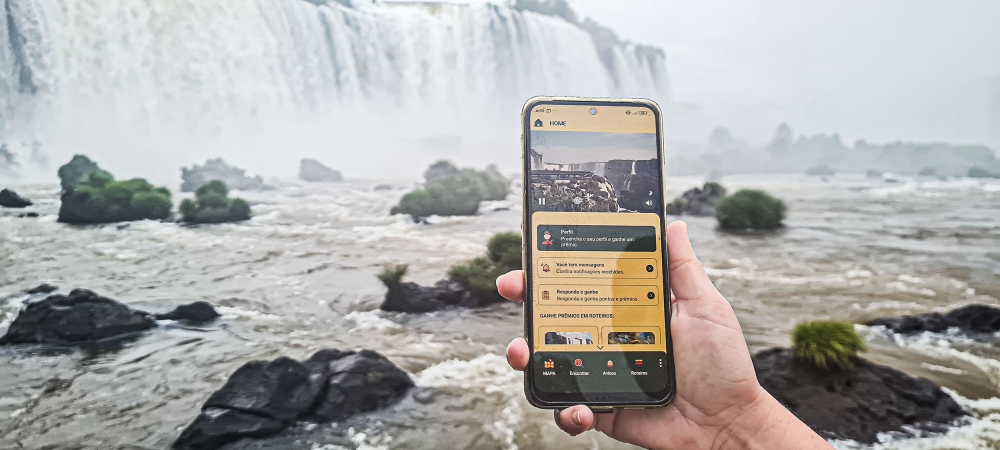
The solution, developed with support from FAPESP’s Innovative Research in Small Businesses Program (PIPE), uses gamified logic and the smartphone’s geolocation system to track visitors’ movements through the site. As visitors pass by native trees, lakes, historic landmarks, and points of cultural interest, collectible stickers appear on their phones. In other words, there is no need to look for signs, scan QR codes, or interrupt the tour. The stickers are accompanied by explanatory text, audio, or videos about the setting.
The content is developed based on public curiosity. The developers listen to visitors’ questions and comments onsite to tailor the language of the app to actual expectations.
According to Valenti, one of the challenges in creating the app was ensuring that the smartphone would not compete with nature. The goal is not to keep users’ eyes glued to the screen but rather to use the device as a lens that reveals the invisible layers of the environment. For this reason, the content is brief and appears automatically along the route. It aims to encourage awareness of the surroundings and reflection on the impact of everyday actions on socio-environmental conservation.
Another key aspect of the platform’s development was accessibility. BoRa offers audio descriptions of images, content translated into Brazilian Sign Language (LIBRAS), appropriate color contrast, easy-to-read typography, and offline functionality, which is an important feature in areas with limited internet access. Information is available in Portuguese (Brazilian and European), English, Spanish, French, Japanese, and Mandarin.
Currently, the team is using artificial intelligence to further develop the platform. This technology is already being used to assist with content translation and narration production. The next step is to use AI to support content production. Humans supervise all stages to ensure the language aligns with the team’s defined principles.
The researcher points out that environmental education goes beyond forest conservation and proper waste disposal. “It involves social, cultural, and even psychological aspects,” she says. This perspective informs the creation of content and the language used in the app, which aims to welcome diverse audiences and encourage reflection without turning the tours into lessons.
Iguaçu National Park
BoRa’s main testing ground is the famous waterfall-filled Iguaçu National Park in Paraná state. As one of the country’s most visited tourist destinations, the park wanted to show visitors that there is more to experience than just the waterfalls. With the app, tourists can discover other trails and learn about the local flora and fauna. They are also encouraged to spend more time in the conservation area. “There’s so much more to explore besides the waterfalls,” Valenti summarizes.
Currently, BoRa is being used in ten Brazilian and Portuguese destinations. In addition to Iguaçu National Park, these include Emas National Park in the state of Goiás, urban tours in São Carlos, an interpretive trail at the Federal University of São Carlos (UFSCar), Parque Lage in Rio de Janeiro, and projects in Lisbon, Porto, and Sintra in Portugal.
At the same time, the startup is crossing borders. After launching tours in Portugal, BoRa began partnering with institutions such as the Royal Botanic Gardens in Kew (also known as Kew Gardens) in London and the nongovernmental organization Plantlife, both of which are based in England. Together, they are developing initiatives to map and promote Important Plant Areas (IPAs) for species conservation in Brazil and the United Kingdom.
In addition to the public, the app benefits those who manage these spaces. It allows for opinion surveys and provides metrics that help understand how the public uses these environments and which topics spark the most interest. This data can inform decisions about infrastructure, communication, and environmental education.
A global trend
The initiative responds to a growing demand. According to data from the Chico Mendes Institute for Biodiversity Conservation (ICMBio), which is affiliated with Brazil’s Ministry of the Environment and Climate Change, federal conservation areas monitored by the agency received 25.5 million visits in 2024 – the highest number ever recorded. National parks received 12.5 million of these visits, demonstrating the consolidation of these areas as important destinations for nature tourism and environmental education.
The shift is global. The Sustainable Travel Report indicates that 75% of global travelers want to take more sustainable trips. Furthermore, data from Grand View Research indicate that the ecotourism market generated USD 215.5 billion worldwide in 2023 alone, with an annual growth rate of 14.5%. In Brazil, the Ministry of Tourism’s Revista Tendências do Turismo magazine highlights the importance of connection with nature in destination choice: 37% of tourists choose a destination motivated by a desire to connect with the natural environment.
For BoRa, the results are already evident. The app has been downloaded more than 50,000 times and brings together users from 56 countries. This year, it received the Embratur Visit Brasil Award in the category of technological solutions for promoting international tourism in Brazil. Additionally, Google selected the founders’ story for campaigns promoting women’s technological entrepreneurship.
For Valenti, however, the greatest recognition lies beyond the statistics. “We want people to leave the park different from how they arrived,” she says. BoRa’s goal isn’t to make visitors look at their cell phones more; it’s to help them take a closer look at the landscape. Visitors will still take photos, but they’ll also gain a deeper understanding of the place they visited.
The BoRa app can be downloaded from Google Play or the App Store.
Republish
The Agency FAPESP licenses news via Creative Commons (CC-BY-NC-ND) so that they can be republished free of charge and in a simple way by other digital or printed vehicles. Agência FAPESP must be credited as the source of the content being republished and the name of the reporter (if any) must be attributed. Using the HMTL button below allows compliance with these rules, detailed in Digital Republishing Policy FAPESP.
