





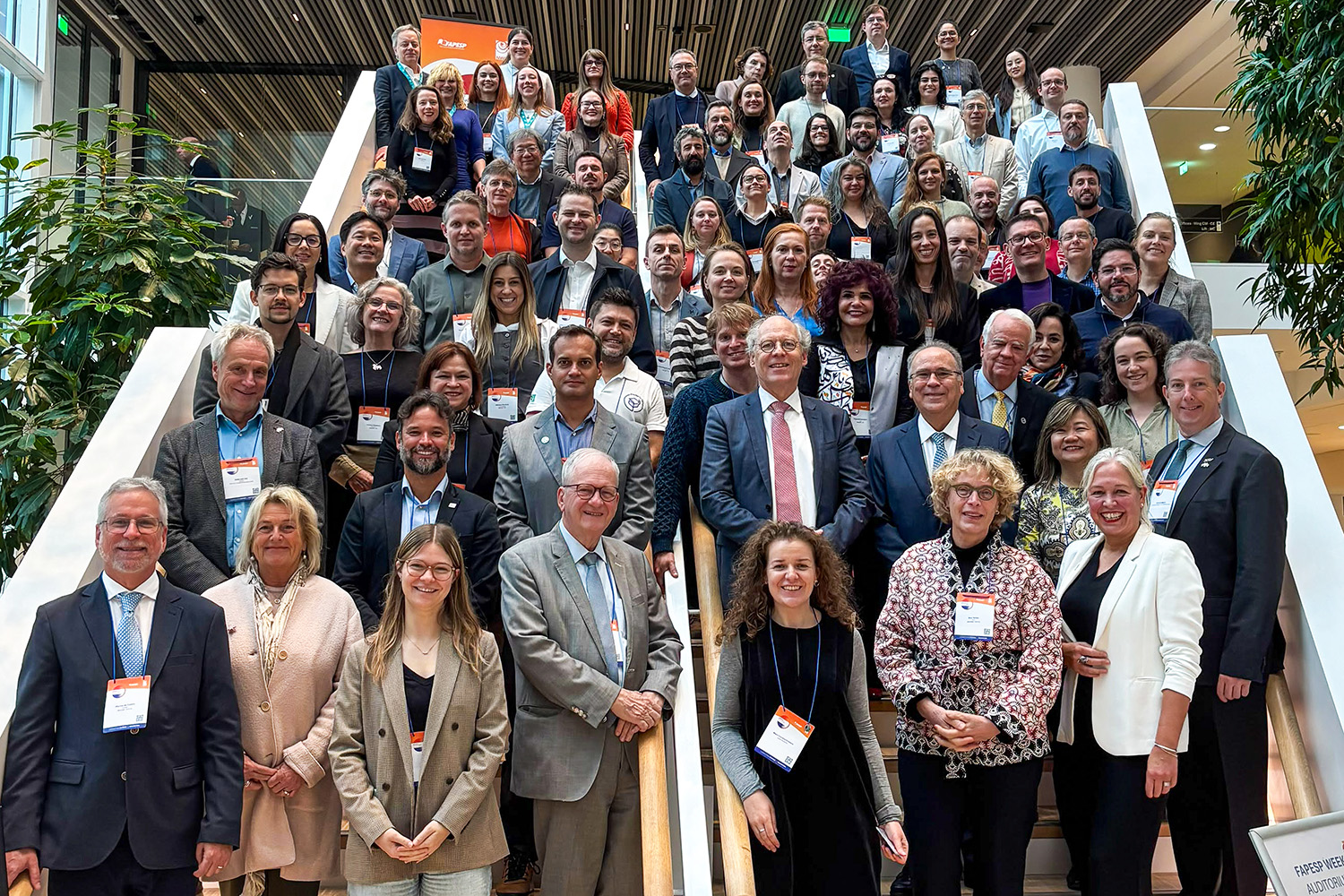
By Elton Alisson, from Leiden (Netherlands) | Agência FAPESP – The growing scientific partnership between Brazil and the Netherlands is gaining new momentum with the 28th edition of FAPESP Week, which began on October 27 in the city of Leiden. At the event’s opening, participants highlighted the importance of the gathering for strengthening long-term collaboration between research institutions in both countries. The international symposium, which ran through October 29, aimed at bringing together the state of São Paulo and the Dutch academic community in strategic areas such as health, sustainable agriculture, energy transition, artificial intelligence, and biotechnology.
During the opening ceremony at Leiden University, institutional leaders presented data on the growth of academic exchange and outlined their perspectives on the future of the bilateral alliance.
FAPESP President Marco Antonio Zago opened the proceedings by emphasizing that the resurgence of global scientific output following the critical years of the pandemic is taking place against a backdrop transformed by technology. “Artificial intelligence, both in its fundamental research and in its practical application, has emerged as a structural shift. It is now the number one priority on the research agendas of most countries,” he noted.
Zago highlighted the institutional stability of São Paulo’s research funding agency, which annually awards more than 10,000 new scholarships and fellowships and supports 50 world-class research centers with a ten-year duration, in addition to 115 Science Centers for Development (SCDs). In detailing the progress of exchanges with Dutch partners, the president highlighted the recent growth in joint research.
“Over the past five years, researchers from the Netherlands and São Paulo have published more than 1,000 collaborative articles each year. That’s an impressive achievement and serves as an indicator of the strength of the cooperation between our respective regions,” he concluded.
Ena Voûte, a member of the executive board and head of the international collaboration portfolio at the Dutch Research Council (NWO), emphasized that the scientific alliance between the regions has been gaining momentum. “Our collaboration has only grown stronger over the past ten years. Therefore, rather than simply extending our current memorandum of understanding on cooperation after 15 years, we’ll draft a new one to reflect the changes that have taken place since 2012 and reassess how we want to collaborate in the future,” she stated (read more at agencia.fapesp.br/59496).
Voûte highlighted the application of methodologies focused on social impact from the very conception of projects and noted that the human dimension is the true driving force behind the partnership: “At the heart of FAPESP Week and at the heart of any international initiative are people like you,” she said. Concluding her remarks, Voûte outlined the developments to come throughout the week: “FAPESP Week isn’t the end, and I’m excited to see where the next few years of partnership between the NWO and FAPESP will take us. I hope that over the next few days we’ll all learn new things, make new connections, and strengthen bonds with old friends.”
Luc Sels, chair of the Executive Board of Leiden University, highlighted the tradition and international focus of the institution, which was founded in 1575. “I’m convinced that the university’s strength lies not only in its traditions but, above all, in its ability to build new connections, embrace new perspectives, and remain open to the world,” he stated. Sels emphasized the importance of interdisciplinary integration and praised the excellence of research in São Paulo: “What fascinates me isn’t only the strength of individual disciplines, but even more so what becomes possible when we begin to connect them. That makes São Paulo, in my opinion, an exciting partner, as it has remarkable scientific strength in biodiversity, health, agriculture, energy, and emerging technologies.”
In his closing remarks, Sels highlighted the role of science in the face of global tensions: “At a time of geopolitical tension, governments on both sides of the Atlantic are increasingly talking about technological and digital sovereignty. But sovereignty should strengthen our ability to cooperate, not become an excuse for scientific isolation.”
Scientific diplomacy
Brazil’s ambassador to the Netherlands, Fernando Simas Magalhães, spoke about the mutual benefits of scientific diplomacy. “Deepening bilateral cooperation in science, technology, and innovation benefits both sides by leveraging the strengths of our nations. That cooperation is even more important at a time of apparent growing mistrust in international partnerships,” he said. The diplomat highlighted Brazil’s strategic position and the historic milestone of 200 years of diplomatic relations between the two countries, which is being celebrated this year.
“Brazil is a strategic partner at a time when economists around the world are seeking supply chains that combine technological advances, sustainability, diversification, and reliability,” he stated. Magalhães also highlighted the strength of the national innovation environment: “Brazil’s innovation ecosystem has grown significantly and now comprises approximately 20,000 startups in sectors such as fintech, health technology, and agritech. The National Strategy for Science, Technology, and Innovation aims to increase investment in R&D to 2% of GDP [gross domestic product] by the end of 2027.”
Susanne Caarls, a representative of the Dutch Ministry of Education, Culture, and Science, celebrated the diplomatic bicentennial milestone and highlighted the high caliber and international impact of their joint research. “I was particularly impressed by the significant impact of the collaboration between the NWO and FAPESP. Together, the state of São Paulo and the Netherlands have produced more than 8,000 joint publications in key areas of science,” she said. Caarls concluded by reaffirming the global dimension of knowledge production: “Science knows no borders. The challenges we face – whether in health, agriculture, or energy – are global and require global solutions. The partnership between Brazil and the Netherlands is a shining example of how we can tackle these issues together.”
FAPESP’s scientific director, Marcio de Castro, presented quantitative data to demonstrate the scale of São Paulo’s scientific hub and the objectives for the bilateral relationship. “São Paulo is responsible for nearly 42% of Brazil’s scientific output and could be considered a country in its own right. It has the population of Spain, the GDP of Sweden, and the land area of the United Kingdom,” he reported.
Castro also highlighted the state’s prominent position in South America: “São Paulo is the only science and technology hub in South America to appear in the global ranking of the top 200 scientific cities, occupying the 49th position, and is home to about 55% of all deep tech startups in the country,” he said. Regarding the symposium’s goals, the director emphasized the determination to further strengthen ties: “When we look at São Paulo’s partners, we see that the Netherlands is among the top ten countries. But the reason we’re here is that we decided the Netherlands would move up on that list by fostering joint research centers and global impact.”
Concluding the remarks from the opening panel, Raul Machado Neto, manager of FAPESP’s International Relations Office, emphasized the event’s practical proposal and the organizational efforts that went into making it happen. “This is the 28th edition of FAPESP Week. This event isn’t a presentation of academic papers; rather, its main goal is to foster connections and enhance collaboration, research, and science between the two sides,” he emphasized.
For more information on FAPESP Week Netherlands, visit fapesp.br/week/2026/netherlands.
Republish
The Agency FAPESP licenses news via Creative Commons (CC-BY-NC-ND) so that they can be republished free of charge and in a simple way by other digital or printed vehicles. Agência FAPESP must be credited as the source of the content being republished and the name of the reporter (if any) must be attributed. Using the HMTL button below allows compliance with these rules, detailed in Digital Republishing Policy FAPESP.
