





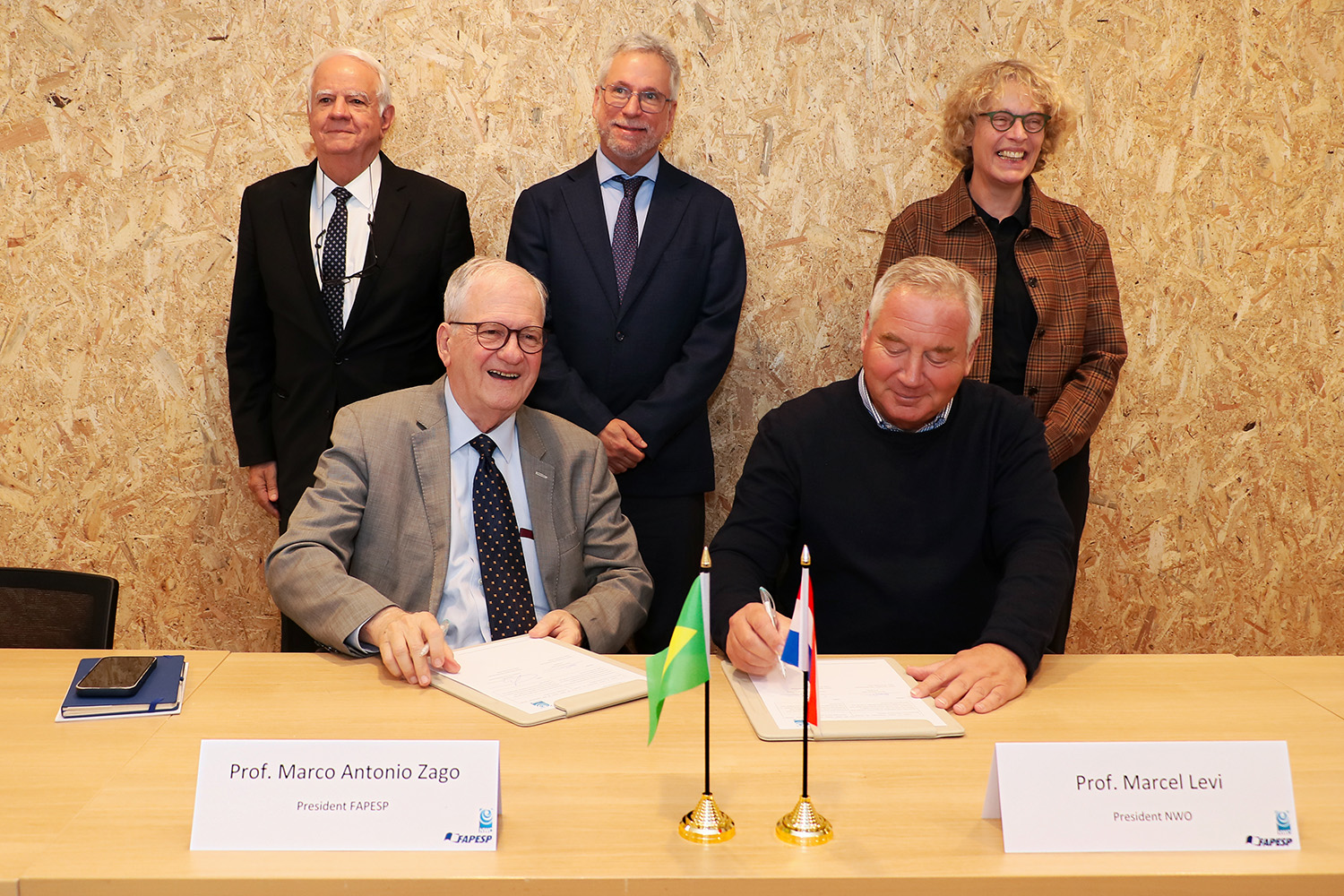
By Elton Alisson, from Leiden (Netherlands) | Agência FAPESP – On October 26, FAPESP and the Dutch Research Council (NWO) signed an amendment extending the scientific cooperation agreement between the two institutions. The goal is to ensure the continuity of calls for proposals and joint projects.
“The idea is to extend our scientific cooperation for another five years through a memorandum of understanding to be signed in 2028 – the year in which a meeting between the institutions will take place and which will also mark the bicentennial of the friendship agreement between Brazil and the Netherlands,” said Marcel Levi, president of the NWO.
The amendment was signed during a visit by a FAPESP delegation to the Dutch host institution’s headquarters in The Hague, 52 kilometers from the capital, Amsterdam, with the aim of discussing opportunities to consolidate and expand scientific and academic collaboration between the state of São Paulo and the European country.
The meeting preceded the opening of FAPESP Week Netherlands, an international symposium organized by the two institutions, which was held 27-29 October at Leiden University.
“We’re very flexible in the mechanisms we use to fund research, and we can adapt as needed. We have only one important rule in that regard: the quality of the projects,” emphasized Marco Antonio Zago, president of FAPESP.
The Dutch research funding agency invests between €1 billion and €1.5 billion annually in curiosity-driven research focused on major social and infrastructure challenges. The institution operates on three main fronts – conducting research at its own institutes, funding projects, and connecting researchers with society – covering everything from open basic research to funding startups and open innovation.
Internationally, the NWO allocates approximately €10 million per year to bilateral and multilateral initiatives, maintaining strategic programs with FAPESP in areas such as agriculture, biodiversity, integrated biorefineries for the circular economy, energy transition, and increasing resilience to extreme weather events.
“For us, it’s extremely important to maintain the quality of research and ensure its real impact on society. We want to foster a culture of open research, in which scientists have the freedom to investigate and bring unique perspectives – such as the specific knowledge that Brazil possesses and that we lack here,” said Ena Voûte, a member of the executive board and head of the NWO’s international collaboration portfolio.
Long-term partnership
To raise the bar for academic and technological cooperation between São Paulo and the Netherlands, representatives from both institutions discussed the integration of advanced long-term research models, combining the attraction of international centers, partnerships with companies, and the alignment of clusters of scientific excellence.
One of the pillars presented by the president of FAPESP was the International Research Centers (IRCs) model, a funding mechanism recently created by the Foundation to attract globally prestigious institutions willing to establish a permanent physical presence in São Paulo. Under this model, a São Paulo-based institution provides the infrastructure and technical staff, while the foreign institution assigns researchers to work there on a permanent basis, with research funding from FAPESP for up to five years (read more at agencia.fapesp.br/54270).
The president of FAPESP cited examples that are already well-established or in the process of being set up – such as the centers of the Pasteur Institute and the National Center for Scientific Research (CNRS) of France, and the Max Planck Society of Germany, at the University of São Paulo (USP); of the Polytechnic University of Turin at the Institute for Technological Research (IPT); of the Fermi National Accelerator Laboratory (Fermilab) at the State University of Campinas (UNICAMP); and of Tsinghua University in China at São Paulo State University (UNESP). In addition, similar initiatives are being negotiated with the Netherlands Organization for Applied Scientific Research (TNO) at the IPT and with Delft University of Technology at UNICAMP.
Another mechanism discussed was that of the Applied Research Centers (ARCs), which involve partnerships lasting up to ten years with funding shared equally between FAPESP and private companies. Zago highlighted the successful partnership with the Dutch company Koppert at the Luiz de Queiroz College of Agriculture (ESALQ-USP), focused on biological control to replace chemical pesticides in agriculture, as well as the centers developed with Shell for the production of green hydrogen from ethanol, and with Embraer, focused on sustainable aviation.
Clusters of excellence
Complementing the presentation on the major Applied Research Centers, FAPESP’s scientific director, Márcio de Castro Silva Filho, highlighted the launch of a new center focused on improving the quality and sustainability of the beef production chain in Brazil, established in partnership with Minerva Foods.
In the realm of cutting-edge scientific research, the director and representatives of FAPESP’s Scientific Board proposed a strategic alignment of clusters of excellence, promoting partnerships between São Paulo’s Research, Innovation and Dissemination Centers (RIDCs) in São Paulo – supported by FAPESP for up to 11 years – and the NWO’s programs of excellence. “In the future, we could consider something like a more structured, long-term collaboration between groups of excellence on both sides,” Zago emphasized.
To support the expansion of joint calls, FAPESP announced the allocation of additional resources to seven areas considered strategic: biotechnology; digital transition and artificial intelligence; quantum technology; sustainable food production and biodiversity; human and animal health; energy transition; and violence and public safety.
In addition, discussions focused on simplifying participation in European consortia, such as Horizon Europe, and in the Marie Skłodowska-Curie Actions doctoral networks. Niels Olsen, an advisor to FAPESP’s Scientific Board, explained that the Foundation can directly provide the necessary funding to researchers from São Paulo who are part of pre-selected European groups of excellence, making participation in major international projects faster and more efficient.
Strengthening academic ties
On the same day, the Brazilian delegation visited Delft University of Technology (TU Delft), located about 55 km from Amsterdam, where they were received by the chair of the Executive Board, Ingrid Thijssen. She highlighted the institution’s pride – as it approaches its 185th anniversary – in hosting 28,000 students and more than 125 world-class research facilities, such as the Green Village sustainability testing facility.
The institution’s campus is home to the Green Village, a “living laboratory” that functions as a mini-city free from traditional regulations, allowing scientists, startups, companies, and governments to test urban innovations under real-world conditions with actual residents.
“Our collaboration with Brazil goes back a long way. We see many opportunities for the future in our cooperation, expanding into areas such as critical materials and educating new generations of researchers. Our shared ambition is to deepen our collaboration, develop our talent, and make an impact through research and innovation,” said Thijssen.
The executive and representatives from the institution highlighted a unique milestone in their collaboration with Brazil: the only dual-degree PhD program offered by TU Delft worldwide is conducted in partnership with UNICAMP. Over the past 25 years, the partnership has already enabled more than 50 students to earn PhDs in fields such as chemical engineering, industrial microbiology, water management, and biotechnology.
Representatives from the Dutch university also emphasized that scientific cooperation between the state of São Paulo and the Netherlands reflects consistent, high-impact bibliometric progress. Analyses presented during the visit indicate that, over the past 15 years, more than 10,000 scientific publications co-authored by researchers from São Paulo and the Netherlands have been recorded.
Furthermore, bibliometric data reveal that the growth rate of joint publications between Dutch and Brazilian researchers increased by 10% between 2013 and 2022, surpassing the overall increase of 6.5% recorded in Dutch international publications.
At the end of the day, the Brazilian delegation was welcomed by Ambassador Fernando Simas Magalhães at a reception at the Brazilian Embassy in The Hague.
More information about FAPESP Week Netherlands: fapesp.br/week/2026/netherlands.
Republish
The Agency FAPESP licenses news via Creative Commons (CC-BY-NC-ND) so that they can be republished free of charge and in a simple way by other digital or printed vehicles. Agência FAPESP must be credited as the source of the content being republished and the name of the reporter (if any) must be attributed. Using the HMTL button below allows compliance with these rules, detailed in Digital Republishing Policy FAPESP.
