





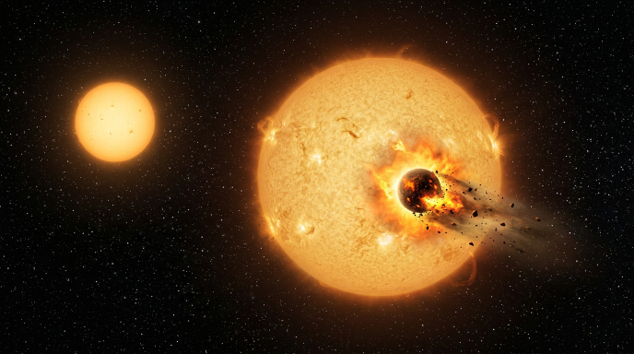
By José Tadeu Arantes | Agência FAPESP – An international team led by researchers from the University of São Paulo (USP) in Brazil has developed an innovative method to identify stars that have consumed the planets around them. The technique detects variations in the abundance of beryllium, a relatively rare chemical element, and could open a new window into studying the evolution of planetary systems.
The study, published in the journal Astronomy & Astrophysics, analyzed a binary system consisting of two very similar stars, both of the solar type (with physical, chemical, and magnetic activity characteristics similar to those of our Sun), named HD 129171 and HD 129209. In principle, binary stars like these should have virtually the same chemical composition since they formed from the same molecular cloud (a cluster of dust and gas that acts as a stellar nursery). However, the researchers found significant differences between the two stars.
“The star HD 129171 is enriched in refractory elements – that is, elements that typically condense in the solid state and make up rocky planets. That strongly suggests that it has engulfed planetary material throughout its evolution,” says Anne Rathsam, a doctoral student at the Institute of Astronomy, Geophysics, and Atmospheric Sciences (IAG-USP) and the first author of the article. Rathsam is a FAPESP scholarship recipient.
Scientists had previously suspected that some stars might incorporate planets or planetary fragments. This new study is unique because it demonstrated for the first time that differences in beryllium abundance in binary stars can reliably indicate this process.
Beryllium has an important characteristic: it is not produced in the “heart” of stars throughout their evolution. Therefore, when astronomers detect the signature of this element in the light emitted by a star, it is a warning sign. This indicates that the star swallowed rocky material, such as planetary remnants, long after forming.
As the authors explain, lithium, beryllium, and boron are important exceptions in the chemical history of the universe. “All other chemical elements originate from primordial nucleosynthesis [the formation of the first atomic nuclei in the minutes following the Big Bang] or stellar nucleosynthesis [the nuclear fusion process that occurs inside stars throughout their lifetimes]. But not beryllium and boron. They primarily arise through a process called ‘cosmic spallation,’ in which high-energy particles fragment heavier nuclei, such as carbon, nitrogen, and oxygen, producing lighter elements,” explains Jorge Luis Melendez Moreno, an astronomer and professor at IAG-USP, as well as the study advisor.
Lithium is also produced primarily by spallation, although a minuscule amount of this element arose during primordial nucleosynthesis, and it can form in certain types of stars under special circumstances.
“Lithium had already been used as a possible indicator of planetary engulfment, but it’s destroyed relatively easily. Beryllium is more resistant, and its chemical signature can last longer,” Rathsam explains.
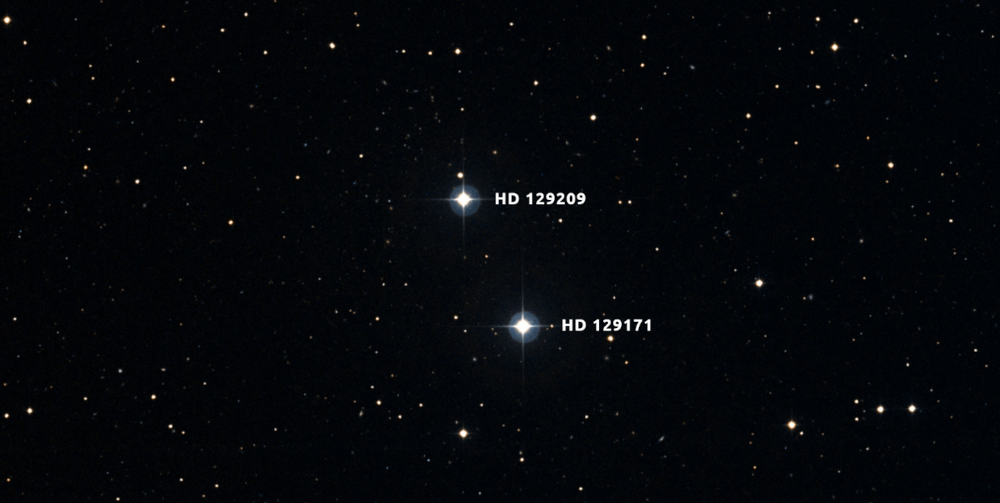
Actual image of the binary system studied (imagem: Digital Sky Survey/Aladin/Anne Rathsam)
More than 11 Earth-like planets
The team conducted the study using data obtained with the UVES spectrograph installed on the European Southern Observatory’s (ESO) Very Large Telescope (VLT) in Chile. The instrument breaks starlight down into different wavelengths, enabling the identification of extremely subtle chemical signatures.
The observations revealed that HD 129171 has a notably higher concentration of refractory elements, including iron, magnesium, silicon, calcium, and titanium, compared to its companion, HD 129209. Additionally, the star exhibits an excess of both lithium and beryllium. According to the researchers, this pattern is consistent with the ingestion of rocky material equivalent to more than 11 times the mass of Earth.
“That material may have come from a single large planet or from several smaller bodies. However, in the case of Sun-like stars, internal mixing is so efficient that the final chemical signature doesn’t allow us to distinguish between those scenarios,” Rathsam comments.
The main original contribution of the study was the chemical analysis, which made it possible to identify beryllium as a marker of planetary engulfment events. The authors also discussed the dynamic mechanisms capable of causing planets to fall into their host stars, based on the existing literature. These mechanisms include gravitational interactions between planets, perturbations caused by companion stars, and orbital migration processes. They can make orbits highly eccentric and unstable, causing planets to be ejected from the system, collide with one another, or be absorbed by the central star.
An important implication of the study is that stable systems, such as the Solar System, may be rare. Melendez points out that several independent lines of evidence converge on this idea. Computational simulations of planetary formation indicate that configurations like that of the Solar System, with giant planets in nearly circular outer orbits and rocky planets in stable inner orbits, are not common. Furthermore, observational surveys of Sun-like stars have found few Jupiter-like planets in orbits comparable to that of Jupiter.
“When we bring together evidence from dynamical simulations, exoplanet observations, and chemical studies of binary stars, a consistent picture emerges, indicating that systems similar to the Solar System may be less common than we imagined,” the researcher explains.
Melendez also notes that binary systems are very common in the Milky Way. Current estimates indicate that approximately half of the galaxy’s stars have a gravitational companion. Since the two stars in a binary system form at virtually the same time and from the same molecular cloud, chemical differences between them are a strong indication that subsequent processes, such as the ingestion of planets, have altered their original composition.
“In our planetary system, the planets have relatively stable, low-eccentricity orbits. However, if planetary engulfment is common, it suggests that many systems undergo violent dynamic phases,” Rathsam emphasizes. According to her, this may have direct implications for the existence of complex life.
“Life wouldn’t just need billions of years to emerge and evolve. The planet would also have to remain in a sufficiently stable orbit to survive significant gravitational perturbations,” she explains.
In addition to shedding light on the evolution of planetary systems, the study has implications for theories of star formation and a technique called “chemical tagging.” This technique uses the chemical composition of stars to reconstruct the history of the Milky Way.
If the observed chemical differences in binary stars were caused by heterogeneities in the primordial cloud from which they originated, currently accepted models of star formation would require revision. However, the results obtained by the team support the planetary ingestion hypothesis.
The study included researchers from USP, the Polish Academy of Sciences, the Chinese Academy of Sciences, Monash University in Australia, and Italian astronomical observatories. The study received support from FAPESP through a Thematic Project coordinated by Melendez.
The article “Planet engulfment in the chemically anomalous HD 129171/HD 129209 pair” can be read at aanda.org/articles/aa/full_html/2026/06/aa59556-26/aa59556-26.html.
Republish
The Agency FAPESP licenses news via Creative Commons (CC-BY-NC-ND) so that they can be republished free of charge and in a simple way by other digital or printed vehicles. Agência FAPESP must be credited as the source of the content being republished and the name of the reporter (if any) must be attributed. Using the HMTL button below allows compliance with these rules, detailed in Digital Republishing Policy FAPESP.
