




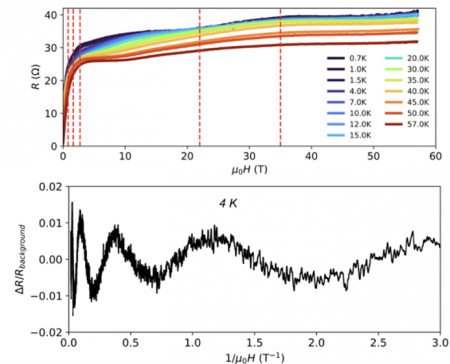
(a) Electrical resistance of the topological insulator ZrTe₅ under extreme magnetic fields and at low temperatures; (b) Non-periodic or anomalous quantum oscillations observed in the high-field regime (figure: Cauê Kaufmann Ribeiro)
Experimental and theoretical study shows that, under extreme magnetic fields, electrons in zirconium pentatelluride exhibit unconventional behavior indicating a topological origin rather than many-body interactions.
Experimental and theoretical study shows that, under extreme magnetic fields, electrons in zirconium pentatelluride exhibit unconventional behavior indicating a topological origin rather than many-body interactions.
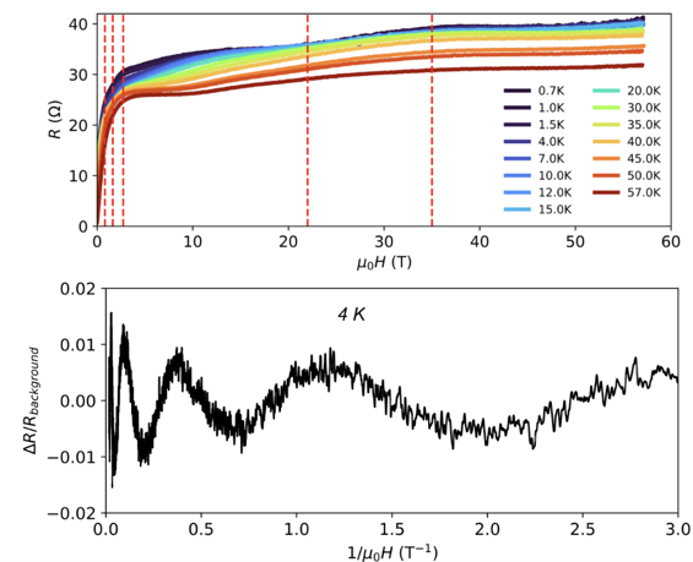
(a) Electrical resistance of the topological insulator ZrTe₅ under extreme magnetic fields and at low temperatures; (b) Non-periodic or anomalous quantum oscillations observed in the high-field regime (figure: Cauê Kaufmann Ribeiro)
By José Tadeu Arantes | Agência FAPESP – In May, a study was published in Nature Communications that identified an unusual regime of quantum oscillations in a three-dimensional topological insulator. The results show that, when subjected to temperatures near absolute zero and extreme magnetic fields, electrons in the material zirconium pentatelluride (ZrTe₅) exhibit behavior that deviates from the pattern predicted by conventional theory.
The study, led by researchers from the University of São Paulo (USP) in Brazil, the Los Alamos National Laboratory, and the University of Washington, among other U.S. institutions, combines electrical transport experiments conducted in magnetic fields of up to 60 tesla and at temperatures around 0.7 kelvin (-272.45 °C) with detailed theoretical modeling.
“This work expands our understanding of electron transport in exotic phases of matter and suggests that topological insulators support the transport of not only electric charge, but also another fundamental degree of freedom: electron spin,” says Julio Larrea Jiménez, a professor at USP’s Physics Institute (IF) and co-founder and director of the Laboratory for Quantum Matter under Extreme Conditions (LQMEC).
Larrea was the doctoral advisor for Cauê Kaufmann Ribeiro, the first author of the article. Ribeiro conducted a significant portion of the experiments during an internship at the National High Magnetic Field Laboratory in Los Alamos, United States, with a FAPESP Research Internship Abroad. There, he was co-advised by Johanna Palmstrom and Sean Thomas.
Dual identity
Topological insulators behave as insulators internally but conduct electricity on their surface. This property stems from the topology of the electronic bands, or the global characteristics of the quantum structure of electronic states protected by crystal symmetries.
ZrTe₅ is of particular interest because the material lies near the boundary between different topological phases. Minimal changes in temperature, mechanical deformation, composition, or magnetic field can alter its electronic response. For this reason, ZrTe₅ has become a prime platform for investigating topological phase transitions and relativistic quasiparticles in solids.
Generally, when electrons move in a magnetic field, their orbits no longer have continuous energy. Quantum mechanics imposes discrete energy values, called Landau levels, named after the great Soviet physicist and mathematician Lev Landau (1908–1968). In very pure metals, these levels successively cross the Fermi level – the energy separating occupied and empty electronic states – producing periodic oscillations in electrical resistance. These oscillations, known as Shubnikov–de Haas oscillations, exhibit regular periodicity in 1/B, where B is the magnetic field.
However, something different occurred in the ZrTe₅ studied. The magnetoresistance oscillations did not follow the conventional 1/B periodicity and persisted well beyond the quantum limit, a regime in which electrons should be confined to the lowest Landau level and conventional oscillations should disappear.
“In materials near topological phase transitions, electrons may cease to behave like ordinary particles within a metal. Their electronic excitations begin to behave like quasiparticles similar to Dirac fermions – that is, relativistic particles. In our work, we show that the spin of these quasiparticles plays a central role: when we apply strong magnetic fields, the interaction between spin and the magnetic field profoundly alters the energy levels of the electrons. As a result, Landau levels that would normally move away from the system’s relevant energy can ‘return’ and cross it again. This unusual behavior is what we call reentrant Landau levels,” says Kaufmann.
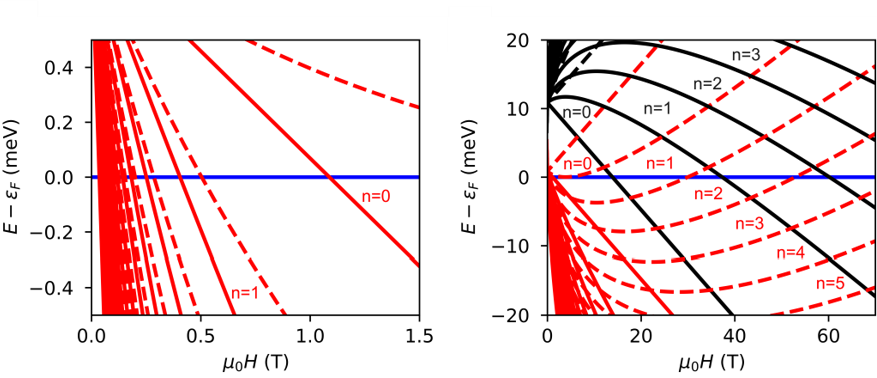
On the left, a representation of Landau level energies crossing the Fermi level in periodic quantum oscillations. On the right, the energies of Landau levels reentrantly crossing the Fermi level in the topological insulator ZrTe5 (figure: Cauê Kaufmann Ribeiro)
The authors’ proposed explanation involves a mechanism known as the “back-bending” of Landau levels. Simply put, the energy of these levels does not change in a straight line with the magnetic field. It can bend and cross the Fermi level again, producing new oscillations where conventional theory predicts they should no longer occur.
This effect results from the interplay of two phenomena. The first is cyclotron energy, which is associated with the orbital motion of electrons in a magnetic field. The second is the Zeeman effect, which is linked to the coupling between the magnetic field and the spin of the electrons. In materials with strong spin-orbit interaction, such as ZrTe₅, these contributions cannot be treated separately. Spin and orbital motion become entangled, leading to nonlinear energy level evolution.
The study focused on distinguishing between two possible explanations for the anomalous oscillations: many-body effects, or those produced by collective interactions among many electrons, and intrinsic topological effects arising from the electronic structure of the material. The authors demonstrate that interactions between electrons are not necessary to explain the phenomenon in the case studied. A single-particle model based on a three-dimensional Dirac Hamiltonian that incorporates strong spin-orbit coupling is sufficient to reproduce the observed regimes.
“What we saw is that the effect doesn’t stem from many-body interactions, but rather from a nontrivial topology of the electronic bands,” Larrea summarizes.
The study also helps resolve a controversy in the literature regarding ZrTe₅. Different samples of the same material can exhibit distinct behaviors. Some samples show conventional oscillations in 1/B, while others show non-periodic oscillations in 1/B. Still other samples show signals that appear to have logarithmic periodicity in B.
The new work suggests that these behaviors do not necessarily result from different physical mechanisms. Rather, they may arise from the same Dirac electronic structure, depending primarily on the carrier density and the size of the Fermi surface of each sample.
“In samples with low carrier density, such as the one investigated here, the Zeeman and cyclotronic effects become comparable in experimentally accessible magnetic fields. That favors the re-entry of Landau levels and makes the anomalous oscillations visible. In samples with higher carrier density, the conventional term dominates, and the oscillations retain their usual periodicity of 1/B,” Larrea comments.
Another important result was the identification of two distinct contributions to the oscillations associated with spin-separated states. These contributions have different effective masses and interfere with one another. This explains an unexpected feature of the data: the amplitude of the oscillations does not decrease monotonically with increasing temperature as predicted by the conventional Lifshitz–Kosevich model. Rather, a local minimum in amplitude appears in certain temperature ranges, indicating interference between the two electronic channels.
Angular magnetoresistance measurements also indicated that the Fermi surface of the material is three-dimensional and approximately ellipsoidal under low magnetic fields. The carrier density derived from this analysis is very low, approximately 10¹⁶ per cubic centimeter, which is consistent with ZrTe₅ being very close to a topological transition.
The experiments were conducted at the National High Magnetic Field Laboratory in Los Alamos, which is one of the few facilities in the world capable of combining pulsed magnetic fields of up to 60 tesla with temperatures below 1 kelvin. “This type of experiment can only be performed in a few places around the world. Access to those facilities is highly competitive,” Larrea notes.
In addition to explaining a specific phenomenon, the study establishes ZrTe₅ as a promising platform for exploring new topological phases of matter. The authors suggest that controlling symmetries, carrier density, mechanical stress, temperature, and magnetic field could lead to even more exotic states, such as phases associated with Weyl quasiparticles. “Our experiment provided the first empirical demonstration of a process that had previously been shrouded in controversy,” Larrea summarizes.
The work was also supported by FAPESP through a Young Investigator Grant awarded to Larrea and received funding from U.S. institutions, including Los Alamos National Laboratory, the National High Magnetic Field Laboratory, the National Science Foundation, and the U.S. Department of Energy.
The article “Reentrant Landau levels in a Dirac topological insulator” can be found at nature.com/articles/s41467-026-72885-9.
The Agency FAPESP licenses news via Creative Commons (CC-BY-NC-ND) so that they can be republished free of charge and in a simple way by other digital or printed vehicles. Agência FAPESP must be credited as the source of the content being republished and the name of the reporter (if any) must be attributed. Using the HMTL button below allows compliance with these rules, detailed in Digital Republishing Policy FAPESP.
