



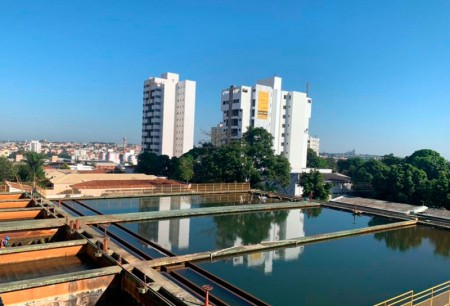
The SCD-SHQV will collect sewage samples weekly at strategic points in São Carlos, which will be georeferenced, meaning they will be associated with their respective neighborhoods of origin (photo: SAAE)
The Science Center for Development will bring together the University of São Paulo in São Carlos, the Federal University of São Carlos, EMBRAPA, and the Autonomous Water and Sewage Service.
The Science Center for Development will bring together the University of São Paulo in São Carlos, the Federal University of São Carlos, EMBRAPA, and the Autonomous Water and Sewage Service.
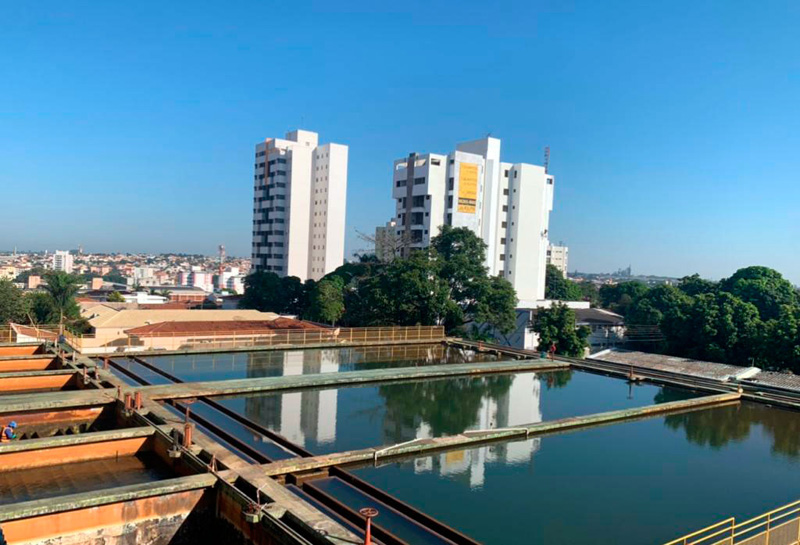
The SCD-SHQV will collect sewage samples weekly at strategic points in São Carlos, which will be georeferenced, meaning they will be associated with their respective neighborhoods of origin (photo: SAAE)
Agência FAPESP – During the COVID-19 pandemic, analyzing urban waste became essential for tracking viral load evolution. Now, a group of researchers in São Carlos in the state of São Paulo, Brazil, wants to expand on this concept by transforming sewage into a continuous source of information on population health, the environment, and quality of life.
With this goal in mind, São Carlos will host a new Science Center for Development (SCD), supported by FAPESP and focused on Water and Sanitation Health and Quality of Life (SHQV, the Portuguese acronym). The SHQV project partners with the Autonomous Water and Sewage Service (SAAE), the Federal University of São Carlos (UFSCar), and the Brazilian Agricultural Research Corporation (EMBRAPA). Emanuel Carrilho, from the São Carlos Institute of Chemistry at the University of São Paulo (IQSC-USP), will coordinate the project. With an investment of nearly BRL 10 million, the project is expected to last five years.
According to André Carlos Ponce de Leon Ferreira de Carvalho, a professor at the Institute of Mathematical and Computer Sciences (ICMC) at USP and one of the researchers at the new SCD, artificial intelligence (AI) tools will be used to cross-reference chemical, biological, and socioeconomic information. This will reveal patterns that can help predict and prevent diseases, map pollution, and guide public policy.
“We’re talking about a model that can transform the way cities monitor public health and the environment. AI will be the bridge between the data collected and the actions that can improve people’s lives,” Carvalho told the ICMC-USP Communications Office.
The SCD-SHQV will collect sewage samples weekly at strategic points in São Carlos. These samples will be georeferenced, or associated with the neighborhood of origin. Each collection will allow identification of microorganisms, viruses, bacteria, parasites, hormones, pesticides, heavy metals, and drug residues. When this data is cross-referenced with health, education, and income indicators, it will provide an unprecedented view of the city.
“With this information, we’ll be able to anticipate the emergence of diseases [pandemics], locate sources of industrial contamination, and even recognize patterns of substance consumption in different areas of the city,” Carrilho explained. According to the scientist, the goal is for the project to be replicable in other cities after five years, helping managers make more efficient decisions based on real data.
The center also plans to actively involve undergraduate and graduate students by offering research scholarships and training in data science, environmental chemistry, and molecular biology. “It’ll be a unique opportunity for training and developing analytical methods applied to a real problem, with a direct impact on society,” the ICMC-USP professor concluded.
The Agency FAPESP licenses news via Creative Commons (CC-BY-NC-ND) so that they can be republished free of charge and in a simple way by other digital or printed vehicles. Agência FAPESP must be credited as the source of the content being republished and the name of the reporter (if any) must be attributed. Using the HMTL button below allows compliance with these rules, detailed in Digital Republishing Policy FAPESP.
