




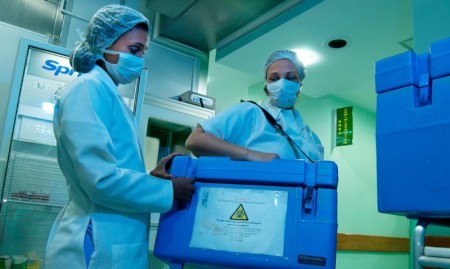
In Brazil, between 60% and 70% of patients who receive a kidney from a deceased donor develop temporary acute renal failure shortly after transplantation. This rate is twice as high as that observed in Europe and the United States. The difference is directly related to the time and conditions in which the organ is preserved (image: Agência Brasil)
A study by the São José do Rio Preto School of Medicine could increase the use of the most sought-after organ in Brazil. There are almost 30,000 people on the waiting list.
A study by the São José do Rio Preto School of Medicine could increase the use of the most sought-after organ in Brazil. There are almost 30,000 people on the waiting list.

In Brazil, between 60% and 70% of patients who receive a kidney from a deceased donor develop temporary acute renal failure shortly after transplantation. This rate is twice as high as that observed in Europe and the United States. The difference is directly related to the time and conditions in which the organ is preserved (image: Agência Brasil)
By Fernanda Bassette | Agência FAPESP – More than 60,000 people in Brazil are waiting for an organ transplant, nearly 30,000 of whom are on the waiting list for a kidney, the most sought-after organ for transplants. According to data from the Brazilian Association of Organ Transplants (ABTO) from 2024, the use of kidneys from deceased donors in Brazil was between 68% and 70%. This means that nearly one-third of the collected kidneys were not used for transplantation due to clinical, anatomical, or logistical criteria. This reinforces the urgent need for new strategies to improve the preservation and use of available organs.
Transplantation remains the most effective treatment for chronic kidney disease, offering longer survival and a better quality of life than dialysis. Hospitals and research centers around the world have been seeking alternatives to increase the number of usable organs, including resorting to donors with extended criteria. Although viable, the kidneys of these donors present a higher risk of complications after transplantation.
With support from FAPESP (projects 23/17655-1, 23/03915-1, and 23/08792-5), researchers at the São José do Rio Preto School of Medicine (FAMERP) tested anakinra, a drug approved by the Brazilian Health Regulatory Agency (ANVISA) for treating rheumatoid arthritis. They investigated whether anakinra could reduce inflammation in the kidneys of deceased donors prior to transplantation. This process could improve organ function and increase its utilization.
In October 2025, the study received the award for best work at the Latin American Transplant Congress (https://stalyc.org/) in Paraguay, in recognition of its scientific relevance and potential clinical impact in the field of kidney transplantation. “We’re looking for a way to improve the quality of donated kidneys using a safe, accessible drug that has already been approved for clinical use,” explains Mário Abbud-Filho, the study advisor.
According to the researcher, between 60% and 70% of patients who receive a kidney from a deceased donor in Brazil develop temporary acute renal failure shortly after transplantation. This rate is twice as high as that observed in Europe and the United States. This difference is directly related to the time and conditions under which the organ is preserved.
“The time the kidney spends refrigerated, the donor’s stay in the ICU, transportation, and handling greatly influence the outcome. This prolonged period of cold ischemia causes a type of ‘numbing’ in the kidney, which can result in the patient spending weeks in the hospital on dialysis until the organ returns to full function,” says Abbud-Filho. “This means longer hospital stays, more comorbidities, and higher costs for the healthcare system.”
Additionally, kidneys from donors classified as “extended criteria” (typically older donors or those with comorbidities) are at a higher risk of long-term malfunction and are often rejected by transplant centers. “Our question for initiating this study was: how can we improve the quality of these organs to increase the use and supply of viable kidneys for transplantation?” the researcher explains.
One of the most promising technologies for improving organ preservation is currently the use of a perfusion machine, which keeps the kidney irrigated with an oxygenated solution and nutrients continuously, thus simulating blood circulation until transplantation. This reduces damage caused by a lack of oxygenation and increases the likelihood that the organ will function properly after implantation.
Despite the good results, the method is not widely available in Brazil. Only one transplant center routinely uses perfusion – a reflection of the high cost of equipment and supplies. The rest of the country continues to use the standard procedure of storing organs at about 4 °C in Styrofoam boxes with ice, which is simple and low-cost but slightly less effective at preserving kidney function.
“Each perfused organ costs about BRL 15,000 more, which would increase the cost of transplants in the SUS [‘Sistema Único de Saúde,’ the Brazilian national public health network] by 50%,” says Abbud-Filho. However, although the initial cost is higher, international studies indicate that using perfusion machines can reduce complications, shorten hospital stays, and ultimately save the healthcare system money.
That is why the team decided to test the potential of anakinra as an alternative, using perfusion machines to deliver the drug directly to renal tissue. “We know that inflammation begins in the donor immediately after brain death,” explains Heloísa Cristina Caldas (https://bv.fapesp.br/en/pesquisador/684962/heloisa-cristina-caldas), the researcher responsible for the FAPESP grant. “This process is aggravated by the time the organ is stored at low temperatures. So, we decided to add the drug to the perfusion machine to reduce the inflammatory response and better preserve the kidney.”
The research was conducted at the University Medical Center Groningen (UMCG) in the Netherlands in partnership with the FAMERP group as part of an international collaboration established under the project. Twenty-four pig kidneys were used for the study; they were chosen for their similarity to human kidneys. The organs were divided into three groups. The first group received no treatment. The second group received the drug during hypothermic perfusion at around 4 °C. The third group received the drug during normothermic perfusion at 37 °C to simulate the moment of transplantation.
The results were encouraging. “We were able to significantly reduce the expression of inflammatory cytokines in the treated kidneys during both cold perfusion and reperfusion,” reports Ludimila Leite Marzochi, lead author of the study. “Anakinra blocked inflammation and improved the molecular profile of the organs.”
Another important finding is that the drug was safe and did not damage kidney tissue. “Toxicity analysis showed that anakinra doesn’t cause injury or affect organ function, which is an important step toward testing it in human kidneys,” adds the researcher.
Human testing
The group’s next step is to test the drug on discarded human kidneys in partnership with a research center in Indiana, USA. Starting in 2026, Marzochi will carry out a new phase of the project there. “The idea is to move closer to a clinical setting and assess the drug’s feasibility in actual transplants,” she explains.
If the results are confirmed in research with human kidneys, Abbud-Filho believes that the next step will be to test the use of this drug in the traditional static preservation method, in which the kidney is kept in a cold solution inside a Styrofoam box. This method is used in almost all transplant centers in the country.
“If we can add anakinra to the solution used today, we could improve kidney quality without major investments in technology. This would reduce hospital stays, improve transplant outcomes, and be economically viable,” he says.
The researchers emphasize that this study underscores the importance of seeking viable, high-impact solutions that combine technological innovation and clinical applicability. “Brazil needs to advance in the use of perfusion machines, which already demonstrate concrete benefits in organ preservation. But we also need to develop strategies that can be incorporated into the reality of the SUS,” Abbud-Filho notes.
The research results demonstrate that innovation can arise from optimizing available technologies. “Anakinra can be an important tool for treating kidneys before transplantation and increasing the chances of success,” says Marzochi. “Our challenge is to transform this experimental knowledge into real benefits for patients.”
The Agency FAPESP licenses news via Creative Commons (CC-BY-NC-ND) so that they can be republished free of charge and in a simple way by other digital or printed vehicles. Agência FAPESP must be credited as the source of the content being republished and the name of the reporter (if any) must be attributed. Using the HMTL button below allows compliance with these rules, detailed in Digital Republishing Policy FAPESP.
