




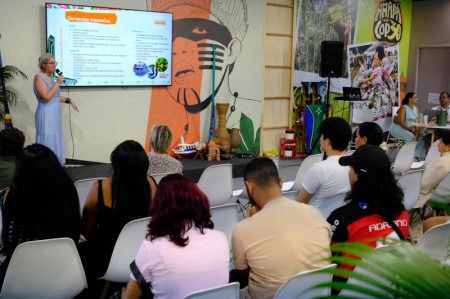
Nubia Caramello (IFAP), one of the coordinators of the Amazon+10 Initiative project in the state of Amapá, says demands range from access to energy and education to new income alternatives (photo: FAPEAP)
Researchers from the Amazon+10 Initiative begin presenting their initial findings in the social, environmental, and economic areas.
Researchers from the Amazon+10 Initiative begin presenting their initial findings in the social, environmental, and economic areas.
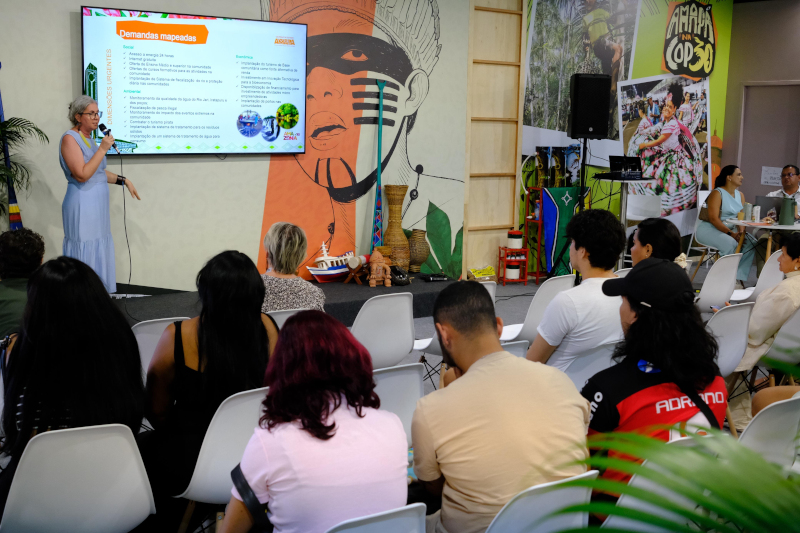
Nubia Caramello (IFAP), one of the coordinators of the Amazon+10 Initiative project in the state of Amapá, says demands range from access to energy and education to new income alternatives (photo: FAPEAP)

By Luciana Constantino | Agência FAPESP – Researchers from the Amazon+10 Initiative are beginning to present the initial results of a detailed assessment of communities in the Guaporé and Jari valleys, located in the Brazilian states of Rondônia and Amapá, respectively. The assessment was conducted with the direct participation of 2,000 residents and is based on approximately 400 interviews.
A little over three years after the expeditions began, the mapped demands are now guiding practical actions in three areas: social, environmental, and economic. These actions range from offering short- and medium-term courses to developing initial and continuing education programs, as well as monitoring the water quality of the Jari River (which flows into the Amazon River), and defining guidelines for implementing tourism in extractive and quilombola communities (descendants of populations of African origin who escaped slavery and formed villages starting in the 16th century).
The socio-environmental characterization and territorial management diagnosis project in the two valleys involves researchers from four institutions: the Federal Institute of Amapá (IFAP), the Federal University of Rondônia (UNIR), the State University of Western Paraná (UNIOESTE), and the Federal University of São Carlos (UFSCar).
Some of the expedition results were presented at a panel discussion held in early November 2025, in the Green Zone of COP30 in Belém, Pará state, by IFAP professor Nubia Caramello, one of the coordinators of the Amazon+10 Initiative project in Amapá. In Rondônia, Professor Nara Luísa Reis de Andrade from UNIR is the project coordinator.
“There are many demands. They range from access to energy and education to new income alternatives that contribute to the development of the local bioeconomy. Tourism is one of these alternatives. In view of the demand, we’re working on a book of guidelines developed jointly with the communities for tourism in riverine territories in the Amazon,” Caramello explained to Agência FAPESP.
The book was pre-launched at the International Climate Resilience Workshop, which took place from December 8 to 11 in Foz do Iguaçu and gave community residents a space to share their stories of entrepreneurship.
FAPESP announced the Amazon+10 Initiative at COP26 in Glasgow in 2021. The initiative aims to expand funding for research and innovation in the Legal Amazon. Initially, the initiative took the form of a consortium involving the state of São Paulo and the nine states of the Legal Amazon, an area created by the Brazilian federal government for regional development and environmental preservation policies. It was later taken over by the National Council of State Research Support Foundations (CONFAP). Today, it includes the participation of the FAPs of 25 states.
Training
For Professor Irene Carniatto of UNIOESTE, one of the most important issues for communities is education and continuing education. In some of these locations, up to 40% of adults are illiterate, and many do not attend high school due to a lack of schools in their communities.
“In places where transportation depends on boats, children leave in the morning and return at the end of the day, missing out on much of their family life and learning. Often, these families are divided so that their children can continue their studies. Mothers are forced to move to nearby towns so that their children can attend high school. This creates a major difficulty. They also lose their cultural connection and sense of belonging to the local community. We don’t want this exodus to happen. That’s why we went there, to listen to them and try to help,” says Carniatto.
In this sense, not only courses aimed at young people are being planned, but also continuing education focused on local production chains. One of the delivery stages will be identifying micro-production chains in agro-extractive communities.
According to Professor Frederico Yuri Hanai from the Department of Environmental Sciences at UFSCar, one of the positive aspects of the project is the vast experience of the teams of coordinators and researchers involved in community work.
“They’ve demonstrated deep harmony and synergy in the execution of actions, acting with responsibility and sensitivity. This is also evident in the application of inclusive and integrative methods and the adoption of an immersive commitment, aiming to promote reciprocal learning, while respecting and valuing the identity of all communities,” he says.
Hanai received two grants from FAPESP for the project (25/01200-0 and 22/10445-9).
Collective construction
According to Caramello, the diagnostic process developed in the project was guided by the United Nations Sustainable Development Goals (SDGs). Workshops were held to explain the SDGs and their significance. Residents then chose the goals and identified 13 of the 17 SDGs as priorities.
The SDGs, established in 2015, comprise a global agenda for developing and implementing public policies focused on the 2030 Agenda – an action plan to eradicate poverty, protect the planet, and ensure the well-being of all people.
The project’s methodology was based on action research and participatory management with successive validations and the joint definition of short-, medium-, and long-term priorities.
The Guaporé Valley (Western Amazon) and the Jari Valley (Eastern Amazon) are home to rich Amazonian socio-biodiversity. However, these territories are marked by socio-environmental conflicts that affect populations and natural resources.
Sport fishing has also impacted some areas, causing environmental damage and losses, especially for traditional communities, including quilombolas and indigenous peoples, who depend on fish and river water for survival.
The Agency FAPESP licenses news via Creative Commons (CC-BY-NC-ND) so that they can be republished free of charge and in a simple way by other digital or printed vehicles. Agência FAPESP must be credited as the source of the content being republished and the name of the reporter (if any) must be attributed. Using the HMTL button below allows compliance with these rules, detailed in Digital Republishing Policy FAPESP.
