




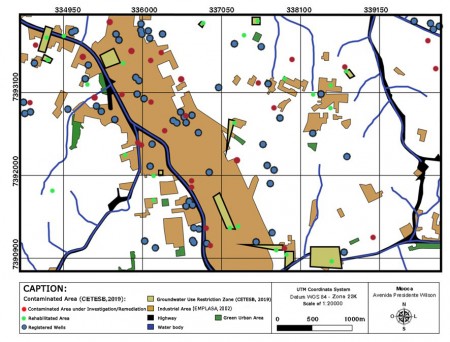
The map shows a section of the Mooca neighborhood in the city of São Paulo, where wells are located in close proximity to or overlap with former contaminated industrial areas (image: Luiz Fregona)
Two-thirds of the 14,000 private wells in the São Paulo Metropolitan Area in Brazil are not formally registered, and many of the compliant wells operate in areas contaminated by toxic industrial waste.
Two-thirds of the 14,000 private wells in the São Paulo Metropolitan Area in Brazil are not formally registered, and many of the compliant wells operate in areas contaminated by toxic industrial waste.
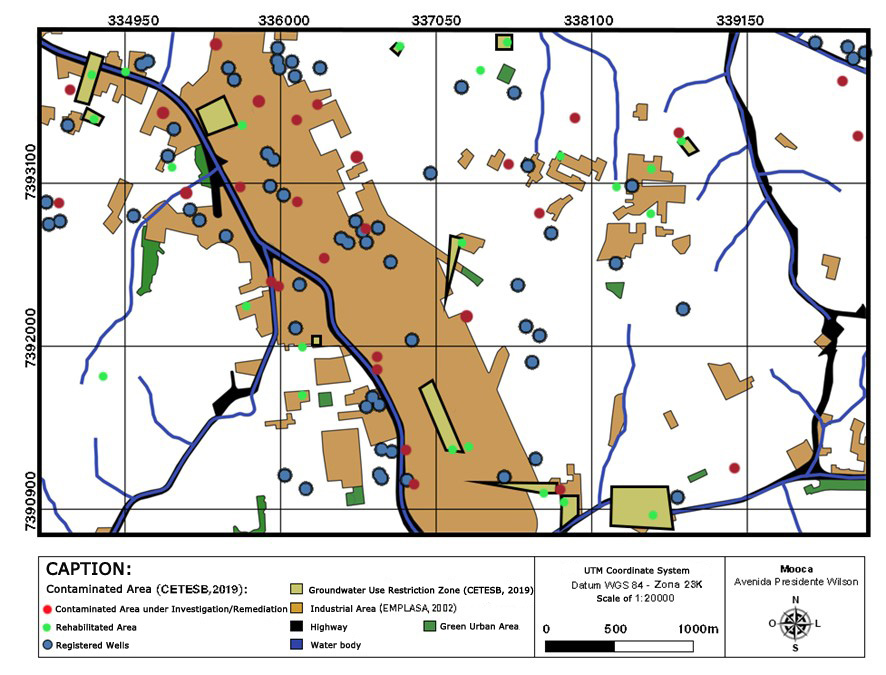
The map shows a section of the Mooca neighborhood in the city of São Paulo, where wells are located in close proximity to or overlap with former contaminated industrial areas (image: Luiz Fregona)
By José Tadeu Arantes | Agência FAPESP – The São Paulo Metropolitan Area (SPMA) in Brazil has approximately 22 million inhabitants and consumes an average of 61.6 cubic meters (61,600 liters) of water per second. Although nearly the entire public water supply originates from surface sources, it is estimated that about 18% of total consumption relies on aquifers through approximately 14,000 private wells. Aquifers contribute approximately 347 million cubic meters of water per year.
However, two-thirds of these wells are not formally registered. Many of them were drilled in former industrial zones that are now deindustrialized and undergoing real estate redevelopment. Contamination of these areas by industrial waste, particularly by chlorinated solvents used for cleaning machines, poses a risk to groundwater consumption. This is because it is difficult to manage this environmental liability on a scale commensurate with water demand.
This is the main warning in an article published in the scientific journal Environmental Earth Sciences. Supported by FAPESP, the study was authored by Daphne Silva Pino and colleagues and examines the situation in Brazil, with a special focus on the SPMA. “We draw attention to the potential risks associated with using aquifers in former industrial areas or areas undergoing redevelopment, where monitoring remains fragmented,” says Pino.
Pino is a postdoctoral researcher at the Institute of Geosciences at the University of São Paulo (IGc-USP). Her supervisor, Reginaldo Antonio Bertolo, is also an author of the article.
Bertolo sums up the situation: “For every three wells that are drilled, two are unregulated, in the sense that government authorities are unaware of their existence, and can’t assess whether the water poses a risk to users.” According to the researcher, clubs, condominiums, industries, and hospitals are among the main consumers of this groundwater resource.
Perchlorethylene (C₂Cl₄) and trichloroethylene (C₂HCl₃), which are used as industrial degreasers, stand out among the main contaminants classified under the category “chlorinated solvents.” “These substances are widely used for cleaning metal parts and are highly toxic,” says Pino. She adds that perchloroethylene was used for decades in dry cleaning establishments, and current Brazilian legislation permits its use despite imposing various restrictions and requirements. “Use has decreased significantly, but these solvents are still present in industrial settings,” she says.
These products are regulated in the industrial sector, yet public information on who uses them and in what quantities is scarce. Additionally, there are regulatory gaps concerning the disposal and recycling of these solvents.
From a hydrogeological perspective, the risk is not limited to toxicity. Bertolo notes that hydrocarbons leaked from gas stations tend to degrade more quickly. Chlorinated solvents, on the other hand, behave more persistently. “When degradation occurs, ‘offspring’ compounds are formed that can be even more toxic than the original compound,” he states. Pino adds that deep-well pumping operations create a downward hydraulic gradient that facilitates the migration of these contaminants to deeper levels of the aquifer.
One of the key contributions of the study is the cartographic overlay of three layers of information: industrial zones, areas officially contaminated by chlorinated solvents, and water supply wells. The analysis shows that these three dimensions frequently overlap in São Paulo. Pino describes one of the figures produced by the study corresponding to an area in the Mooca neighborhood. Mooca is one of the regions of São Paulo that underwent significant deindustrialization. “The blue dots represent known water supply wells, the red, contaminated areas, and the green polygons indicate areas where there should be no water extraction. What stands out is the proximity, and even overlap, between registered wells and contaminated areas. The problem becomes even more serious when considering the prevalence of unregistered wells, which obviously don’t appear in the figure.”
This phenomenon is also occurring in other deindustrialized areas of the city of São Paulo. Deindustrialization began in the late 1970s, took hold in the following decade, and has intensified ever since. Due to high urban costs, many companies moved their factories to municipalities in the Metropolitan Area, to other parts of the state of São Paulo, or even to other states.
This process has left behind abandoned warehouses and contaminated soil. Former industrial districts that were not simply left to ruin began to house service activities, commerce, and real estate developments in areas unprepared for this economic and social reconfiguration. According to São Paulo state law, if there is a contaminated area within 500 meters of a well, the responsible party must submit water quality reports to the environmental agency. The authors applied this criterion to maps produced in the study and identified 17 clusters of contaminated areas and wells with overlapping radii in regions such as Jurubatuba, Jaguaré, Mooca, and Vila Prudente in the state capital, as well as Diadema, Mauá, and Osasco in the SPMA.
“Many of these areas act as multipoint sources of contamination, with intersecting plumes. And there are deep wells used for human consumption within these belts,” Pino emphasizes. The study points out that contaminated areas are usually managed at the boundary of each property, but groundwater ignores property lines. “Topsoil is removed to control the immediate risk and prevent toxic vapors from entering buildings, for example. But much of the contaminant mass remains deep underground and continues to be transported by groundwater,” Bertolo describes.
By 2020, only 18.6% of sites contaminated by chlorinated solvents had been classified as “rehabilitated for the declared use.” This category does not imply the complete elimination of the contaminant mass but rather its reduction to acceptable risk levels. Upon analyzing the São Paulo registry, the researchers identified 596 areas with a history of chlorinated solvents. More than half were still in the remediation phase, while 26% remained under investigation.
Bertolo states that contamination tends to be concentrated in the top few meters of the aquifer. “But when pumping at a depth of 100 meters, a downward gradient is created that causes the contaminated water from the shallow zone to slowly migrate downward,” he explains. He notes that less permeable geological layers can act as natural filters but acknowledges significant uncertainties about the effectiveness of this mechanism over decades. The toxicity of the solvents exacerbates the situation. “The potability limit is in the order of parts per billion,” the researcher notes. “Even a minimal amount dissolved is sufficient to compromise enormous volumes of water.”
Jurubatuba, in the southern part of the municipality of São Paulo, is cited in the article as the most studied area in the SPMA. Nevertheless, three-quarters of the sites located there lack detailed information in environmental registries. Half of these sites are industrial facilities with a documented history of using chlorinated solvents. Bertolo views monitoring the region as a pilot for larger-scale action in other industrial hotspots, such as parts of the ABCD region of São Paulo (a subregion of the SPMA), involving coordinated efforts between the São Paulo State Environmental Company (CETESB) and the São Paulo State Water Agency.
“Today, the situation calls for strategic action that goes beyond a case-by-case approach and directs public policy to prevent the use of groundwater in broader areas. When looking at the aquifer, rigid geometric boundaries around a property make no sense. We need to treat these regions as integrated hydrogeological systems,” adds Pino.
The article concludes with a call for more robust databases, multidisciplinary technical teams, and systematic regional assessments capable of gauging the true extent of the problem and guiding long-term policies.
The article “Overview of groundwater management at sites contaminated by chlorinated solvents in Brazil” can be read at doi.org/10.1007/s12665-025-12727-x.
The Agency FAPESP licenses news via Creative Commons (CC-BY-NC-ND) so that they can be republished free of charge and in a simple way by other digital or printed vehicles. Agência FAPESP must be credited as the source of the content being republished and the name of the reporter (if any) must be attributed. Using the HMTL button below allows compliance with these rules, detailed in Digital Republishing Policy FAPESP.
