





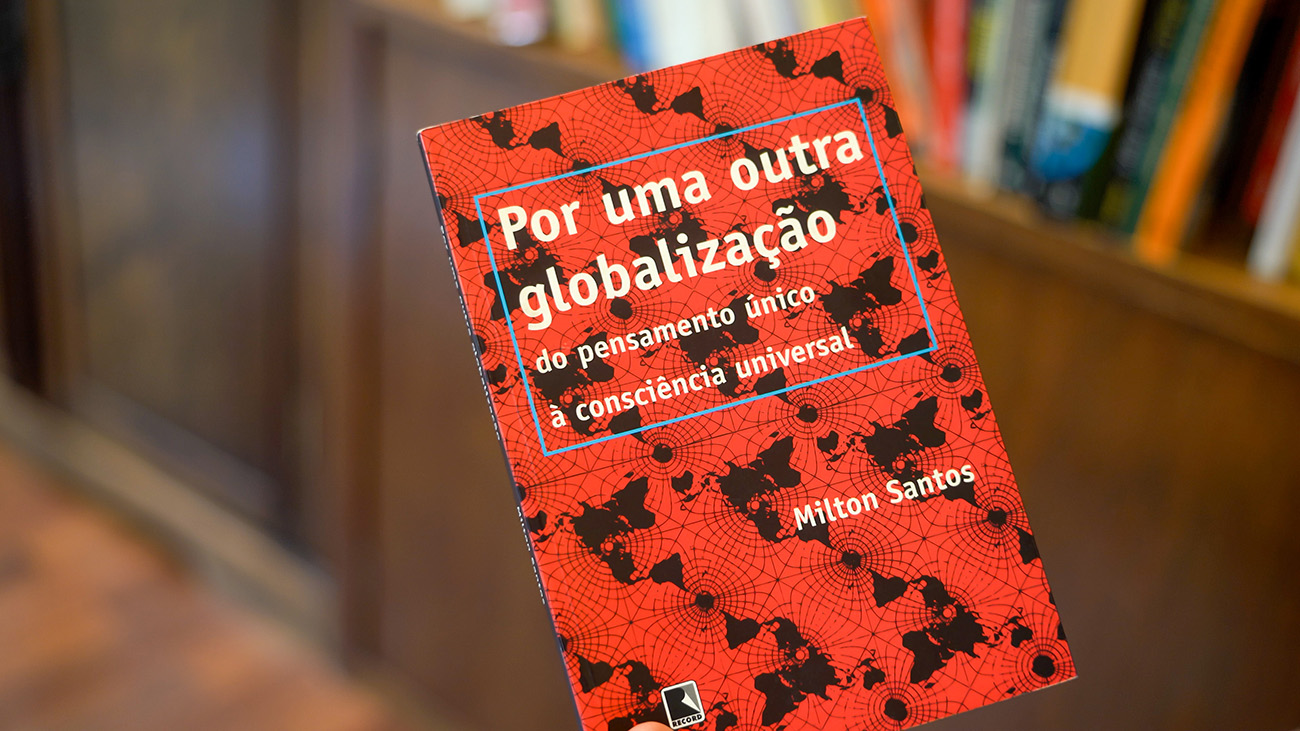
By José Tadeu Arantes | Agência FAPESP – In Toward an Other Globalization (2000), Milton Santos offers one of the most original interpretations of contemporary globalization. He proposes a reading that breaks with common sense and the dominant narrative produced by centers of power. The book is organized around a famous conceptual triad – globalization as a fable, as perversity, and as a possibility – which simultaneously synthesizes a radical critique and a horizon of transformation.
Globalization as a fable corresponds to the world as it is portrayed. It is an ideological construct that presents the planet as a unified, transparent space accessible to all. In this discourse, the dissemination of technology and information enables the integration of economies and societies. The speed of flows, the instantaneity of communications, and the expansion of markets appear in this discourse as signs of inevitable progress. However, Milton Santos shows that this narrative does not describe the real world; rather, it conceals it. According to Santos, it constitutes a fable, or a representation constructed to legitimize the existing order and neutralize criticism. By selling the image of a homogeneous world, this discourse conceals the profound differences that structure the global space and naturalizes inequalities that are, in fact, historically produced.
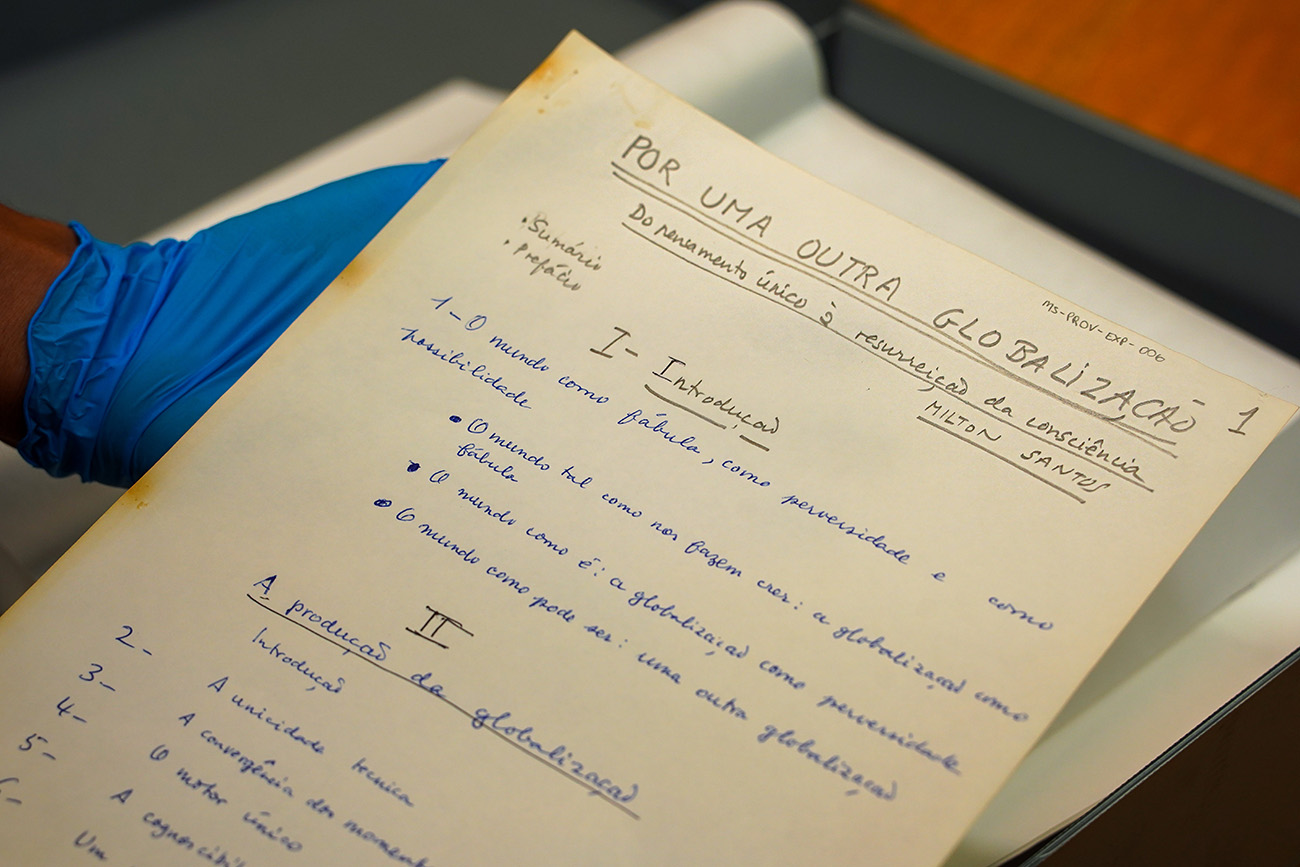
The book’s original manuscript, available at IEB-USP’s archive (photo: Daniel Antônio/Agência FAPESP)
When we move from fable to reality, globalization emerges as a perverse force. Here, the author shifts the focus to how the system actually functions, revealing that globalization fragments rather than integrates and concentrates rather than distributes. Technology, a central element of the contemporary world, is not neutral. It is appropriated by hegemonic actors and placed at the service of a logic of accumulation that reinforces asymmetries. Consequently, the world organizes itself selectively, linking spaces that are highly integrated into global circuits with others that remain marginalized or subordinated. In this context, phenomena such as structural unemployment, precarious work, and social exclusion are not anomalies but inherent results of the model. The territory itself becomes the most visible expression of this inequality because, as the author emphasizes throughout his work, space is an inseparable set of systems of objects and systems of actions. It is precisely in this articulation that power relations materialize.
The perversity of globalization also manifests itself in everyday life, where the promise of universal consumption coexists with the reality that most people cannot access it. Consumption, presented as the common language of global citizenship, becomes a mechanism of differentiation and exclusion in practice. Although information is technically widespread, it is socially controlled, which limits its capacity to promote true democratization. Thus, what appears to be integration is actually subordinate integration, in which vast segments of the population are only partially and precariously incorporated.
However, Milton Santos’s originality lies in not limiting his analysis to denunciation. The third dimension – globalization as a possibility – introduces a decisive shift in the argument. The same process that produces inequalities also creates the conditions to challenge them. The technical unity of the planet, by making the world interdependent, creates space for a universal consciousness. At this point, the author shifts his focus to subaltern subjects and everyday practices, identifying in them a potential often overlooked by traditional analyses. In this context, the concept of “slow men” emerges – those who do not fully participate in the accelerated logic of capital and, for that very reason, have a more acute perception of the system’s contradictions.
These individuals are anything but passive. They construct alternative ways of using the territory based on solidarity, proximity, and the reinvention of available resources. In this case, technology can be reappropriated and given new meaning. It ceases to be merely an instrument of domination and becomes a means of collective action. As the author himself observes, every place is the world in its own way, and the possibilities for transformation open up in the place – understood not as a backdrop, but as a lived space. The power of the place lies in its ability to articulate experiences, produce meanings, and sustain practices that escape, at least partially, the dominant logic.
The book thus points to the emergence of another globalization, one founded not on competitiveness and exclusion but on solidarity and citizenship. This other globalization is not an abstract utopia but a possibility rooted in the contradictions of the present. It depends on constructing a new political project capable of reorienting technology use and placing territory at the service of the majority. In this sense, Milton Santos’s work balances criticism and hope, demonstrating that while the contemporary world intensifies inequalities, it also contains the elements necessary for overcoming them.
Ultimately, a shift in perspective emerges. Globalization is no longer seen as an inevitable destiny, but rather as an open historical process in which human intervention is possible. Rather than embracing a single rationality, Milton Santos affirms the plurality of experiences and the possibility of building a more just world. His analysis dismantles the illusions of the present and restores society’s capacity to imagine and shape the future.
Republish
The Agency FAPESP licenses news via Creative Commons (CC-BY-NC-ND) so that they can be republished free of charge and in a simple way by other digital or printed vehicles. Agência FAPESP must be credited as the source of the content being republished and the name of the reporter (if any) must be attributed. Using the HMTL button below allows compliance with these rules, detailed in Digital Republishing Policy FAPESP.
