




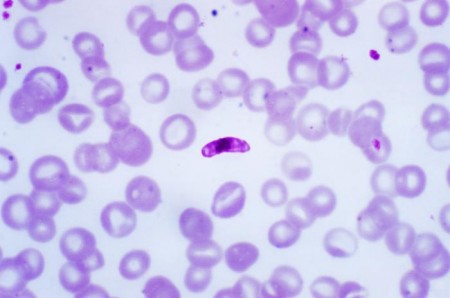
According to the researchers, the new molecule is highly selective because it acts on the parasite’s mitochondria and not on those of humans, inhibiting an enzyme complex that is essential for the formation of nitrogenous bases in DNA, without which the parasite cannot replicate or complete its life cycle (image: P. falciparum macrogametocyte/Wikimedia Commons)
Tests on cell cultures and rodents have shown that the new molecule acts on all three stages of the disease cycle, eliminating the parasite from human blood and liver and preventing transmission to mosquitoes.
Tests on cell cultures and rodents have shown that the new molecule acts on all three stages of the disease cycle, eliminating the parasite from human blood and liver and preventing transmission to mosquitoes.
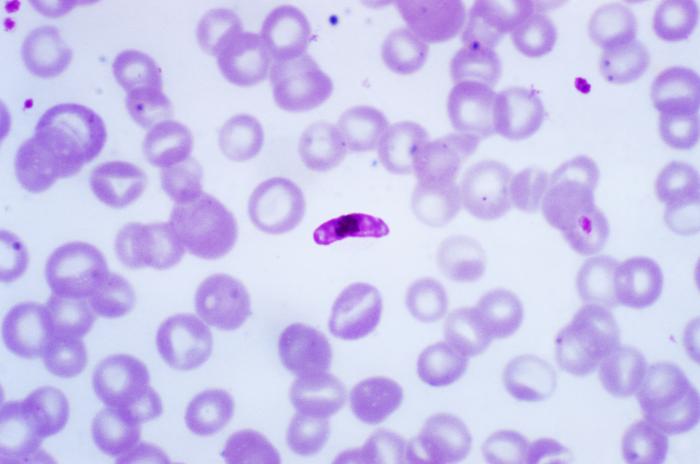
According to the researchers, the new molecule is highly selective because it acts on the parasite’s mitochondria and not on those of humans, inhibiting an enzyme complex that is essential for the formation of nitrogenous bases in DNA, without which the parasite cannot replicate or complete its life cycle (image: P. falciparum macrogametocyte/Wikimedia Commons)
By Maria Fernanda Ziegler | Agência FAPESP – Brazilian researchers have developed a synthetic compound that has the potential to treat malaria and block its transmission. The new molecule acts during three phases of the disease cycle, eliminating the asexual form of the parasite from human blood and liver, and preventing transmission to mosquitoes. This multi-stage approach is a more comprehensive strategy for combating the disease.
“An important difference with this compound is its effectiveness against Plasmodium vivax, the predominant species in Brazil, which can’t be continuously cultivated in the laboratory. The discovery was made possible thanks to tests carried out at FIOCRUZ [Oswaldo Cruz Foundation] in Rondônia, using blood from infected patients. The molecule also acts against P. falciparum, a commonly more aggressive parasite of the disease,” says Anna Caroline Aguiar, a professor at the Federal University of São Paulo (UNIFESP) and author of the study.
The work was conducted at UNIFESP in collaboration with researchers from the Center for Research and Innovation in Biodiversity and Pharmaceuticals (CIBFar), a FAPESP Research, Innovation, and Dissemination Center (RIDC) based at the São Carlos Institute of Physics at the University of São Paulo (IFSC-USP).
FAPESP supported the research through Thematic Projects (21/12394-0 and 24/04805-8) and a Young Investigator Grant, as well as through partnerships with the Oswaldo Cruz Foundation in Rondônia, the Center for Tropical Medicine in Rondônia, the Federal University of São Carlos, and NOVA University Lisbon in Portugal.
In their article published in the journal ACS Omega, the researchers describe the triple effect of the compound derived from natural 4-quinolones. This compound blocks asexual liver infection, combats the blood stages of the disease (which are responsible for the symptoms), and prevents transmission to mosquitoes.
“We’ve been studying this compound for five years and, during that time, we’ve proven its effect against the parasite in the hepatic and blood stages, when it’s in the host. In this new article, we demonstrate its action in blocking disease transmission for the first time experimentally,” Aguiar explained to Agência FAPESP.
Tests conducted on cell cultures with blood from infected patients showed that the molecule inhibits parasite formation in stages that occur inside the mosquito vector (when the parasite is in the ookinete, oocyst, and sporozoite stages). Therefore, even if an infected person treated with the compound is bitten by the insect, the parasite cannot be transmitted to another person.
This finding was confirmed in studies conducted on mice at NOVA University Lisbon. The animals were treated with the compound and infected with Plasmodium berghei, a malaria parasite that infects rodents.
“What makes this molecule particularly interesting is that it acts on all three stages of the malaria cycle: hepatic, blood, and transmission. In general, malaria patients need different medications to cover these stages, and this compound combines treatment and transmission-blocking potential, with possible use for prevention,” Aguiar says.
Many stages
Malaria is a complex disease caused by protozoa of the genus Plasmodium. The life cycle of these protozoa involves two hosts: humans and female Anopheles mosquitoes. In humans, the life cycle is divided into three stages: hepatic, blood, and transmission.
The disease begins in humans when an infected mosquito bites someone and injects parasites called sporozoites. The parasites then reach the bloodstream and travel to the liver, where they invade liver cells and multiply.
After multiplying in the hepatic phase, the parasites return to the bloodstream and invade red blood cells, destroying them. The typical symptoms of malaria, such as fever, chills, and anemia, appear during this phase, called the blood phase.
Transmission occurs when another mosquito bites an infected person and ingests the parasites in their blood. Inside the mosquito, the parasites develop until they reach a form capable of infecting other humans, thus restarting the cycle.
Aguiar explains that the new molecule acts on the parasite’s mitochondria by inhibiting an enzyme complex called cytochrome bc1. This complex is essential for producing pyrimidines, which are fundamental building blocks of DNA. Without the ability to form DNA, the parasite cannot replicate or complete its life cycle.
“Another important aspect is that this molecule is highly selective. It acts on the parasite’s mitochondria but not on those of humans,” Aguiar says.
The researchers emphasize that there is still a long way to go before the new molecule can be developed into an effective malaria treatment. Currently, malaria kills about 600,000 people a year, most of whom are in Africa.
“The molecule is an excellent candidate, and the evidence warrants investment in the future development of a drug. This is because, although there’s treatment for the disease, it’s a very well-adapted parasite capable of developing resistance to existing drugs,” says Rafael Guido, a professor at IFSC-USP and co-author of the study.
The article “Evaluation of the activity of 4-quinolones against multi-life stages of Plasmodium spp.” can be read at pubs.acs.org/doi/10.1021/acsomega.5c08663.
The Agency FAPESP licenses news via Creative Commons (CC-BY-NC-ND) so that they can be republished free of charge and in a simple way by other digital or printed vehicles. Agência FAPESP must be credited as the source of the content being republished and the name of the reporter (if any) must be attributed. Using the HMTL button below allows compliance with these rules, detailed in Digital Republishing Policy FAPESP.
