




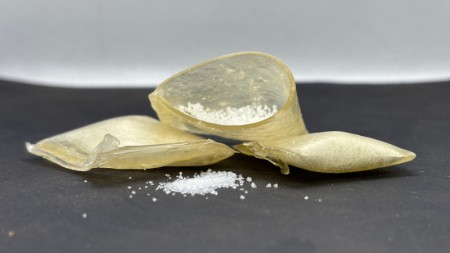
Research has developed starch sachets that are processed with urea and citric acid and reinforced with copper-ion-rich zeolite (photo: João Otávio Donizette Malafatti)
Nanoparticle-reinforced wrappers can be filled with various formulations of the granular products needed for crops, a versatility that facilitates application by agribusiness.
Nanoparticle-reinforced wrappers can be filled with various formulations of the granular products needed for crops, a versatility that facilitates application by agribusiness.
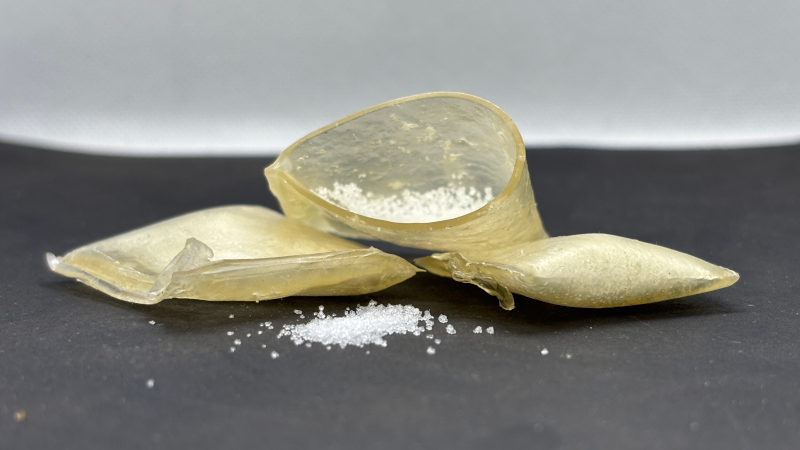
Research has developed starch sachets that are processed with urea and citric acid and reinforced with copper-ion-rich zeolite (photo: João Otávio Donizette Malafatti)
By Karina Ninni | Agência FAPESP – An innovative product with the potential to replace polymers used in soil fertilizers is being developed in São Carlos in the state of São Paulo, Brazil, through a collaboration between the National Nanotechnology Laboratory for Agriculture (LNNA) of EMBRAPA Instrumentation, one of the decentralized units of EMBRAPA (the Brazilian Agricultural Research Corporation), and the Federal University of São Carlos (UFSCar). The innovation consists of starch sachets reinforced with nanoparticles that contain powdered or granulated fertilizers. Starch is a biodegradable polymer, and in sachet form, it can be filled with a mixture of various nutrients that are essential for crops.
“There are essential and irreplaceable nutrients for plants, such as the trio of nitrogen, phosphorus, and potassium [NPK] – usually applied to the soil in the form of highly soluble potassium chloride salt. Farmers generally apply a large amount to the field to ensure absorption. However, the cultivated plant cannot immediately absorb all of this fertilizer,” explains chemist João Otávio Donizette Malafatti. “This excess becomes an economic loss and can contaminate the surrounding environment. The sachets aim to control the release so that the plant feeds gradually. In this sense, we modulate different types of sachets depending on the nutrients we’re going to add inside them.”
Malafatti is the first author of an article published in the Journal of Inorganic and Organometallic Polymers and Materials about the work, supervised by EMBRAPA Instrumentation researcher Elaine Cristina Paris. Paris is a researcher in the Graduate Program in Chemistry (PPGQ) at UFSCar.
Malafatti developed starch sachets that were processed with urea and citric acid and reinforced with zeolite that was rich in copper ions. Zeolite is a porous mineral with a high adsorption capacity for ions, such as copper.
“Starch is a material that’s susceptible to degradation. Therefore, a formulation is needed so that the sachets preserve their characteristics until they reach their destination in the soil. In this process, the copper ions present in zeolite have a dual function: they have great antimicrobial properties, both for fungi and bacteria, controlling the growth of microorganisms, and, in addition, they’re sources of mineral micronutrients, which are subsequently absorbed by the roots.” In the study, the presence of copper controlled the growth of the fungus Alternaria alternata, Malafatti explains. “The goal is to strike a balance between preserving the sachets in the final application in the soil and subsequently making their contents available to the external environment.”
Resistance and stability
According to Malafatti, biodegradable polymers and starch matrices still need to overcome certain challenges compared to similar petroleum-derived products, especially regarding mechanical resistance and stability over time. Therefore, the research seeks to develop formulations capable of improving these properties.
In the study, the group evaluated various zeolite concentrations and found that a maximum value of 3% relative to starch significantly increased mechanical resistance. Above that limit, however, the particles tend to agglomerate, which weakens the film. In addition to releasing nutrients, zeolite fulfills another function during periods of drought. “It can store water because it’s very porous and hydrophilic, meaning it has a high affinity for water molecules,” Paris explains. The researcher compares the sachet to a tea bag to which granular fertilizer is added.
The work was supported by FAPESP through a scientific initiation scholarship and postdoctoral fellowships in Brazil and abroad.
Versatility
According to the scientists, the sachets are versatile because they increase the solubility of stored fertilizers and control the release of highly soluble sources. This reduces fertilizer loss through aerial dispersion and leaching from rainfall.
In previous work supervised by Paris, UFSCar doctoral student Camila Rodrigues Sciena investigated a fertilizer candidate: hydroxyapatite, a phosphorus source. The goal was to increase its solubility. The scientists discovered that acidifying the medium using pectin in the starch sachet composition increased solubility when combined with nanoparticulated hydroxyapatite.
“With water, the starch becomes gelatinous and holds the fertilizer in the soil available for the plant, so that future losses due to rain or wind can be minimized. The goal is to reduce percolation [the passage of water through porous material, causing the extraction of compounds] and the dragging of particulate fertilizer inside the sachet,” says Sciena.
In the case of Malafatti’s work, the group is working with a highly soluble fertilizer that quickly dissolves when it comes into contact with water. “In this case, the intention is for the fertilizer to be released gradually, avoiding losses due to leaching or air dispersion. It’s a sustained release, which will depend on the formulation of the sachets,” says Paris.
To test the nutrient release capacity, the sachets were kept in an aqueous medium for 30 days. The experiment demonstrated the partial release of copper ions (7 mg L-1) and urea (300 mg L-1). The hydrophilic properties of the sachets favored contact with the external environment, helping water permeation and potassium chloride release. “The sachets obtained could minimize losses in fertilizer application, in addition to controlling the amount of nutrient that would be in contact with the soil,” say the authors.
Solubility and cytotoxicity tests were also performed on copper zeolite to determine its properties and potential interaction with the environment after release from the sachets. Cytotoxicity tests performed on cress root growth suggest 92% germination viability after one hour of exposure to zeolite, indicating its potential use in agriculture. To verify copper availability, solubility tests were performed in water (neutral pH) and citric acid. Desorption efficiency, or the process by which a substance is released from the mass or surface of another substance, increased the availability of copper in an acidic environment, rising from 5% to 45% of the expected total.
Costs and customization
According to Paris, ongoing research is seeking alternatives to reduce the cost of processes and materials for the prolonged release of fertilizers. “Starch is a promising raw material, although the addition of extra components can influence the final cost of the material. In Malafatti’s work, we didn’t use starch from other sources, such as waste, for example. It’s commercial starch,” says the researcher. “But for soil fertilization, it isn’t necessary to use high-purity starch, such as that used in the food industry. So, the goal is to try to make it as cheap as possible so that agribusiness can incorporate it. Thus, the sachets have greater potential to be effectively marketed, contributing to technological advancements in agriculture.”
Another advantage is that the added fertilizer does not affect the formulation or format of the sachet during processing. “Any granular or particulate fertilizer can be inserted into the sachet, which is another positive point for its incorporation by the industry,” Malafatti points out. Additionally, the sachet eliminates the need for agricultural workers to handle fertilizers in particle form directly.
According to Paris, the technology is still in the laboratory phase. Initial applications would be in landscaping, gardening, hydroponics, and greenhouses. For large-scale agricultural production, however, optimizations in scaling and economic viability are necessary, which are the next steps planned by the group.
Sciena points out that the sachet can be used for different crops. “Grapes have different needs than tomatoes, for example. It’s a form of customized fertilization where you can adapt the mixture of nutrients and the type of sachet. One can be more acidic to enhance the solubilization of poorly soluble fertilizer, while another can be less acidic to slowly solubilize soluble fertilizer,” she summarizes.
The article “Copper-modified faujasite zeolite reinforcement in biodegradable starch sachets for potassium fertilizer releasing” can be read at link.springer.com/article/10.1007/s10904-025-03655-1.
The Agency FAPESP licenses news via Creative Commons (CC-BY-NC-ND) so that they can be republished free of charge and in a simple way by other digital or printed vehicles. Agência FAPESP must be credited as the source of the content being republished and the name of the reporter (if any) must be attributed. Using the HMTL button below allows compliance with these rules, detailed in Digital Republishing Policy FAPESP.
