




Structure of the GP1 protein of the Sabiá virus and its differences compared to previously known strains (figure on the right in blue). These changes may influence how the virus interacts with human cells (image: Ingra M. Claro/FM-USP)
Researchers at a FAPESP-supported center developed a new method and identified the infection in two patients who died from acute hemorrhagic and neurological syndrome in São Paulo in 2019 and 2020.
Researchers at a FAPESP-supported center developed a new method and identified the infection in two patients who died from acute hemorrhagic and neurological syndrome in São Paulo in 2019 and 2020.
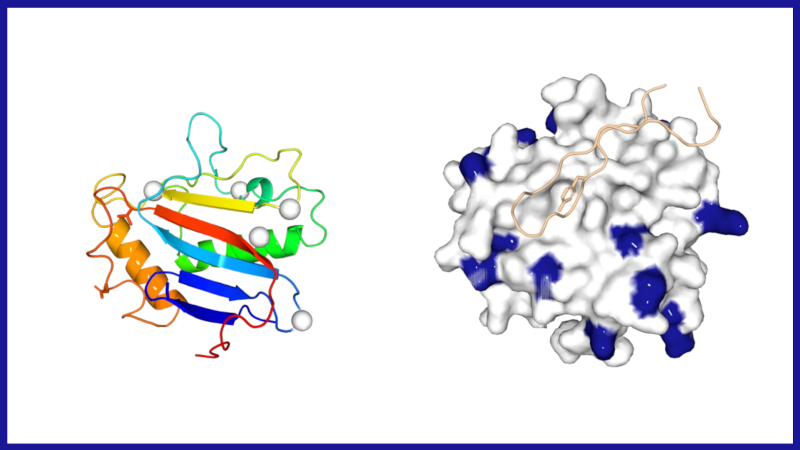
Structure of the GP1 protein of the Sabiá virus and its differences compared to previously known strains (figure on the right in blue). These changes may influence how the virus interacts with human cells (image: Ingra M. Claro/FM-USP)
By André Julião | Agência FAPESP – The Sabiá virus causes an acute hemorrhagic and neurological syndrome. Four fatal cases have been recorded in the state of São Paulo since 1990. The virus has been circulating in Brazil for about 142 years. Genomic analyses of two cases recorded in 2019 and 2020 show that the virus has undergone genetic changes over time, which explains why it was not identified by existing tests.
These results are part of a study published in the journal PLOS Neglected Tropical Diseases. The study was conducted by researchers from the Brazil-UK Joint Center for Arbovirus Discovery, Diagnostics, Genomics, and Epidemiology (CADDE), a research center supported by FAPESP and based at the University of São Paulo Medical School (FM-USP) and Imperial College London in the United Kingdom.
“The reference strain of the Sabiá virus dates back to 1990, from a case in Cotia. The diagnostic method was developed based on that genome. Since more than 30 years have passed, it was very likely that the virus had mutated. We don’t have enough cases to validate this method further, but it can be used for future suspected cases with greater accuracy than the tests used until now,” says Ingra Morales Claro, who conducted the research during her Ph.D. studies with a FAPESP scholarship at FM-USP and is currently pursuing postdoctoral research at the University of Kentucky in the United States.
The team developed primers – small DNA fragments used to detect the virus in laboratory tests – and sent them to the Adolpho Lutz Institute in São Paulo, the state’s leading facility for this type of testing.
The genomes recovered from Sabiá were approximately 89% genetically identical to strains previously described in 1999, when the second case in history was recorded. “When analyzing the genomes of the new cases, we identified mutations in target regions of the primers that prevented detection by existing diagnostic tests. We modified those regions, and now it’s possible to identify the circulating strains,” Claro explains.
The CADDE is coordinated in Brazil by Ester Sabino, a professor at FM-USP who led the first sequencing of SARS-CoV-2 in the country in March 2020, as well as the mpox virus in 2022 (read more at agencia.fapesp.br/32656/, agencia.fapesp.br/35414/, and agencia.fapesp.br/38928). In the United Kingdom, the center is coordinated by Nuno Faria of Imperial College London.
His team led the ZiBRA project which sequenced the Zika virus and mapped the yellow fever outbreak in Brazil and São Paulo. Together with Sabino, his team also coordinated the initial characterization of the SARS-CoV-2 Gamma variant in Manaus (read more at revistapesquisa.fapesp.br/en/breaking-boundaries/ and agencia.fapesp.br/35449).
How the virus interacts with human cells
The 2020 case of Sabiá virus infection was identified through metagenomic analysis, a technique that detects different microorganisms in a sample without knowing which virus to look for in advance. The virus was present in the blood of a 52-year-old patient from Sorocaba. A rapid metagenomic approach developed during Claro’s doctoral studies was used to detect emerging pathogens in clinical samples.
The man, who had a history of hiking in forested areas, sought care at a primary care clinic on December 30, 2019. He was then transferred to FM-USP’s general and teaching hospital (Hospital das Clínicas) in São Paulo with a suspected case of yellow fever and died on January 11, 2020. Initial tests were negative for yellow fever and Sabiá virus.
After detecting the virus in subsequent tests, the researchers analyzed blood samples from seven previous cases of acute hemorrhagic and neurological syndrome that had tested negative for yellow fever. They found a case involving a 63-year-old rural worker from Assis who was admitted to the Hospital das Clínicas on December 10, 2019, and died two days later.
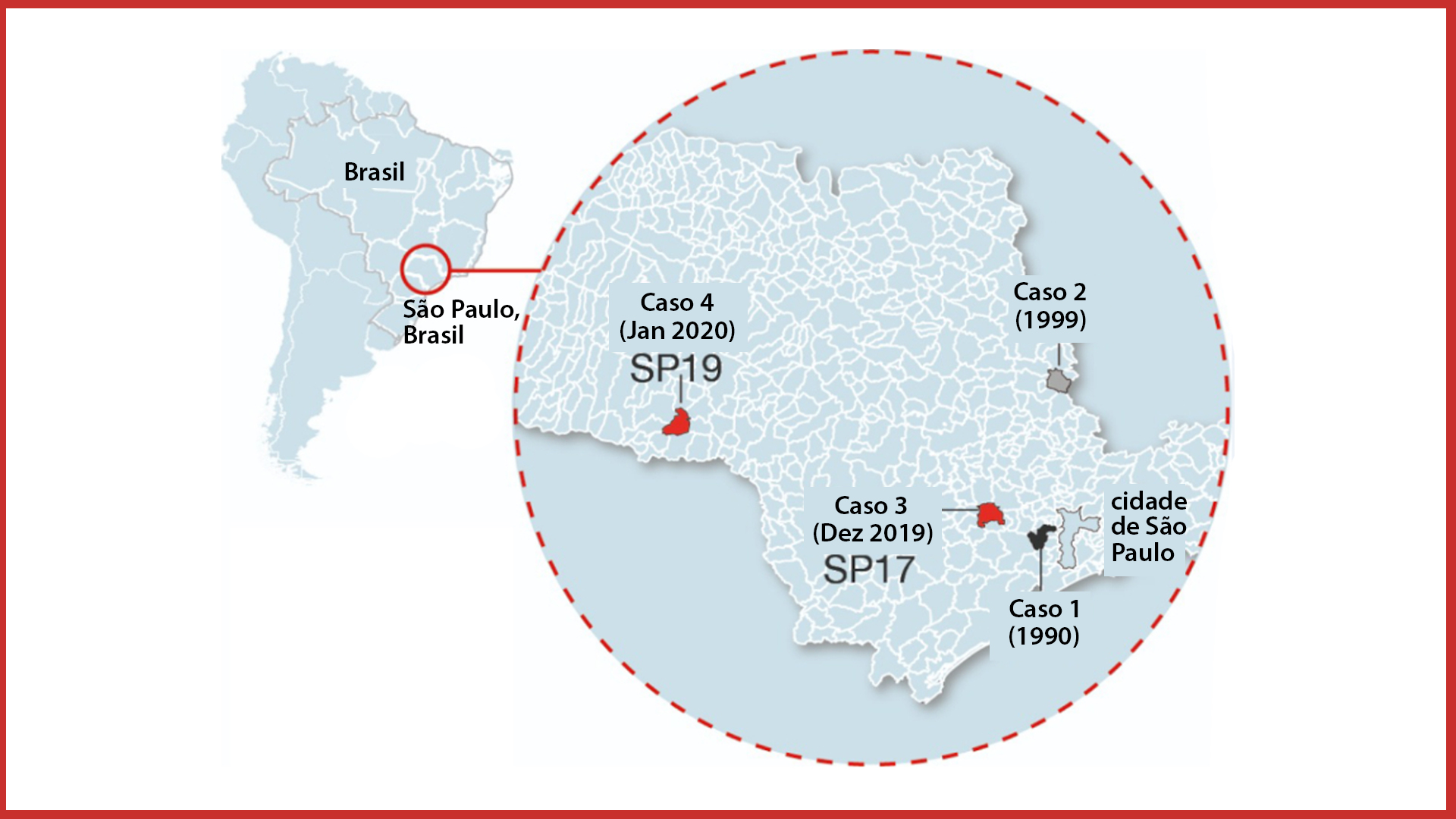
Map of municipalities in the state of São Paulo indicating locations where natural Sabiá virus (SABV) infections were detected. Case 1 (1990) occurred in Cotia, and Case 2 (1999) occurred in Espírito Santo do Pinhal. Cases 3 and 4 are from 2019 and 2020 and are from patients in Sorocaba and Assis. Taken together, the data indicate the silent circulation and genetic diversity of SABV over time (image: Ingra M. Claro/FM-USP)
In both cases, the researchers observed changes in the protein that allow the virus to bind to human cells. Phylogenetic analyses, which allow for the reconstruction of the evolutionary history of a virus, indicated that the pathogen has been circulating in Brazil for decades and is likely not a recent introduction.
“There were likely other cases in the past that went unidentified. It’s important to understand the virus, develop tests, and study the changes occurring in its genome so that we can anticipate future cases, and even outbreaks, of the disease,” Sabino warns.
Unknown reservoir
The species that serves as a reservoir for the virus is not yet known, but it is believed to be wild rodents. The infections occurred in rural areas where wild animals and humans may interact.
“In this context, metagenomic approaches have proven to be essential tools for detecting rare or unexpected pathogens, especially when targeted diagnostic tests fail. This strategy was fundamental in identifying both fatal cases of Sabiá in humans and in wild animals, and it highlights the essential role of genomic surveillance in detecting public health risks,” says Faria, citing as an example a recent study by the group on the evolution and transmission dynamics of yellow fever in Brazil.
The Sabiá virus is considered one of the Brazilian viruses with the highest risk of aerosol transmission in a laboratory setting. Handling it requires the highest level of biosafety, a capability that does not yet exist in South America.
The country’s first laboratory capable of storing and handling the active virus, Orion, is scheduled to open in 2030. It is currently under construction at the Brazilian Center for Research in Energy and Materials (CNPEM) in Campinas. Currently, the Sabiá reference strain is stored in the United States (read more at agencia.fapesp.br/52207).
The article “Genomic characterization of Sabiá virus in Brazil, 2019-2020: Implications for diagnostics, virus evolution, and receptor binding” can be read at journals.plos.org/plosntds/article?id=10.1371/journal.pntd.0014008.
The Agency FAPESP licenses news via Creative Commons (CC-BY-NC-ND) so that they can be republished free of charge and in a simple way by other digital or printed vehicles. Agência FAPESP must be credited as the source of the content being republished and the name of the reporter (if any) must be attributed. Using the HMTL button below allows compliance with these rules, detailed in Digital Republishing Policy FAPESP.
