





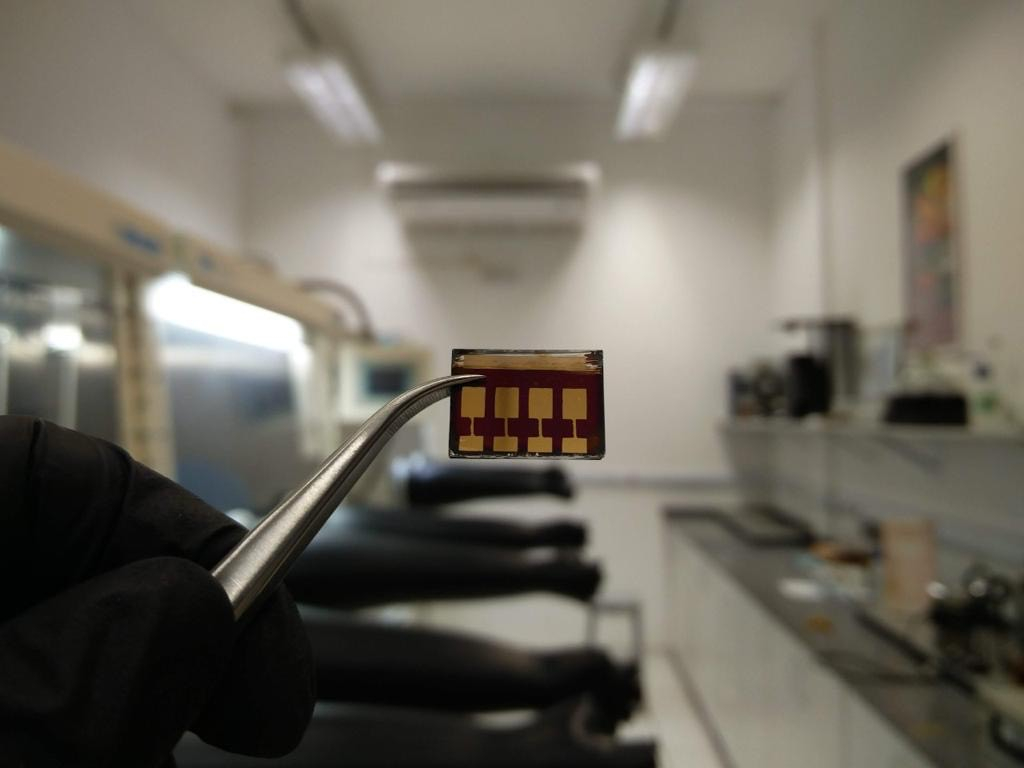
Agência FAPESP* – Researchers at the State University of Campinas (UNICAMP) and the Brazilian Center for Research in Energy and Materials (CNPEM) in the state of São Paulo, Brazil, have taken an innovative approach to the problem of perovskite solar cell instability. They presented a new strategy to optimize these devices. The study was published in the Journal of Materials Chemistry A and was conducted in the context of projects led by the Center for Innovation on New Energies (CINE).
The CINE is an Applied Research Center (ARC) established by FAPESP and Shell in 2018. The center is based at UNICAMP, the University of São Paulo (USP), and the Federal University of São Carlos (UFSCar), with the participation of eight other Brazilian institutions.
Metal halide perovskite films promise to be the stars of the next generation of solar cells due to their exceptional ability to convert sunlight into electricity (read more at revistapesquisa.fapesp.br/en/the-race-for-perovskite-solar-cells/). However, to fully exploit their potential, the stability of these materials in the face of heat and humidity must be improved.
Similar to a sandwich, perovskite solar cells are formed by several thin layers. The electrodes are the slices of bread, and the light-absorbing layer (the perovskite film) and the transport layer (which carries electrical charges to the electrodes) are the filling.
Many approaches to addressing the instability of these devices have already been researched, with varying results. In their new work, however, the authors take a novel approach, investigating how the quality of the perovskite film is influenced by the underlying layer, the part of the transport layer in direct contact with the perovskite.
To produce a solar cell, a liquid solution containing the perovskite components is deposited on the surface of this layer. The perovskite then crystallizes and forms a solid film whose grains align according to specific crystalline orientations.
The authors produced perovskite films with different crystalline orientations using different materials in the underlying layers and subjected them to a temperature of 85 °C for 500 hours.
“The main contribution of the study is to demonstrate, in a systematic and unprecedented way, how different underlayers – fundamental in the architecture of conventional and inverted perovskite solar cells – directly influence the crystalline orientation of metal halide perovskite and, consequently, its thermal stability,” says Murillo Henrique de Matos Rodrigues, a CINE postdoctoral researcher and one of the study’s authors.
This result was achieved through a partnership between the UNICAMP group, led by Ana Flávia Nogueira, a pioneer in Brazilian research on perovskite solar cells, and CNPEM researchers, who enabled the use of advanced material characterization techniques. “This synergy has already resulted in several relevant works in the field and strengthens the role of the institutions in the search for sustainable technological solutions in energy,” says Rodrigues.
The new research opens up interesting possibilities for optimizing the next generation of solar cells. “A deeper understanding of the role of the underlying layer represents a milestone for designing new transport layers that promote oriented growth, resulting in more efficient and durable devices – a crucial difference compared to previous studies,” says Rodrigues.
The work received also support from FAPESP also through a Regular Research Grant and a postdoctoral scholarship. Other institutions involved in the study’s funding include Shell, the Brazilian National Council for Scientific and Technological Development (CNPq), and the Brazilian National Agency of Petroleum, Natural Gas, and Biofuels (ANP).
The article “The influence of the buried interface on the orientational crystallization and thermal stability of halide perovskite thin films” can be read at pubs.rsc.org/en/content/articlelanding/2025/ta/d5ta01772f.
* With information from Verónica Savignano from the CINE.
Republish
The Agency FAPESP licenses news via Creative Commons (CC-BY-NC-ND) so that they can be republished free of charge and in a simple way by other digital or printed vehicles. Agência FAPESP must be credited as the source of the content being republished and the name of the reporter (if any) must be attributed. Using the HMTL button below allows compliance with these rules, detailed in Digital Republishing Policy FAPESP.
