





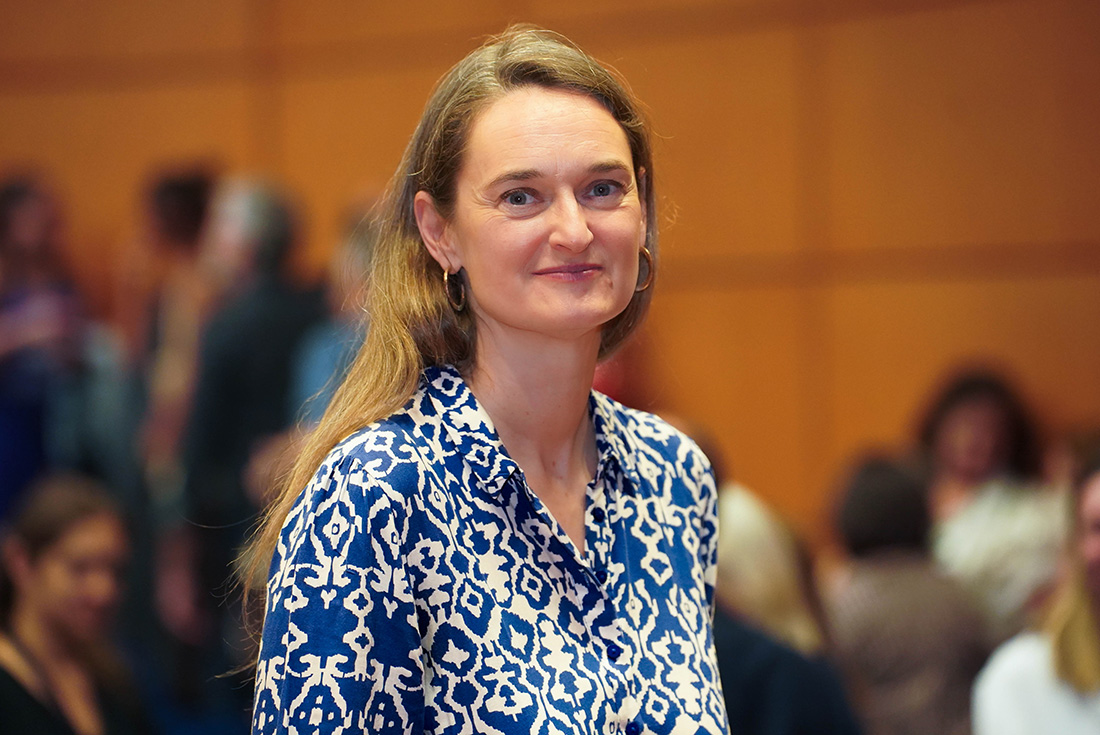
By José Tadeu Arantes | Agência FAPESP – In a world marked by fragmented social ties, political polarization, and the rapid circulation of often-false information, museums are called upon to assume a new role. They must serve as spaces for dialogue, reflection, and the reconstruction of the social fabric.
Art historian Aurélie Clemente-Ruiz, director of the Musée de l’Homme in Paris, delivered this message during the opening of the FAPESP 2026 Conference series on March 27.
According to Clemente-Ruiz, museums can no longer limit themselves to preserving, exhibiting, and transmitting knowledge. They must engage with society, participate in the debates shaping it, and help create spaces for dialogue.
Clemente-Ruiz highlighted the profound transformation these institutions are undergoing as they address contemporary challenges, including social inequalities, identity issues, the environmental crisis, and the erosion of trust in traditional sources of information.
She also noted that museums remain places of trust. At a time when the word of politicians and even the media is being questioned, the word of museums still carries weight. “This imposes an enormous responsibility on us,” she said.
From the “Temple of the Muses” to a social space
Clemente-Ruiz began her lecture with a historical overview of the museum institution, tracing its origins back to antiquity. “The museum derives from the Mouseion, the Temple of the Muses. From the beginning, it has thus embodied an almost sacred dimension linked to preserving knowledge for future generations,” she reflected.
“In the history of France, there was a profound rupture: the French Revolution. At that time, a central debate arose: Was it necessary to destroy the past, to make a clean slate, to forget the monarchy? We cut off heads, but should we also destroy the heritage?” she asked.
Clemente-Ruiz recalled that Abbot Henri Grégoire (1750–1831) played a decisive role in safeguarding this historical and artistic heritage. Grégoire was a member of the National Assembly and an advocate for the abolition of privileges. He argued that this heritage did not belong to the monarchy, but to the nation. It should be preserved as a tool for civic education and understanding of history. This position ultimately prevailed, materializing in 1793 with the establishment of the Louvre Museum. Housed in the former royal palace, the museum was intended to be accessible to all citizens.
“The 19th century was the century of collecting in every sense, of exploring the planet through scientific expeditions linked to territorial expansion, which brought back a great deal of material to form collections. This collecting fever fueled Western museums to the detriment of colonized territories, from which heritage – natural, material, and immaterial – was transferred to Europe,” she noted.
According to the director, the major turning point occurred in the second half of the 20th century when museums began to be viewed as a means rather than an end in themselves. “The turning point took place at the Santiago Round Table in Chile in 1972. This event truly transformed the concept of the museum, placing the relationship with the public at the center and affirming that museums are social phenomena that serve the development of communities and territories.”
Organized by the International Council of Museums (ICOM) and the United Nations Educational, Scientific, and Cultural Organization (UNESCO), the Santiago Round Table took place in a specific political context: Chilean President Salvador Allende was still in power, and the country was undergoing profound social transformation with an emphasis on popular participation, education, and culture. All of this would be destroyed the following year by the military coup led by Augusto Pinochet.
Neutrality called into question
One of the central themes of the conference was critiquing the concept of neutrality. “There’s a myth of museum neutrality. But a museum is never neutral,” stated Clemente-Ruiz. According to her, every museum is a product of its historical and social context, incorporating choices and perspectives. “A museum is conceived by people at a specific historical moment with a specific background. All our actions are guided,” she added.
The director stated that the challenge is different: “If we can’t be neutral, we can – and must – seek objectivity. This means recognizing our biases and working with scientific rigor.”
In this context, it is necessary to critically review the collections, especially those formed in colonial contexts. “Today, we’re living in a moment of deconstruction and reconstruction of museum narratives. We need to integrate other voices, other discourses, other perspectives. There’s much talk of decolonization. I prefer to speak of deconstructing biases. Because it’s not just about colonization; it’s something broader. The difficult part isn’t giving a voice to different perspectives. The difficult part is creating a narrative that integrates this plurality.”
Immigration and Islamophobia
During the Q&A with the audience, Clemente-Ruiz was asked about some of the most controversial issues in today’s world. Regarding her previous role as director of the Institut du Monde Arabe, she discussed the role of the institute’s exhibitions in countering Islamophobia and highlighted the importance of cultural mediation in combating prejudice.
“During my eight years heading the Exhibitions Department, we sought to combat preconceived notions about the Arab world and Islam in every project. At one point, the Arabian Peninsula was at the center of the world, connecting Europe, Africa, and Asia. We therefore sought to offer a different perspective on this culture and the history of these countries,” she summarized.
She elaborated: “I organized a series of three major exhibitions to directly address the issue. The first was about the Muslim religion and centered on the pilgrimage to Mecca. Two years later came an exhibition titled ‘Christians of the East,’ showcasing the region’s Christian communities. And after another two years, the exhibition ‘Jews of the East,’ also addressing the Jewish communities. All of this was done to deconstruct the idea that Islamic culture is closed off within itself.”
Also on the topic of immigration, which is currently at the center of the French political arena, Clemente-Ruiz presented examples of concrete action. “Last year, we presented a temporary exhibition titled ‘Migration, a Human Odyssey.’ To address migration flows, we drew on scientific data to create a well-founded exhibition on a topic that can be politically very sensitive. Based on this data, we were able to construct a narrative. And within it, we sought to give a voice to different people in migration situations, with very diverse backgrounds. We didn’t want us, as an institution, to speak on behalf of these people. Whatever the situation – undocumented migrants, expatriates, students who came to study in France – it was always a matter of giving them a voice, so that the museum wouldn’t speak for them. At the same time, it fell to us to take on and uphold the scientific discourse. That is, very concretely, how we addressed this issue. And that’s generally how we seek to work.”
These and other presentations formed a subtheme that ran throughout the conference: the role of museums in fostering a sense of belonging in increasingly diverse societies.
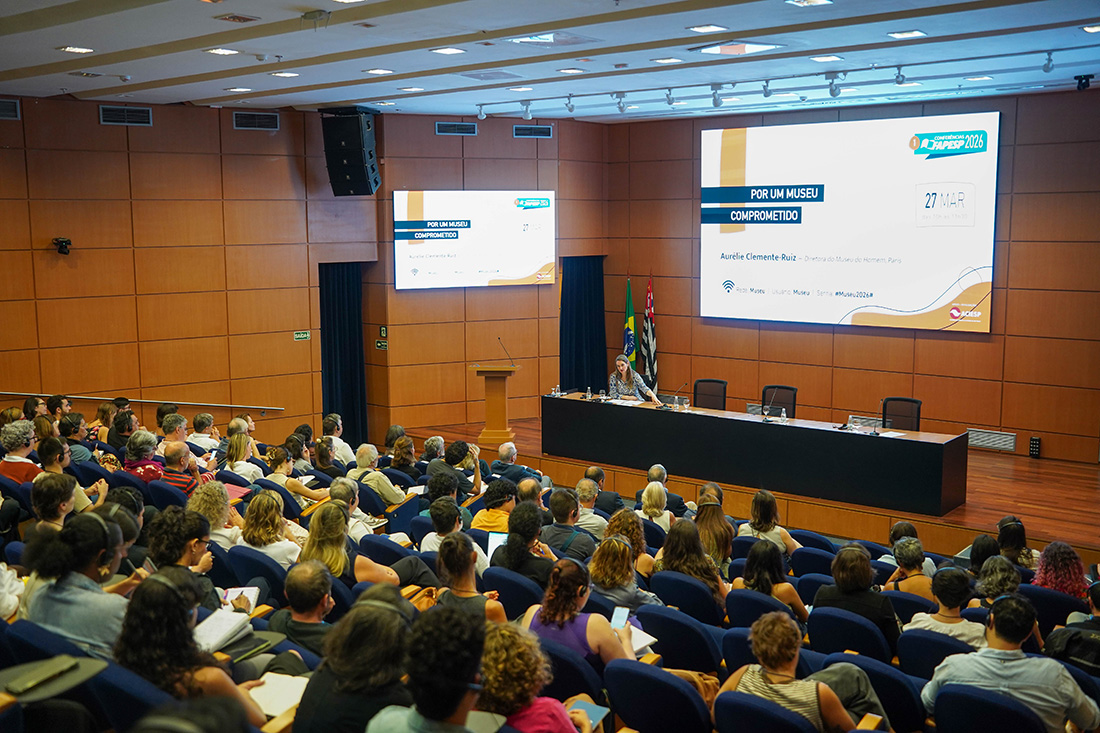
“We’re living in a moment of deconstruction and reconstruction of museum narratives. We need to integrate other voices, other discourses, other perspectives. There’s much talk of decolonization. I prefer to speak of deconstructing biases. Because it’s not just about colonization; it’s something broader. The difficult part isn’t giving a voice to different perspectives. The difficult part is creating a narrative that integrates this plurality,” said Clemente-Ruiz (photo: Daniel Antônio/Agência FAPESP)
Aurélie Clement-Ruiz is an art historian who graduated from the École du Louvre, specializing in the Islamic world. She has primarily worked at the Institut du Monde Arabe, serving as director of exhibitions and overseeing large-scale international projects focused on intercultural dialogue. She has also pursued academic activities as a professor at institutions such as Sorbonne Abu Dhabi and the École du Louvre itself, combining curatorial work, research, and education.
She joined the Musée de l’Homme as director of exhibitions in 2021 and assumed the general directorship of the institution in 2022, becoming the first woman to hold the position since the museum’s founding in 1938. She is known for advocating for an engaged museology, in which museums cease to be merely spaces for conservation and become social agents. She systematizes this perspective in her book Pour un Musée Engagé: Transmettre, Interroger, Inspirer, in which she proposes that museums act as spaces for dialogue, the production of meaning, and civic education. These spaces would be capable of addressing issues such as inequality, cultural diversity, and sustainability.
Renata Vieira da Motta, executive director of the Museum of the Portuguese Language, moderated the 1st FAPESP 2026 Conference, “For a Committed Museum.” Referring to the range of issues linked to redefining the social role of museums, Vieira da Motta emphasized that this agenda becomes even more urgent in the face of fragmented social bonds, rising extremism, and the transformations brought about by digital media. “Where can museums play a role in rebuilding these bonds? How can they contribute to listening and the construction of shared meanings?” she asked.
The opening panel featured Professor Oswaldo Baffa Filho, coordinator of the FAPESP 2026 Conferences, and Maria Arminda do Nascimento Arruda, vice-rector of the University of São Paulo from 2022 to 2026 and a member of the FAPESP Board of Trustees. Baffa presented the conferences scheduled for the first half of 2026 and shared a bit about his personal experience as a museum visitor.
Nascimento Arruda highlighted the role of museums “in a world dominated by digital platforms, social media, misinformation, and virtual forms of interaction,” which place us “on the brink of a collapse of the reference points that structured modernity.”
“In this turbulent context, institutions dedicated to preserving tangible and intangible heritage, as well as artistic production in its various forms, are compelled to rethink the very foundations of their existence and redefine their role in contemporary society,” she emphasized.
Professor Marco Antonio Zago, president of FAPESP, also attended the event.
The 1st FAPESP 2026 Conference, “For a Committed Museum,” is available in its entirety at youtu.be/hktDtjHcWAs.
Republish
The Agency FAPESP licenses news via Creative Commons (CC-BY-NC-ND) so that they can be republished free of charge and in a simple way by other digital or printed vehicles. Agência FAPESP must be credited as the source of the content being republished and the name of the reporter (if any) must be attributed. Using the HMTL button below allows compliance with these rules, detailed in Digital Republishing Policy FAPESP.
