




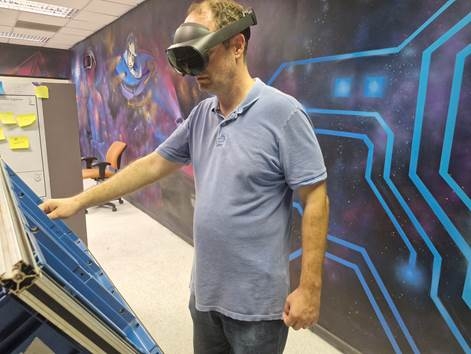
Unlike virtual reality, which completely isolates the user, mixed reality glasses allow the user to see the real environment while projecting digital information (photo: Pathernon Labs)
A startup supported by the Centelha program has developed a solution that combines cutting-edge technology with ease of use, transforming production lines without the need for expensive automation.
A startup supported by the Centelha program has developed a solution that combines cutting-edge technology with ease of use, transforming production lines without the need for expensive automation.
Unlike virtual reality, which completely isolates the user, mixed reality glasses allow the user to see the real environment while projecting digital information (photo: Pathernon Labs)
By Roseli Andrion | Agência FAPESP – The factory floor has always been a place of silent challenges. Amid the noise of machines and the comings and goings of operators, one challenge has persisted for decades: How can we ensure that parts are assembled correctly day after day? The answer may lie in mixed reality glasses that look like something out of a science fiction movie.
Eduardo Miller, a computer engineer with a master’s degree in robotics, is well aware of this reality. With experience at major automakers, he has witnessed the invisible cost of human error: rework, parts disposal, delays, and constant pressure on operators. “If there’s a 10% error rate in the production of a thousand parts, you have to manufacture 100 more to compensate,” he points out. “In addition to the cost of the quality error, more production is required. Few factories do this calculation.”
This gap motivated the creation of the startup Parthenon Labs, with the aim of developing a mixed reality system for manual assembly lines. Inspired by the Greek temple dedicated to the goddess Athena, the name carries the ambition to create solutions that are almost divine in their efficiency. The initial numbers are impressive. In a real-world application in the automotive sector, the company reduced daily failures from 1,600 to just 80 – a 95% drop, according to Miller.
The technology combines mixed reality glasses, which allow users to see their surroundings while projecting digital information, with a step-by-step guidance system. Unlike virtual reality, which isolates the user, mixed reality keeps them connected to the physical environment.
While wearing the glasses, an operator can see holograms indicating which part to pick up and where it is located, as well as instructions on how to assemble it. The system uses voice commands, motion tracking, and real-time visual feedback. If the wrong part is selected, the hologram turns red. If the assembly is correct, it turns green. It’s that simple. “The solution doesn’t require the operator to be tech-savvy,” says Miller. “They use their own skills, but are guided in a humanized way. We tested it with new and veteran operators, and the adaptation was quick.”
A real-life example illustrates the effectiveness of the solution. In an auto parts factory, there is a station with three boxes of different components and an assembly area. Before the solution was implemented, there were 253 component shortages, and 168 parts were assembled incorrectly. After adopting the solution, shortages fell to 19, and assembly errors fell to just 13.
Industrial flexibility
One of the unique features of the solution is the way it is implemented. Unlike rigid automation systems, which can take months to reconfigure in the event of a product change, the Parthenon Labs platform can be easily customized. “We have a database system in which everything is registered in a modular way,” Miller explains. “To assemble an airplane in an area of 1,000 square meters, you just need to mark it out so that the system can map the space. Then, you just need to register the location of the components and define the size and position of each part.”
This flexibility is an important differentiator in a market where product variety is growing. According to data from the global automotive industry, the average lifespan of a car model has fallen from seven years in the 1990s to approximately four years today. This means that production lines need to adapt much more frequently.
The technology also benefits from recent hardware developments. The project began with Microsoft’s HoloLens glasses, which are no longer available for commercial use. “The transition was complex,” Miller acknowledges, “but we migrated to Meta Quest 3, which is Android-based.” “We were able to maintain functionality and reduce costs.”
Although the initial focus is on manufacturing, the potential applications are vast. Miller envisions uses for training, inspections, and preventive maintenance. “For training, it’s perfect. First, a video of the process is shown. Then, the user goes to a test station with the glasses. Only after these steps do they go to the actual production line. In the first few weeks, we keep the system active to provide more security.”
In aviation, where strict quality standards are in place, the solution can document inspections and maintenance processes. “Everything you do can be recorded by the glasses. This serves as proof that the inspection was performed correctly. For sectors such as civil aviation or critical equipment maintenance, this traceability is essential.”
Challenges and acceptance
As with any innovation, the concept may face resistance. “Initially, operators are afraid: they’re afraid of getting dizzy or that it’s a surveillance system,” he says. “After a few hours of use, however, they realize that the tool helps improve the quality of the final product and their quality of life. They no longer need to memorize complex sequences or worry so much about mistakes.”
Another challenge is market timing. “In 2024, the auto parts sector suffered greatly from the global economic situation,” he notes. Parthenon Labs competes with international solutions, but its approach is different. Competitors have more rigid systems that require controlled infrastructure, whereas the Brazilian solution works in any environment.
One advantage is that it does not increase assembly time. “Our system doesn’t add time to the process. It improves quality while maintaining production pace. This is essential because time is money in industry,” he says. The solution received support from the Centelha program, a national initiative of the Brazilian Innovation Agency (FINEP, linked to the Ministry of Science, Technology, and Innovation), which aims to stimulate innovative entrepreneurship and disseminate this culture among young people. In the state of São Paulo, Centelha is run by FAPESP.
The future of mixed reality
The evolution of the tool points to its integration with artificial intelligence. “We’re studying the use of computer vision systems to compare the final assembly with an ideal standard,” says Miller. “With advanced language models, the operator can communicate with the system to receive real-time guidance: ‘I’m having difficulty with this step. What do you suggest?’”
For Miller, the goal is to democratize the use of technology. “In Japan, I saw systems that were expensive and took up a lot of space, with marked shelves, computer vision systems, and controlled lumen environments. It was impressive, but inaccessible to companies in Brazil,” he says. “Our challenge was to take all that functionality and put it into a pair of glasses.”
The result is a technology that, though seemingly futuristic, has already transformed Brazilian factories. In a country where the manufacturing industry accounts for approximately 11% of GDP, according to the Brazilian Institute of Geography and Statistics (IBGE), and employs millions of workers, solutions that boost efficiency without eliminating jobs are particularly important.
He emphasizes that the technology does not seek to replace people with robots. “On the contrary, the idea is to give operators superpowers. They continue to do what they know how to do, only now with far fewer errors. It’s technology at the service of people, not the other way around.”
According to data from the Brazilian Association of Automotive Vehicle Manufacturers (ANFAVEA), Brazil produced 2.3 million vehicles in 2023. Each of these vehicles underwent complex assembly processes involving thousands of components. In the white goods sector, which includes refrigerators, stoves, and washing machines, the Brazilian Electrical and Electronics Industry Association (ABINEE) reports an annual production of over 10 million units.
Manual assembly is still predominant in critical stages in all these segments. “Complex assemblies are difficult to automate,” Miller explains. “Sometimes, the geometry of the product makes it difficult to use robots. Other times, the design of the part requires specific movements or calibrated force. And then there’s the cost: when switching from model A to B, reconfiguring the automation is time-consuming and expensive.”
A study by Dozuki, a work instruction software brand, identified the main causes of errors in manual assembly. Fatigue tops the list, accounting for 30% of errors. Next are lack of attention (25%), incorrect operator decisions (17%), equipment failures (12%), and inadequate training (8%). Problems with the product itself and work pressure complete the list. “The first three causes are precisely those that our solution can address directly,” the engineer points out.
The Agency FAPESP licenses news via Creative Commons (CC-BY-NC-ND) so that they can be republished free of charge and in a simple way by other digital or printed vehicles. Agência FAPESP must be credited as the source of the content being republished and the name of the reporter (if any) must be attributed. Using the HMTL button below allows compliance with these rules, detailed in Digital Republishing Policy FAPESP.
