




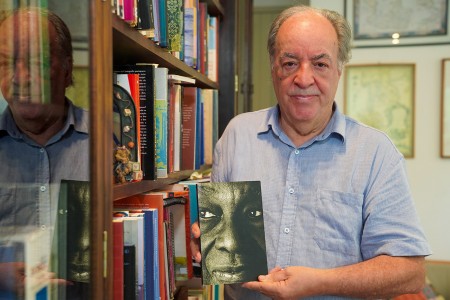
Jaime Tadeu Oliva was a student and collaborator of Milton Santos (photo: Daniel Antônio/Agência FAPESP)
The coordinator of the Milton Santos Archive at USP’s Institute of Brazilian Studies analyzes the geographer’s life’s work and explains how Santos turned territory into a key element of social dynamics.
The coordinator of the Milton Santos Archive at USP’s Institute of Brazilian Studies analyzes the geographer’s life’s work and explains how Santos turned territory into a key element of social dynamics.
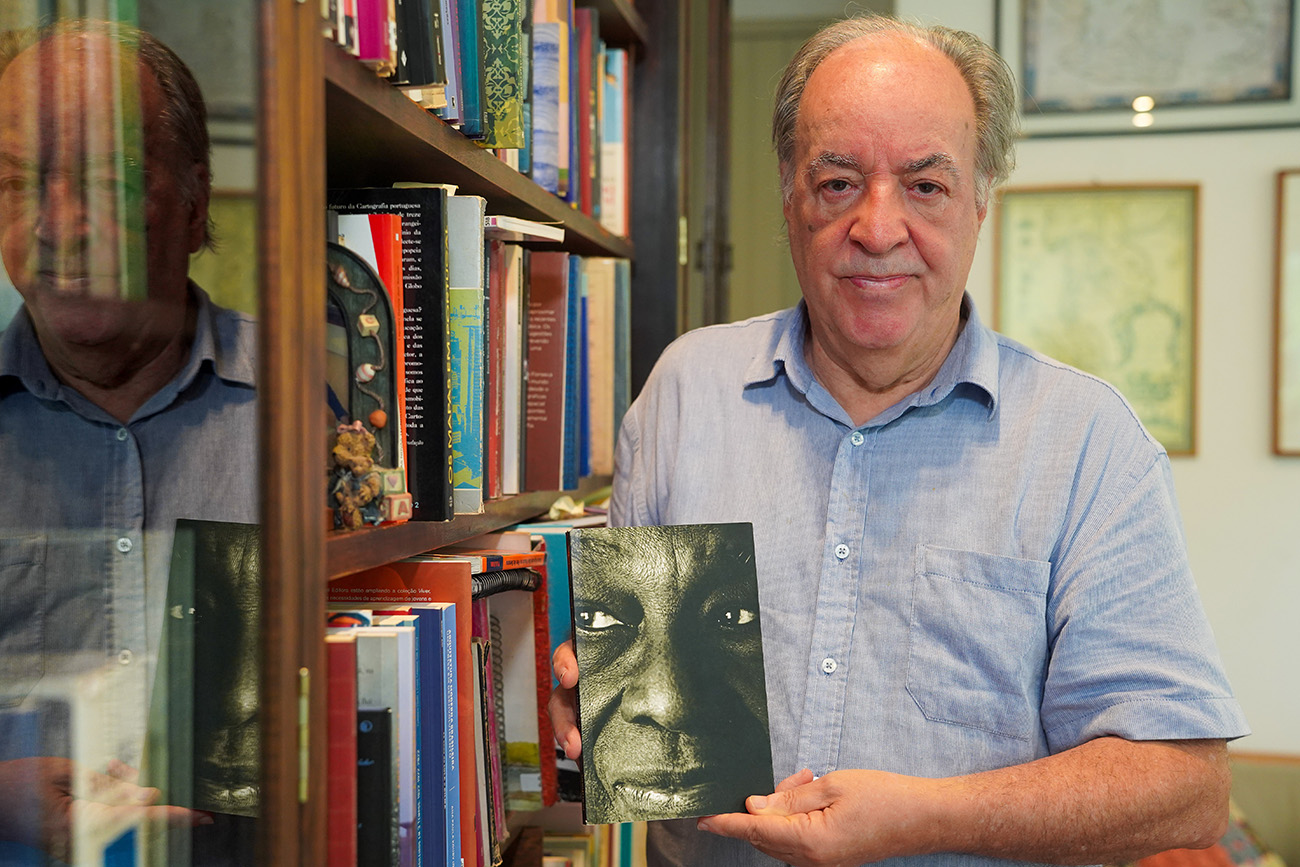
Jaime Tadeu Oliva was a student and collaborator of Milton Santos (photo: Daniel Antônio/Agência FAPESP)
By José Tadeu Arantes | Agência FAPESP – Geographer Jaime Tadeu Oliva was a student and collaborator of Milton Santos. He is currently a professor and researcher at the Institute of Brazilian Studies at the University of São Paulo (IEB-USP), where he coordinates and supervises research in the Milton Santos Archive. In this interview, Oliva presents an overview of his mentor’s work, highlighting his intellectual project, his main theoretical contributions, and his critical stance within the academic community.
Agência FAPESP – What is your strongest impression of Milton Santos’s intellectual trajectory?
Jaime Tadeu Oliva – My first comment is this: from a very early age, even as a young high school geography teacher, Milton Santos proved to be someone who had an intellectual project in life. That’s an extremely rare thing. Generally, people involved in teaching and research tend to be more or less carried along, here and there, depending on the circumstances. That wasn’t the case with him. Although his life was turbulent, from an early age he defined an intellectual project, which he managed to maintain amid the turbulence. Looking back at his work, his body of work as a whole, you can see that that project, which he more or less established in his youth, remained intact and developed.
Agência FAPESP – What was that project, in broad strokes?
Oliva – As I understand it, his intellectual project was structured around three main themes. First, there was an attempt to define what his field of interest – geography – actually was. That hadn’t been clearly established by consensus when he began. So, starting in the 1950s, in various documents and in the first books he published, he questioned the theoretical foundations of geography. But it wasn’t a questioning that concerned only one discipline. It was a questioning of how geography should be practiced as a social science and, more broadly, how the social sciences themselves should be practiced. Even back then, he criticized the influence of natural science methodologies within the social sciences. Very early on, he shared the understanding that geography couldn’t be a discipline that merely described spaces. As it was practiced, it described regional spaces, the natural landscape, the social landscape, and human works, but it didn’t assess how those geographical conditions contributed to social dynamics. What he said ever since is that when humans build a road, they do so with specific intentions – to increase connections, to establish certain social relationships – and that that changes society. Space isn’t merely a stage where drama unfolds; the drama is influenced by the stage, by the way we shape our spaces.
Agência FAPESP – That renewal movement had an international nature, didn’t it?
Oliva – Yes, that movement had an international nature. Much of that discussion was already taking place in Europe. And later, in exile, he interacted extensively with French geography and American geography. But he wasn’t someone who merely adhered to something that already existed. He was one of the initiators of that movement, a leading figure in it. At the same time, he never abandoned that theoretical dimension. He constantly questioned the very architecture of the science, monitoring, refining, and renewing his own thinking. He had a very good saying: “The true intellectual is the first to betray his own ideas.” And he also said: “I have no commitment whatsoever to what I think.” Not because he was irresponsible toward his own thinking, but because he didn’t cling to the formulations he had arrived at. His last major work in that field was The Nature of Space [1996], which is a summary of everything he thought about the theoretical structure of the discipline and its relationship with the world, but a summary in which innovations still appear.
Agência FAPESP – How would you summarize that first major thread of his intellectual trajectory?
Oliva – I would say he helped transform geography into a social science. He used to say: “Geography doesn’t study space; geography studies society, but views society through the window of space. From the perspective of space, I try to understand society in its entirety.” That influenced other disciplines as well, because space is largely absent from sociology and history. It’s as if life were unfolding in the air. He helped those disciplines begin to pay more attention to the spatial dimension.
Agência FAPESP – What was the second major thread?
Oliva – A second, very important strand was the study of the urban world. That interest emerged early on, when he read about African cities, cities in the Middle East, and Latin American cities. In exile, he traveled through many countries, served as a visiting professor, worked in Venezuela, participated in the founding of the University of Dar es Salaam in Tanzania, and worked in Guinea-Bissau. That allowed him to experience a wide variety of cities. What intrigued him was this: how could such enormous cities exist in countries without a strong industrial economy? How is it possible for a city like Kinshasa [the capital of the Democratic Republic of the Congo, with approximately 15 million inhabitants] to exist without a visible economic base to sustain it? He realized that those cities have a set of internal activities dependent on urban growth itself. The city grows and needs bricklayers, domestic workers, gardeners, street vendors, small merchants, artisans – all of that comes together to sustain a large urban economy. Milton called that the “lower circuit of the urban economy.” At the same time, there’s an “upper circuit,” with more capital and technology. That gave rise to the book The Divided Space [1978], about the two circuits of the urban economy.
Agência FAPESP – And the third major thread?
Oliva – A third, very important strand is the centrality of technology. We can’t conceive of spaces or social relations without considering that all of that is mediated by an enormous number of technical objects. Those objects are embedded in space. He used to say that “spaces are intelligent spaces and also repositories of knowledge.” In that regard, his great contribution was to bring the discussion of technology into the conversation and give it a spatial dimension. In that field, he had a significant dialogue with Milton Vargas [1914–2011, professor emeritus at the Engineering School of the University of São Paulo], a leading figure in the reflection on engineering and technology. Milton engaged with fields such as physics, from Newton to Einstein. He had very broad intellectual and personal connections, especially with those who discussed technology, space, and society. He was a visionary because, as early as the 1990s, he argued that globalization depended on the control of technology and that that control subjugated poor countries. He formulated the concept of the technical-scientific-informational milieu, demonstrating that space is constituted by technical systems and information flows. And he asserted that, in that context, technical objects no longer obey us; they rule over us.
Agência FAPESP – What was Milton Santos’s intellectual stance?
Oliva – He always argued that anyone entering university must have their own way of thinking. He said there are two types of university professors: the well-read and those who think. He always sought to see what no one else was seeing and maintained a constant critical stance. He was very critical of the way the university operates. He said that system turns professors into bureaucrats and discourages deeper thought and reflection.
Agência FAPESP – Do you recall any episode that encapsulates that stance?
Oliva – At the ceremony where he received the title of Professor Emeritus at USP, a thank-you speech was expected. He did the opposite: he criticized the university. He said that the university wanted to turn professors into an assembly line for articles, that people were repeating texts, fragmenting ideas, and choosing topics based on funding rather than intellectual interest. He also criticized the absence of Black people at the university. It was a totally unexpected speech. He remained the same Milton, even at that moment.
The Agency FAPESP licenses news via Creative Commons (CC-BY-NC-ND) so that they can be republished free of charge and in a simple way by other digital or printed vehicles. Agência FAPESP must be credited as the source of the content being republished and the name of the reporter (if any) must be attributed. Using the HMTL button below allows compliance with these rules, detailed in Digital Republishing Policy FAPESP.
