




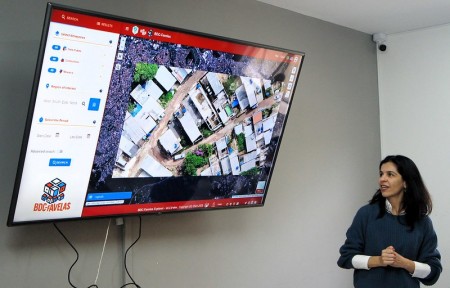
Flávia Feitosa: “Official indicators used today don’t take into account fundamental territorial and local information, such as the location and characteristics of favelas” (photo: CEFAVELA)
The Center for Favela Studies project was launched in the municipality of Jacareí, São Paulo state, using data from the state system that registers low-income families in social assistance programs.
The Center for Favela Studies project was launched in the municipality of Jacareí, São Paulo state, using data from the state system that registers low-income families in social assistance programs.
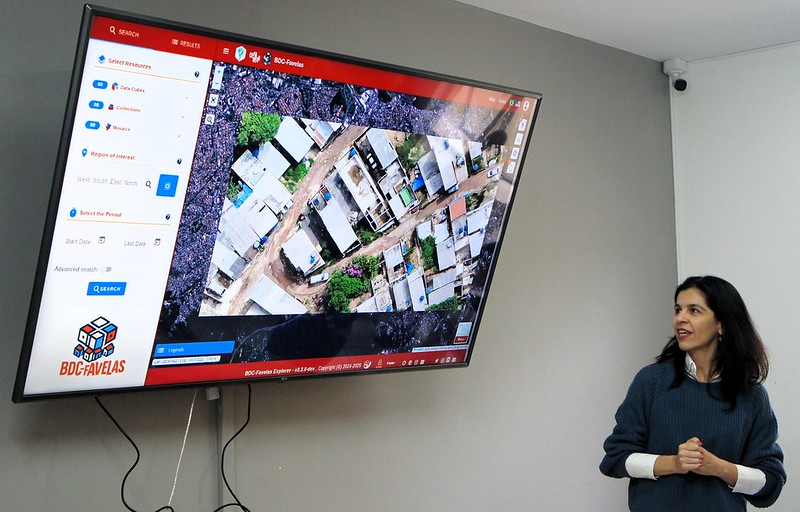
Flávia Feitosa: “Official indicators used today don’t take into account fundamental territorial and local information, such as the location and characteristics of favelas” (photo: CEFAVELA)
Agência FAPESP* – Jacareí, a city in the state of São Paulo, Brazil, has 240,275 inhabitants, according to the 2022 Demographic Census. The city has 14,812 households in a situation of housing deficit or inadequacy, 6,019 of which are located in favelas and irregular low-income settlements.
This information comes from a survey conducted by the Center for Favela Studies (CEFAVELA), a Research, Innovation, and Dissemination Center (RIDC) funded by FAPESP and based at the Center for Engineering, Modeling, and Applied Social Sciences at the Federal University of ABC (CECS-UFABC) in São Bernardo do Campo.
The municipality of Jacareí, located about 80 kilometers from São Paulo, the state capital, partnered in a pilot project to develop a methodology enabling advances in analyzing and monitoring municipal housing needs inside and outside of favelas. The project, called “Multidimensional Estimates of Housing Needs” (ESTIMA), was coordinated by Flávia Feitosa, a researcher and the head of the Technology Transfer Area at CEFAVELA.
“ESTIMA was born out of a recurring demand from government institutions for housing deficit estimates that were more in line with local planning needs, could be updated frequently, and provided spatial details. The official indicators used today don’t take in account fundamental territorial and local information for developing public policies, such as the location and characteristics of favelas,” Feitosa explains.
Based on official indicators, it is impossible to determine how much of the housing deficit and inadequacy affects families living in favelas. “This information is very relevant because it’s directly related to the planning of territorialized and integrated actions, such as those aimed at the urbanization of favelas,” the researcher adds. Housing deficit situations require the construction of new housing units, while cases of inadequacy necessitate improvements to existing housing.
One of ESTIMA’s innovations is combining local favela data with CadÚnico’s georeferenced database. CadÚnico is the federal government’s system for registering low-income families and including them in social assistance programs. It provides a record that allows the government to identify low-income families in Brazil and understand their living conditions. Registration with CadÚnico is necessary to participate in social programs such as Bolsa Família, a conditional cash transfer program. The registry is constantly updated, as registered families must renew their registration every two years.
“It provides very relevant information, such as families’ rental expenses, something that existed in the 2010 Demographic Census of the IBGE [Brazilian Institute of Geography and Statistics], but isn’t included in the 2022 edition. In other words, excessive rental expenditure, which accounts for about 50% of the housing deficit, is no longer captured by the census data,” Feitosa points out.
“CadÚnico also has the addresses of the dwellings, which allows the data to be geocoded, meaning that maps can be produced that reveal the housing conditions in different areas of the municipality. The availability of addresses also allows integration with other spatial data, such as the location of favelas, enabling detailed estimates of the deficit and inadequacy inside and outside these territories,” she continues.
Data processing
In the study, CadÚnico data is processed to protect sensitive information, such as the exact location of each residence. The maps produced by CEFAVELA show the housing deficit and inadequacy situations in an approximate manner without showing individual dwellings. To ensure privacy, ESTIMA uses heat maps, which are graphical representations of data where the intensity of a phenomenon is represented by colors ranging from light to dark. The darker the color, the greater the concentration of families experiencing housing deficits or inadequacies.
City governments traditionally use the indicators produced by the João Pinheiro Foundation to diagnose municipal housing needs. The foundation calculates housing deficits and inadequacies in Brazil. While it predominantly uses data from the Demographic Census, making it very useful, it cannot present the results with the necessary level of spatial detail to identify the incidence of problems inside and outside favelas.
“The indicators calculated from the Census are unable to support public policies that are more closely aligned with the territory due to their low temporal and spatial resolution. With the CadÚnico database, we’re able to overcome these limitations because it provides us with addresses and is updated frequently,” the CEFAVELA researcher explains.
The high spatial resolution of this data allows it to be integrated with other territorial databases. “As a continuation of the research, we intend to integrate it not only with data on favelas, but also with information on areas of risk and proximity to urban facilities. In addition, we need to improve strategies to facilitate the use of the results, developing geoportals that respond to the needs of technicians and managers and expand their applicability in housing planning,” says Feitosa.
Despite the numerous advantages of using CadÚnico, Bianca Santos, a data scientist at CEFAVELA responsible for the ESTIMA methodology calculations, notes a caveat: “CadÚnico is an administrative registry that doesn’t have universal coverage, although it covers more than half of families in vulnerable situations. The Demographic Census remains a fundamental source of data for formulating public policies in the country, and it’s very important that the loss of variables that made up housing indicators be reversed in the 2030 survey.” Santos is conducting the study with a FAPESP scholarship.
Through a partnership with the Jacareí city government, CEFAVELA developed and refined the methodology based on demands identified in previous projects with other government institutions. The results obtained by ESTIMA for the city were presented at a working meeting held in July with approximately 20 representatives from the Pró-Lar Foundation and the municipal departments of Planning, Social Assistance, Education, Urban Mobility, and Infrastructure, in addition to the municipal Attorney General’s Office.
* With information from Janaína Simões from CEFAVELA
The Agency FAPESP licenses news via Creative Commons (CC-BY-NC-ND) so that they can be republished free of charge and in a simple way by other digital or printed vehicles. Agência FAPESP must be credited as the source of the content being republished and the name of the reporter (if any) must be attributed. Using the HMTL button below allows compliance with these rules, detailed in Digital Republishing Policy FAPESP.
