





By Sophia La Banca | Agência FAPESP – Researchers have developed a mathematical method that enables more precise calculations of the most economical travel routes between the orbits of celestial bodies. To demonstrate this method, they calculated a more efficient path between the Earth's and the Moon's orbits than any previously described in the scientific literature. The study was published in the journal Astrodynamics.
The new route requires 58.80 meters per second (m/s) less fuel than the most fuel-efficient routes previously described. This difference may seem small compared to the estimated total cost of the journey (3,342.96 m/s), but it significantly impacts the cost of the mission. "When it comes to space travel, every meter per second equates to a massive amount of fuel consumption," notes Allan Kardec de Almeida Júnior, a researcher at the University of Coimbra and lead author of the study, which also involved the universities of Porto and Évora (Portugal), the Paris Observatory (France), and the universities of Pernambuco (UPE) and São Paulo (USP).
The method is based on the theory of functional connections, which reduces the computational cost of space travel simulations. This allowed the scientists to simulate a much larger number of different trajectories and arrive at a "more affordable" solution.
The study referenced 280,000 simulations to reach a result, while Almeida's research group simulated 30 million different routes.
From Earth to the Moon, in economy class
Almeida and his collaborators mapped out a trajectory to take a spacecraft from Earth's orbit to the Moon's, dividing it into two segments. In the first segment, the spacecraft would leave Earth's orbit and enter an orbit around the L1 Lagrange point, a region between Earth and the Moon where the gravitational pull of the two bodies cancels out. For most of this journey, the spacecraft would be guided by a "variate," or a natural trajectory leading to that orbit.
However, the actual path turned out to be different from what was expected.
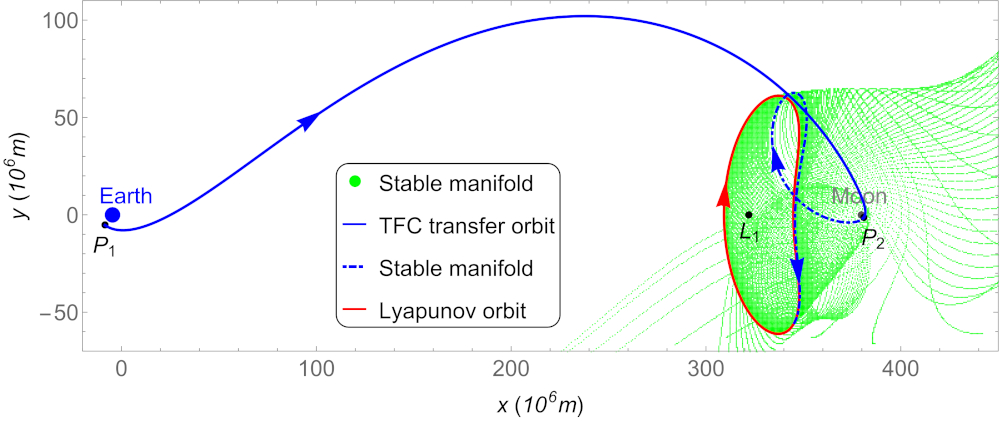
Trajectory of the journey between Earth and the L1 Lagrange point orbit (image: Allan Kardec de Almeida Júnior et al./Astrodynamics)
While most existing models assume it is more efficient to enter the variate at the branch closest to Earth, simulations conducted by the team showed the most economical route actually came closer to the Moon and entered the variate from the opposite side.
Vitor Martins de Oliveira, a postdoctoral researcher at the Institute of Mathematics, Statistics, and Computer Science (IME) at USP and co-author of the study, explains that searching for solutions like this is one advantage of using functional connection theory: "Instead of assuming it's easier to choose the part of the variate closest to Earth, we can use systematic analysis with faster methods to try to find nontrivial solutions."
Using a control system, the spacecraft can remain in this intermediate orbit indefinitely until the mission is ready for the second part of the journey, when it proceeds to lunar orbit. This "space transfer" is advantageous because there is no interruption in communication with Earth or the Moon while waiting.
"The Artemis 2 mission, for example, lost communication with Earth for a while because it was directly behind the moon. The orbit we propose is a solution that maintains uninterrupted communication," Oliveira points out.
The research was supported by FAPESP (projects 21/11306-0 and 22/12785-1). Leonardo Barbosa Torres dos Santos, who gained a Ph.D. from the National Institute for Space Research (INPE) with a scholarship from the Foundation, is also a co-author of the article.
Even greater savings, but only on specific dates
Although it is more economical than the previously described routes, the path mapped out by Almeida and his collaborators is not the cheapest one possible. Their simulations only took the gravity of the Moon and Earth into account, disregarding other celestial bodies, such as the Sun. Including them could lead to an even greater discount, but it would restrict the launch window. "It'd be necessary to run the simulation for a specific position of the Sun. For example, if we simulate the mission's launch date as December 23, we'll obtain results valid only for a mission launched on that date," Almeida notes.
In these cases, however, the method the team developed to perform a large number of simulations can be used to find the best trajectory. "The systematic analysis we applied in our work is something that could be adopted more widely going forward," the researcher suggests.
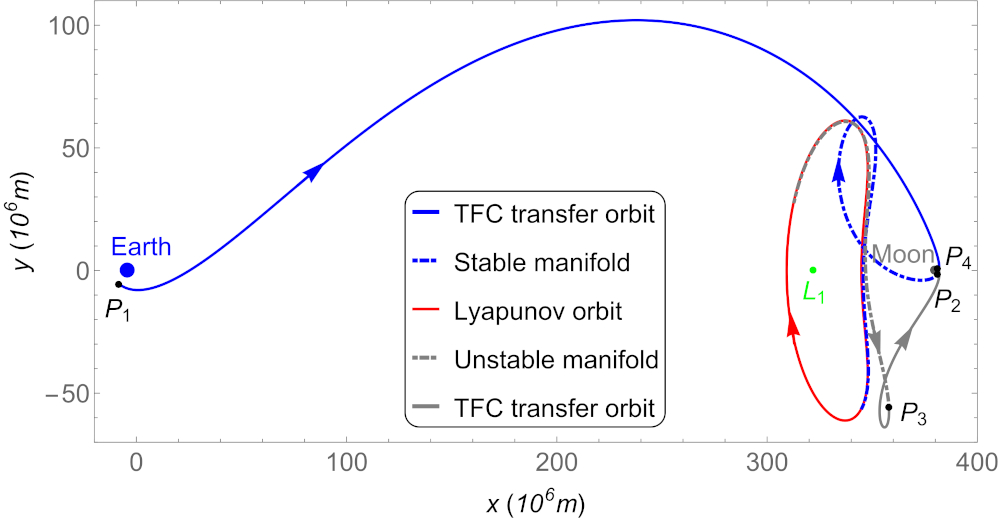
Trajectory of the complete journey between the Earth and Moon orbits (image: Allan Kardec de Almeida Júnior et al./Astrodynamics)
The article "Earth-Moon transfer via the L1 Lagrangian point using the theory of functional connections" can be read at link.springer.com/article/10.1007/s42064-025-0297-x.
Republish
The Agency FAPESP licenses news via Creative Commons (CC-BY-NC-ND) so that they can be republished free of charge and in a simple way by other digital or printed vehicles. Agência FAPESP must be credited as the source of the content being republished and the name of the reporter (if any) must be attributed. Using the HMTL button below allows compliance with these rules, detailed in Digital Republishing Policy FAPESP.
