





By André Julião | Agência FAPESP – A research team led by scientists from the State University of Campinas (UNICAMP) in São Paulo, Brazil, has made significant progress in understanding the relationship between gut microbiota and intestinal cells.
The study, published in the journal Gut Microbes, showed how microbiota and the compounds it produces, such as butyrate, influence the functioning of cells that line the large intestine. This intestinal layer is in close contact with bacteria and produces mucus that contributes to its barrier function, helping to prevent bacteria from entering the body.
Among the findings is a description of the dual function of a cell that was previously thought to be exclusively mucus-secreting. The researchers discovered that the cell also absorbs nutrients and that its abundance in the epithelium is regulated by signals from the gut microbiota. The number of these cells increases when the gut microbiota is reduced.
The abundance of this cell is regulated by the production of butyrate – a compound resulting from the fermentation of dietary fiber – and its receptor, GPR109A. The more butyrate produced, the fewer of these cells there are.
This study paves the way for a better understanding of the role of microbiota and its metabolites in conditions such as inflammatory bowel disease and in developing treatments. Furthermore, the study demonstrates how the integrity of the intestinal wall can change, particularly in older individuals.
“When the microbiota is reduced, the large intestine – which under normal conditions prioritizes mucus production – begins to express characteristics linked to nutrient absorption typically associated with the small intestine. We still don’t know why this happens, but this change may be related to the expansion of dual-function cells and represent an adaptive response to the decrease in bacteria in this portion of the intestine,” explains Vinicius Dias Nirello, first author of the study. Nirello conducted the research during his doctoral studies at the Institute of Biology (IB-UNICAMP) with a scholarship from FAPESP.
“We observed that these dual-function cells are reduced by butyrate and its receptor. However, under conditions of dysbiosis – when there’s a loss of bacteria, whether due to antibiotic use or the aging process – this cell population expands, which we speculate is an adaptive response aimed at reinforcing the intestinal barrier,” adds Marco Vinolo, a professor at IB-UNICAMP and co-advisor for Nirello’s doctoral research alongside Patrick Varga-Weisz, a professor at the University of Essex in the United Kingdom and a researcher at UNICAMP.
The study reveals a level of plasticity governed by microbial triggers that was previously unknown in the intestinal epithelium.
Vinolo and Varga-Weisz received support from FAPESP for the study through four projects (17/16280-3, 18/15313-8, 23/14946-5, and 19/16113-5).

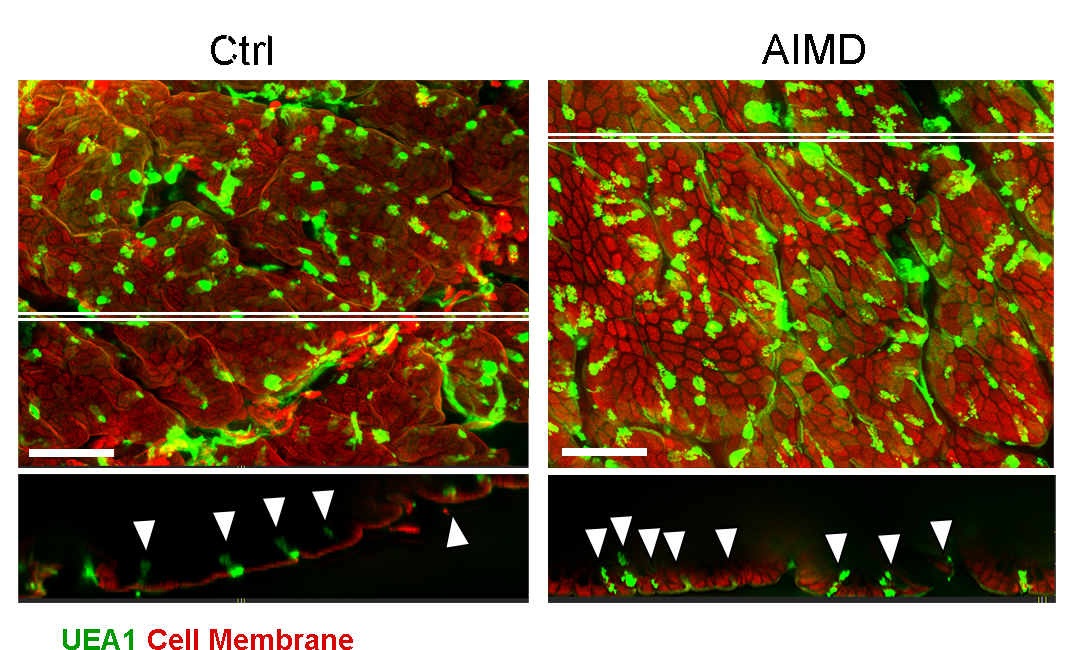
Illustration showing how nutrient absorption and mucus production are altered in the large intestine during dysbiosis (bacterial death), resulting from antibiotic use or the aging process (image: Vinicius Dias Nirello/IB-UNICAMP)
Cells and microbiota
To arrive at these results, the researchers treated a group of mice with a cocktail of antibiotics for three days, causing a sharp reduction in gut microbiota. A control group of mice received only a harmless solution and retained their microbiota intact.
In addition to these mice, the researchers used other germ-free animals, as they were born and raised without microbiota. These animals were divided into two subgroups and received bacteria from the intestines of either young humans (ages 18 to 35) or older adults (over 65). The goal was to examine the effect of microbiota based on donor age.
The researchers also analyzed biopsies, or small tissue samples, from the large intestines of young and older adult humans to assess the effect of aging on the number of cells that make up the intestinal epithelium.
The mouse samples were analyzed using single-cell transcriptomics technology, which analyzes the response of each cell individually. This method allowed the researchers to examine the individual characteristics of cells that make up the intestinal epithelium in much greater depth. These cells include enterocytes, which absorb nutrients, water, and electrolytes, and goblet cells, which secrete mucus.
The researchers observed that a specific population of cells, previously classified only as mucus-secreting, may also perform an absorptive function. “These cells express genes for both functions, which was not previously thought possible for this cell type. Since this population responds directly to the microbiota, the finding suggests a previously unknown adaptation of the intestinal epithelium,” Nirello explains. This cell population is more prevalent in the large intestines of older people, as shown by human biopsies and mice with bacteria from this population in their colons.
New experiments in which the secretory or absorptive genes of these cells are deleted may help clarify their role. This will advance our understanding of intestinal diseases and ways to treat them.
The article “Microbiota shape the colon epithelium controlling inter-crypt absorptive goblet cells via butyrate-GPR109A signalling” can be read at www.tandfonline.com/doi/full/10.1080/19490976.2025.2573045.
Republish
The Agency FAPESP licenses news via Creative Commons (CC-BY-NC-ND) so that they can be republished free of charge and in a simple way by other digital or printed vehicles. Agência FAPESP must be credited as the source of the content being republished and the name of the reporter (if any) must be attributed. Using the HMTL button below allows compliance with these rules, detailed in Digital Republishing Policy FAPESP.
