




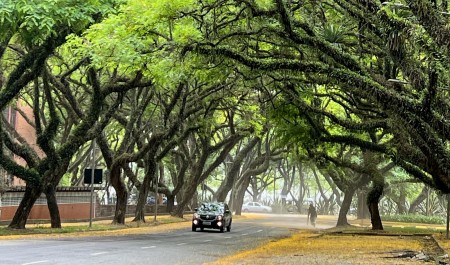
The scientists have been conducting various experiments on trees on the USP campus, assessing their health and the danger they pose (photo: Herton Escobar/Agência FAPESP)
A team from the University of São Paulo has developed an algorithm for optimal pruning that makes trees less vulnerable to wind tunnels. The goal is to create an app to guide human work.
A team from the University of São Paulo has developed an algorithm for optimal pruning that makes trees less vulnerable to wind tunnels. The goal is to create an app to guide human work.
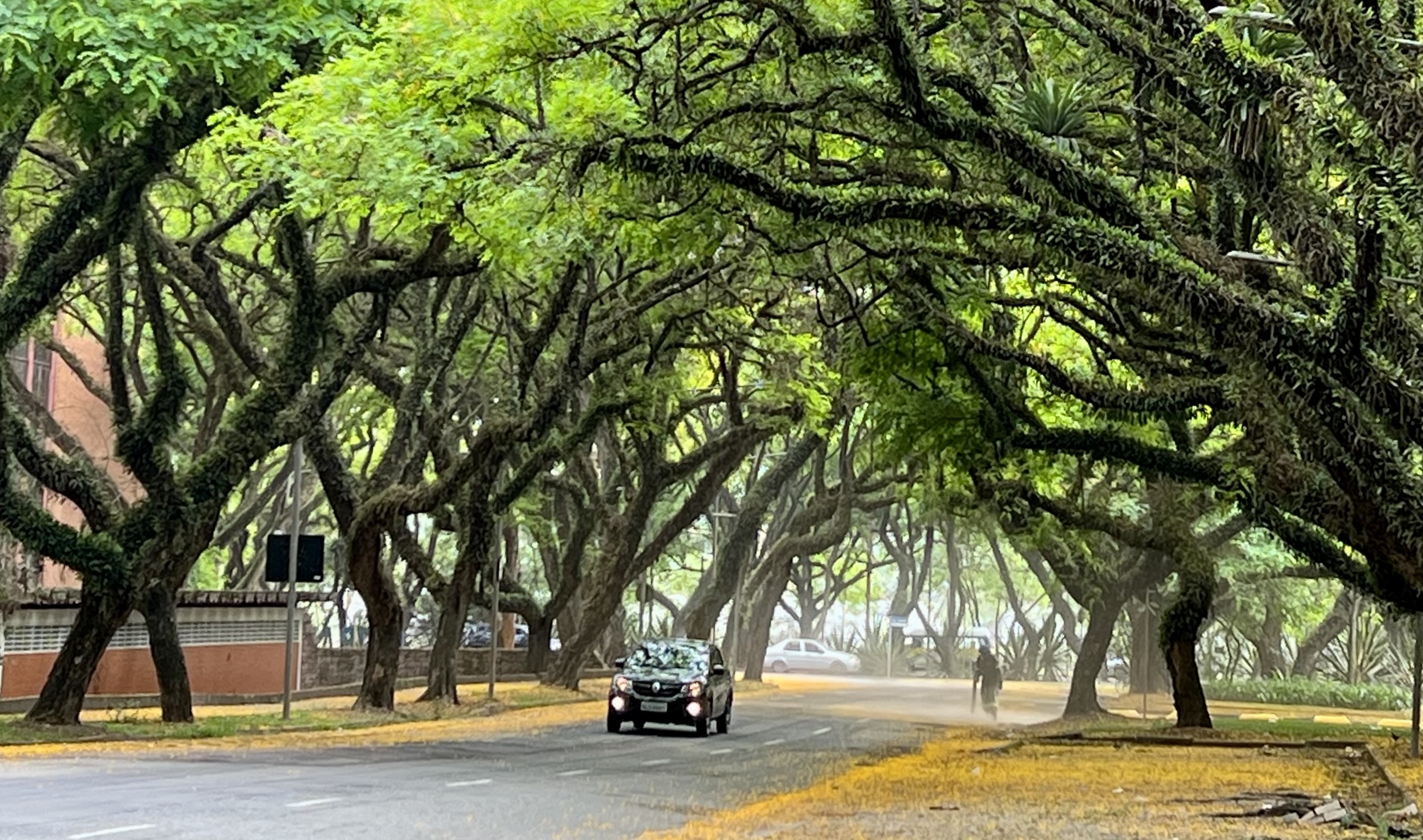
The scientists have been conducting various experiments on trees on the USP campus, assessing their health and the danger they pose (photo: Herton Escobar/Agência FAPESP)
By Karina Ninni | Agência FAPESP – For the first time, a group of biologists and engineers from the University of São Paulo (USP) in Brazil applied LiDAR (light detection and ranging) technology to investigate the health of trees and optimize pruning with the aim of reducing the risk of them falling. This laser sensing technology creates a “point cloud”, a kind of 3D digital mold consisting of millions of coordinates which reproduces in the computer the exact architecture of the plant.
The researchers used this replica to apply a pruning algorithm based on “topological optimization”. The technique simulates in a tree model the strength of the wind to identify the regions in the plant presenting the biggest mechanical vulnerability (compliance). In this manner, the system calculates exactly which branches must be cut off so that the tree can redistribute stress and become stronger and more balanced. The group’s ultimate goal is to use LiDAR and other available techniques to create a pruning app that will make trees less susceptible to wind, thus avoiding the risk of falling.
This problem is well known. In December 2025, winds exceeding 90 km/h swept through São Paulo and its surrounding areas. The result: 1,327 reported incidents of fallen trees in the São Paulo Metropolitan Area, including incidents resulting in injuries. More than 2 million inhabitants were left without power.
“Improper pruning leaves trees vulnerable to wind, which can uproot or break trunks and branches, especially in isolated trees, at high speeds. The problem is exacerbated by wind tunnels, known as urban canyons. Gusts of wind, rain, and temperature fluctuations during the rainy season increase the risk of trees falling, especially in the case of poorly managed or diseased trees,” summarizes Marcos Silveira Buckeridge, coordinator of the Laboratory of Ecological Plant Physiology (LAFIECO) in the Department of Botany at the University of São Paulo’s Institute of Biosciences (IB-USP) and co-author of a paper published in May in the journal Trees: Structure and Function.
The study began with an informal conversation between Buckeridge and Emílio Carlos Nelli Silva of the Department of Mechatronics and Mechanical Systems Engineering at USP’s Engineering School (POLI). “I asked if it’d be possible to develop a better pruning method by studying the balance of trees. He said we could develop a set of equations for that.” The pair also invited Marcelo Knörich Zuffo, from the Department of Electronic Systems Engineering at POLI-USP, who has extensive experience with LiDAR.
FAPESP supported the work through a Scientific Initiation scholarship awarded to the first author of the article, Luís Otávio Trotti Martins Guedes de Souza, who was supervised by Nelli Silva at POLI-USP.
Methodology
The researchers scanned a rosewood tree (Tipuana tipu) located on USP’s Butantã campus. This tree is commonly used in urban landscaping. “The scanner is mounted on a tripod near the base of the tree, which must be well lit. Weather conditions must be favorable. After completing the scan at the first point, the scanner must be moved to another position near the tree, and this process is repeated until enough perspectives have been captured to generate a complete point cloud of the object,” Buckeridge explains.
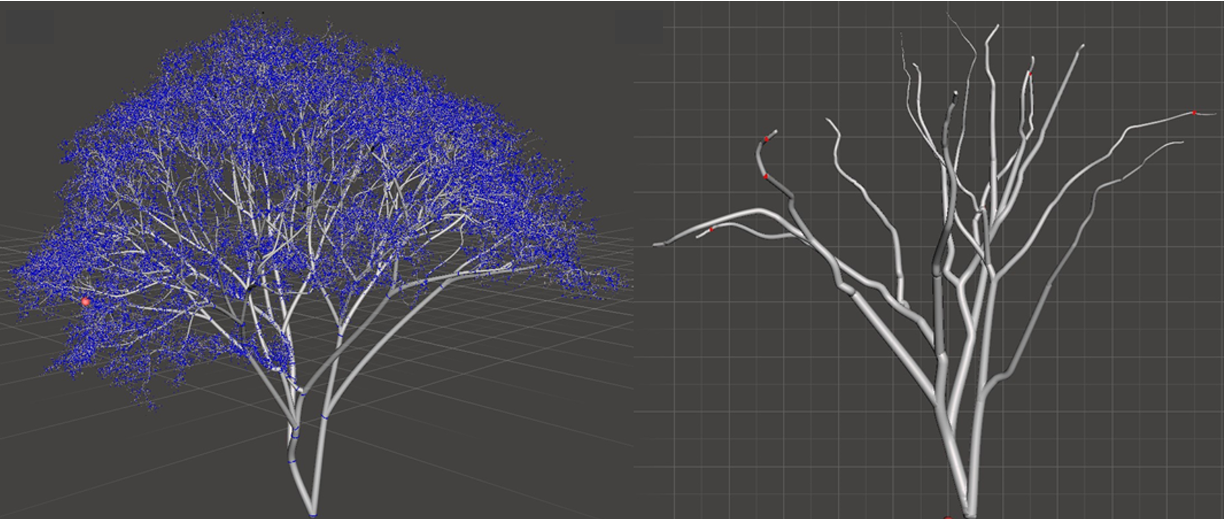
Laser sensing technology creates a “point cloud” that reproduces in the computer the exact architecture of the plant (image: LAFIECO)
A point cloud of 30 million points was formed to capture the tree’s shape. “Using this, Luís Otávio began developing the equations. The leaves were removed from the 3D images, leaving only the trunk. Then, we applied wind from various directions and observed the tree’s sensitivity.”
This exposure to wind is accurately modeled using finite element method (FEM) simulations, which help predict how trees respond to stresses, such as wind and temperature.
The results show that pruning a branch creates topological asymmetry and makes the tree more vulnerable to wind. “This article is important because it’s a proof of concept, using mathematical equations to demonstrate that it’s possible to use LiDAR for this purpose.” The biologist states that mathematical modeling is well-suited to predicting whether a tree might fall. “The problem is that scanning a single tree with the level of detail used in this paper takes 40 minutes.”
In this case, the scanned tree is located in a wind tunnel. There are neighboring trees on its sides, but none behind or in front of it. Therefore, it is directly exposed to the wind. “We found that it’s stronger on the sides where it has no contact with neighboring trees. A cluster of intertwined trees is more resistant than a single tree because the branches help dissipate the wind. We haven’t yet performed calculations on wind dissipation through the leaves, but we intend to.”
The pruning algorithm based on topological optimization recommends removing material (e.g., branches or parts of the tree) based on the stress distribution obtained through FEM. The team aims to minimize structural weaknesses by ensuring that no more than 20% of the tree’s total mass is removed during pruning. According to Nelli Silva, topological optimization prioritizes regions with greater mechanical flexibility, resulting in a balanced, resistant structure. In other words, pruning calculated by the algorithm improves the tree’s response to wind, especially in cases where the tree is unbalanced due to fallen branches or disease.
Buckeridge states that the methodology can be applied to eudicotyledonous angiosperms (the largest group of flowering plants in the planet, encompassing from beans, soybeans, oranges and strawberries to roses, ipes and sunflowers), which have a classic structure of branches and twigs. “I can’t extend this method to palm trees, for example,” he says. However, the author emphasizes that human labor in pruning remains essential. “We aren’t talking about replacing humans in pruning work, but rather providing a tool to facilitate it and, at the same time, make the tree more resilient.”
He mentions a project in São Paulo that is using the technique to scan all 650,000 street trees. “Perhaps it wouldn’t be possible to do it [on a large scale] as precisely as we did in this study, which assessed a single tree”, Buckeridge ponders. Nevertheless, he argues that the strategy would still be able to estimate the plant’s health.
For now, the LiDAR technique is being used only for tree monitoring and cataloging but not to guide pruning.
Roots, movement, and water
The article does not include data on tree roots. However, approximately 30% of tree falls in the city of São Paulo are root-related. “That’s an important point that we address in another paper, which has already been submitted. In it, we compare trees in a parking lot, on the sidewalk, and in a park. A former student of mine, Aline Cavalari, a professor at UNIFESP [Federal University of São Paulo], is leading these studies.”
He explains that the root data are obtained using ground-penetrating radar. “It’s a kind of wheel that we roll around the tree to ‘see’ the roots. In that study, published in Trees, we included an adjustment in the calculation to account for the exclusion of the roots. But that’s a challenge: we’ll have to include the roots.”
The biologist says the ideal solution would be to develop an app that considers most factors contributing to a tree’s risk of falling, such as the expansion and contraction of wood in response to temperature. “That property of wood isn’t yet factored into the models. But now, we’ve purchased several dendrometers – devices that measure expansion and contraction – which is also related to the presence of water, an important factor in the risk of a tree falling. When it rains all week, the tree’s weight increases dramatically, as does the probability of it falling, but we still can’t calculate that. It’s possible to factor water, weight, and everything else into the equations. But processing all of that computationally will be quite a challenge. It’s a problem we’ll have to tackle.”
Other uses for LiDAR
The scientists have been conducting various experiments on trees on the USP campus. Trees with existing issues, such as being hollow inside, having dying roots, or dying canopies, are more vulnerable, and the team is trying to map this vulnerability. “On ‘the street of banks’ [Avenida Professor Luciano Gualberto], we’re examining each tree individually to assess its health and the danger it poses. We’ve already finished half. Now, we’re going to use LiDAR to map that inventory. We bought a small device with suction cups that attaches to the car. Traveling at 20 kilometers per hour, we can map all the trees on the street. We can tell if they have holes in their trunks, for example. The accuracy is down to the centimeter,” Buckeridge assures. He is assisted by mathematician Roberto Hirata in the image recognition work.
Another experiment is being conducted on Avenida Professor Mello Moraes. There, the team – including postdoctoral researcher Fernanda Mendes de Rezende and undergraduate research student Jonatas da Silveira – found sibipiruna trees (Caesalpinia pluviosa) infected with Ganoderma, a fungus that typically grows on the underside of tree trunks.
“With the help of PD Instrumentos, we used a penetrometer to measure the wood’s resistance and determine if there are cavities in the trunk, as well as an ultrasound device to supplement the data. In this case, you tap the trunk with a small hammer, and the ultrasound device captures the returning echo.”
According to the researcher, the team found five infected trees with cavities and five unaffected trees. “Using these two techniques together already yields incredible results. Now, we’re going to use LiDAR to see the differences between them and study the best way to cross-reference the data. If we use LiDAR to examine the canopies and find visible evidence of the trees’ health – or lack thereof – we’ll be able to develop a diagnostic protocol that considers various possibilities. In other words, we’re using LiDAR in a variety of ways.”
Universal markers
There are researchers studying tree biochemistry to find markers that reveal susceptibility. One such researcher is Bruno Viana Navarro. “We’re starting to collect samples to analyze the trees biochemically, with the aim of discovering universal vulnerability markers – that is, markers that can be used across various species. I think it’s possible to find universal markers because there’s basic physiology that all trees share, even palm trees,” Buckeridge explains.
According to Buckeridge, one can seek answers by examining sugars, alcohols, secondary metabolites, or even gene expression in the case of a search for genetic markers.
The article “Improving tree stability with optimized pruning: A comprehensive cycle method” can be read at doi.org/10.1007/s00468-026-02744-z.
The Agency FAPESP licenses news via Creative Commons (CC-BY-NC-ND) so that they can be republished free of charge and in a simple way by other digital or printed vehicles. Agência FAPESP must be credited as the source of the content being republished and the name of the reporter (if any) must be attributed. Using the HMTL button below allows compliance with these rules, detailed in Digital Republishing Policy FAPESP.
