




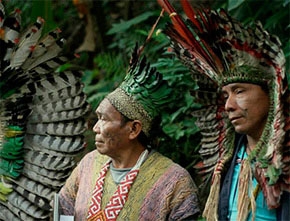
The work describes 109 species of medicinal plants and their uses. A Huni Kuĩ shaman from the state of Acre was the project creator, and the paper is the result of FAPESP-funded research (photo: Pascale/release)
The work describes 109 species of medicinal plants. A Huni Kuĩ shaman from the state of Acre was the project creator, and the paper is the result of FAPESP-funded research.
The work describes 109 species of medicinal plants. A Huni Kuĩ shaman from the state of Acre was the project creator, and the paper is the result of FAPESP-funded research.
The work describes 109 species of medicinal plants and their uses. A Huni Kuĩ shaman from the state of Acre was the project creator, and the paper is the result of FAPESP-funded research (photo: Pascale/release)
By Karina Toledo
Agência FAPESP – A synthetic paper made of recycled plastic, the result of a study conducted with FAPESP funding, is helping to preserve knowledge about medicinal plants transmitted orally for centuries by shamans of the Huni Kuĩ people of the Jordan River in the state of Acre, Brazil.
Descriptions of the 109 species used in indigenous therapies as well as information about the region of occurrence and forms of treatment have been compiled in the book, titled Una Isĩ Kayawa, Livro da Cura [Book of Cures], produced by the Rio de Janeiro Botanical Garden Research Institute (IJBRJ) and published by Editora Dantes.
Three thousand copies of the book were originally published on coated paper. These copies were designed for the general public and were recently released in Rio de Janeiro and São Paulo. Another thousand copies, produced solely for the indigenous peoples, were made of synthetic paper, which is waterproof and has a texture like glossy paper, designed to increase its durability in the moist forest environment. The release was accompanied by a large party in the Huni Kuĩ villages of the Jordan River.
The work of researching and organizing the information took two and a half years and was coordinated by botanist Alexandre Quinet of Rio de Janeiro’s Botanical Garden. The project’s creator, however, was the shaman Agostinho Manduca Mateus Ĩka Muru, who died shortly before the work was completed.
“Shaman Ĩka Muru was a scientist of the forest and an observer of its plants. For over 20 years, he collected notebooks, filling them with knowledge that had previously been passed down only by word of mouth, in an effort to transmit information from tribal elders to apprentice shamans. He dreamed of recording everything in a printed book like those of the white man so that it would be available to future generations,” Quinet explained.
Also known by the name “Kaxinawá” – a term disliked by the indigenous people –, “true people” or “liana people,” the Huni Kuĩ make up the largest indigenous group in the state of Acre. Their presence extends into parts of Peru. There are more than 7,000 members of the tribe in Brazil, divided among 12 different reservations. The “book of cures” describes the treatment practiced in the 33 villages of one of these reservations, which extends along the Jordan River.
In addition to information about the plants, the book uses stories and drawings to present some information about the culture of the Huni Kuĩ people, such as their eating habits, their music and their views regarding disease and spirituality. The entire content is written in “hatxa kuĩ,” the language spoken in the villages of the Jordan River, and translated into Portuguese.
According to Quinet, five trips were made to the Acre region to conduct the research, in addition to four periods of residence by the Huni Kuĩ translators in Rio de Janeiro.
“We held a 15-day workshop and met with the 22 shamans from the Jordan River villages. The chapters of the book are actually literal transcriptions of the topics they brought up, organized within the indigenous system. Revisions were made only to facilitate comprehension,” Quinet explained.
The researchers collected 196 samples of the 351 species that the shamans listed as medicinal, resulting in the selection of the 109 plants that make up the book. The botanical samples were identified according to taxonomic techniques and deposited in the herbarium of the Rio de Janeiro Botanical Garden Research Institute.
Starting from the scientific name of the species when possible, the researchers also referred to the scientific literature to include uses of the species by other people in the world. The book involved collaboration by 21 taxonomists from institutions in Brazil and abroad.
“The initial goal of the shaman Ĩka Muru was to create teaching material for the apprentice shamans so they would be able to find the plants in the medicinal gardens. However, the book is also designed to disseminate the tribe’s culture and the importance of preserving the common forest. They sought out the Botanical Garden so that the scientific basis of this knowledge could be internationally recognized,” Quinet said.
Vitopaper
To represent the written content in “hatxa kuĩ,” editor Anna Dantes created a special typographic font inspired by the handwritten letters in indigenous notebooks. It was also her idea to produce a special edition on synthetic paper.
“From the very first meeting with the shamans in the forest, I was able to see that the books sent to the indigenous peoples get quite damaged by the moisture and are highly perishable. The pages curl up and stick together. They are also damaged by small animals such as termites. It was a very ambitious project that called for tremendous effort, and we didn’t want to create a product that would disappear in just a short time,” said Dantes.
Dantes explained that it was the first time she had worked with Vitopaper, a material produced by the Vitopel company and originally developed by Sati Manrich, a researcher at the Federal University of São Carlos (UFSCar).
“When we began the project in 2003, our idea was to find a common solution to two major problems: the felling of trees for the production of cellulose and the difficulties involved with making good use of the huge volume of plastic waste produced in the urban centers,” Manrich explained.
In the process she developed at the university, plastic originating from food packaging, cleaning products or water bottles is moistened and ground. Mineral particles are then added to give it optical properties such as brightness, whiteness, contrast, dispersion and light absorption, and mechanical resistance to tearing, pulling and folding.
The mixture is placed in an extrusion machine at high temperatures until it softens and melts. Finally, the material is transformed into a large thin sheet similar to cellulose paper, which is then rolled and cut according to the desired use.
According to Vitopel, the production of each ton of Vitopaper removes 750 kilograms of discarded plastic from the streets and trash dumps. In addition, says Manrich, nearly 30 trees are saved.
“I’d like this example to be adopted to not only immortalize the knowledge of indigenous peoples but also manufacture school books, because they would then have much greater durability,” Manrich said.
Una Isĩ Kayawa, Livro da Cura
Editors: Agostinho Manduca Mateus Ĩka Muru and Alexandre Quinet
Release date: 2014
Price: R$120.00
Pages: 260
Additional information available at: www.facebook.com/UnaIsiKayawa?fref=ts.
The Agency FAPESP licenses news via Creative Commons (CC-BY-NC-ND) so that they can be republished free of charge and in a simple way by other digital or printed vehicles. Agência FAPESP must be credited as the source of the content being republished and the name of the reporter (if any) must be attributed. Using the HMTL button below allows compliance with these rules, detailed in Digital Republishing Policy FAPESP.
