




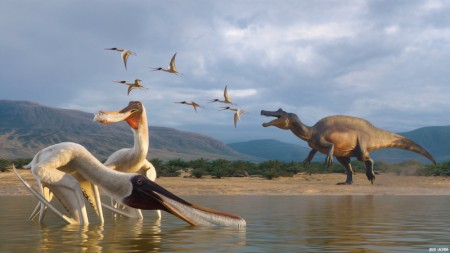
In the foreground, two Bakiribu waridza feed in a lake environment while, in the background, Irritator pursues other specimens (paleoart: Julio Lacerda)
A flying relative of dinosaurs, Bakiribu waridza (“comb mouth” in the Kariri language) filtered crustaceans and other small organisms from rivers and lakes, where it was likely swallowed by a predator that regurgitated it in the Araripe Basin in northeastern Brazil.
A flying relative of dinosaurs, Bakiribu waridza (“comb mouth” in the Kariri language) filtered crustaceans and other small organisms from rivers and lakes, where it was likely swallowed by a predator that regurgitated it in the Araripe Basin in northeastern Brazil.
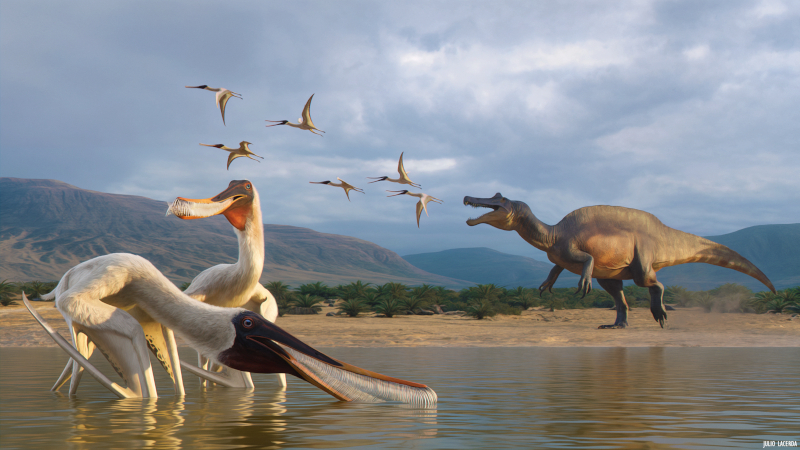
In the foreground, two Bakiribu waridza feed in a lake environment while, in the background, Irritator pursues other specimens (paleoart: Julio Lacerda)
By André Julião | Agência FAPESP – About 110 million years ago, two small pterosaurs, each about the size of a seagull, were flying over a lake or river, looking for food or perhaps bathing, when they were devoured by a large dinosaur or pterosaur. Later, when the predator passed through the Araripe Basin, a coastal region nearby, it regurgitated the least digestible parts of the pterosaurs – their skulls – as well as four fish that it had swallowed in a later meal.
In 2024, a group of researchers affiliated with Brazilian universities found the first species of filter-feeding pterosaur in the tropics in this vomit, which had been fossilized and stored in a museum for decades. The study was published in the journal Scientific Reports.
“It was very unexpected, because fossils from the Araripe region have been studied for decades and almost 30 types of pterosaurs had already been found, none of them filter feeders. We didn’t expect to find a new family for that region,” says Rubi Vargas Pêgas, who is conducting postdoctoral research at the Museum of Zoology of the University of São Paulo (MZ-USP) in Brazil with a fellowship from FAPESP.
Filter-feeding pterosaurs had fine, bristle-like teeth that were very close together. They used these teeth to filter small aquatic organisms, such as crustaceans. For that reason, they were linked to freshwater habitats rather than saltwater habitats, such as the Araripe Basin, during that period.
Therefore, the regurgitation helps explain why Bakiribu waridza, meaning “comb mouth” in the Kariri language, was in that region. The Araripe Basin is now part of three Brazilian states: Piauí, Ceará, and Pernambuco. However, it is a plateau only 160 kilometers long from east to west and 30 to 50 kilometers wide from north to south.
“It was therefore an environment surrounded by others that weren’t necessarily preserved in the fossil record. This species might never have been known if it hadn’t been regurgitated in Araripe, known for the preservation of its fossils,” adds Pêgas, who completed an internship at the Beipiao Pterosaur Museum in China, also with a scholarship from FAPESP.
The “regurgitallite,” or fossilized vomit, showed signs of wear on the pterosaur bones due to gastric juices, as well as four well-preserved fish that were likely swallowed shortly before being “returned” with the Bakiribu.
Paleontologist Aline M. Ghilardi, a professor at the Federal University of Rio Grande do Norte (UFRN) who coordinated the study, was particularly interested in the orientation of the remains, all of which were in the same direction. “Today’s fish-eating birds swallow animals whole by the head to avoid choking on fins. Whoever ate the Bakiribu and the fish probably did so in the same way, since they are all oriented in the same direction,” she explains.
The most likely predator was a spinosaurid, such as Irritator challengeri. This was one of the few piscivores in the region that ate pterosaurs and was large enough to hold Bakiribu, the four fish, and other prey in its stomach.
A less likely candidate would be a larger pterosaur, Tropeognathus mesembrinus. With a wingspan of about eight meters, it was the only one large enough to swallow the filter feeders in the region.
Museums
Bakiribu waridza belongs to the Ctenochasmatidae family of pterosaurs. Until now, species of this family had only been found in Europe, East Asia, and southern South America (Argentina). Within the evolutionary tree of pterosaurs, the new Araripe species lies between the more recent Argentine species, Pterodaustro guinazui, and the older European genus, Ctenochasma.
The rock block was found in the collection of the Câmara Cascudo Museum at UFRN, located in a region not part of the Araripe region. Supervised by Ghilardi, scientific initiation student William Bruno de S. Almeida, supervised by Ghilardi, was conducting a survey of the museum’s fish fossils when he came across the pterosaur.
“Fish are very abundant organisms in the Araripe fossil record, which is perhaps why no one realized that among them was an animal that was still unknown,” suspects Pêgas.
Upon realizing that it was a pterosaur, Ghilardi assembled a team of experts who examined the fossil in Natal. Within a few days, they wrote the first draft of the published scientific article.
The rock containing the fossil is composed of two mirrored parts. One part was donated to the Plácido Cidade Nuvens Museum of Paleontology at the Regional University of Cariri (URCA) in Santana do Cariri, Ceará.
“We incorporated an ethical and decolonial bias into this work. The transfer ensures the preservation of the piece in its territory of origin,” Ghilardi concludes. He was one of the people responsible for repatriating the Ubirajara jubatus dinosaur to Cariri in 2023. German researchers had previously described the dinosaur based on a fossil obtained illegally in the 1990s (read more at revistapesquisa.fapesp.br/en/dinosaur-fossil-to-be-returned-to-brazil/).
The article “A regurgitalite reveals a new filter-feeding pterosaur from the Santana Group” can be read at www.nature.com/articles/s41598-025-22983-3.
The Agency FAPESP licenses news via Creative Commons (CC-BY-NC-ND) so that they can be republished free of charge and in a simple way by other digital or printed vehicles. Agência FAPESP must be credited as the source of the content being republished and the name of the reporter (if any) must be attributed. Using the HMTL button below allows compliance with these rules, detailed in Digital Republishing Policy FAPESP.
