




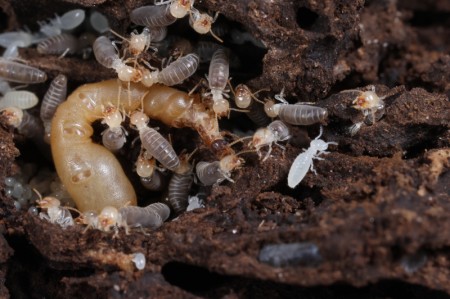
Workers of the species Anoplotermes pacificus with queen in colony (photo: Tiago Carrijo/UFABC)
Study reveals that evolutionary divergence occurred before ecological divergence, enabling these insects to feed on both wood and soil. Future discoveries may be applied to the production of biofuels.
Study reveals that evolutionary divergence occurred before ecological divergence, enabling these insects to feed on both wood and soil. Future discoveries may be applied to the production of biofuels.

Workers of the species Anoplotermes pacificus with queen in colony (photo: Tiago Carrijo/UFABC)
By André Julião | Agência FAPESP – It is not always ecological conditions that determine genes, but rather genes that enable the same group of animals to occupy diverse niches, such as tree trunks and subsoil. The largest termite genome sequencing project analyzed 47 species of insects, and the initial results were published in the journal Nature Communications.
The analyses revealed an expansion of genomes prior to the division of the group into wood- and soil-feeders. The addition of new genes and transposable elements – DNA sequences that can change position in the genome and perform different functions – later allowed termites to develop distinct feeding habits.
“The evolutionary divergence occurred before the ecological one. When they began to explore their environments, termites had a very broad genetic framework with many genes responsible for digesting complex carbohydrates such as cellulose and hemicellulose,” says Ives Haifig, a professor at the Center for Natural and Human Sciences at the Federal University of ABC (CCNH-UFABC) in Santo André, in the state of São Paulo, Brazil. Haifig is the only Brazilian co-author of the study.
Haifig coordinates the project “Consequences of the Loss of Soldiers on Social Immunity in Termites (Isoptera: Termitidae)”, which is supported by FAPESP.
The ability to digest cellulose, hemicellulose, and lignin makes termites interesting from a biotechnological point of view. Future discoveries could be applied to the production of biofuels, for example.
Haifig explains that the main objective of this study, the first in a series on the termite genome, is to provide the necessary tools for more in-depth analysis. Future studies will analyze how the genome relates to aspects such as social behavior and immunity.
“Until now, we only had genomes based on short sequences from nine termite species. In this study, we sequenced long stretches of the genome of 45 species, representing around 80% of the current termite family diversity, which consists of 3,000 described species, as well as two species of cockroaches, which are the closest relatives of termites,” reports Haifig.
Toolbox
The researcher points out that the genome itself does not reveal the specific functions of genes, only their genetic potential. Understanding how these genes work requires conducting transcriptomic studies to indicate what the genes are transcribing and performing functional experiments. “It’s as if we now have a complete toolbox, whereas before, we only had one or two tools,” says the researcher.
In recent years, his group has conducted studies of this type to understand the social immunity of termites. Social immunity is the ability of social insects to protect their colonies from pathogens. This characteristic is also shared by ants (read more at agencia.fapesp.br/54199).
One of the species studied in Haifig’s laboratory is Anoplotermes pacificus, whose genome was sequenced for the recently published study. “It’s a particularly interesting species because it lacks a soldier caste, widely known for defending the colony. The genomic data from this study tells us what’s possible, and the experiments tell us what actually happens,” he explains.
Termites first appear in the fossil record in the Early Cretaceous period, around 130 million years ago. The greatest diversity is found in the Termitidae family, which originated in the Eocene period, around 50 million years ago, and diversified approximately 30 million years ago. This family comprises approximately 80% of existing termite species and is therefore the focus of most studies.
While 12 other families mainly feed on wood with the help of protozoa living in their digestive systems, the Termitidae family has lost its flagellate symbionts and feeds on various types of organic matter from the decomposition gradient. This includes wood, microepiphytes living in it, decaying wood, humus, soil, and fungi.
“By demonstrating that genome expansion occurred before the diversification of feeding habits, the study changes the way we understand the evolution of termites. More than answering a specific question, the work inaugurates a new phase of research on these insects by providing high-quality genomes that will serve as a basis for future investigations into social behavior, immunity, and the ecological adaptations responsible for the group’s evolutionary success,” the researcher concludes.
The article “Unravelling the evolution of wood-feeding in termites with 47 high-resolution genome assemblies” can be read at nature.com/articles/s41467-025-65969-5.
The Agency FAPESP licenses news via Creative Commons (CC-BY-NC-ND) so that they can be republished free of charge and in a simple way by other digital or printed vehicles. Agência FAPESP must be credited as the source of the content being republished and the name of the reporter (if any) must be attributed. Using the HMTL button below allows compliance with these rules, detailed in Digital Republishing Policy FAPESP.
