




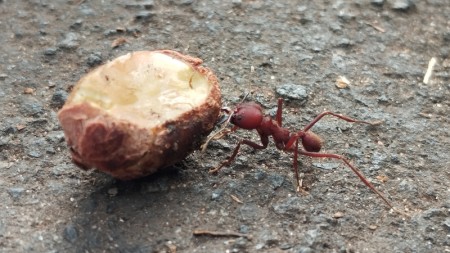
Leafcutter ant cutting a seed. Leafcutter ants carry plant parts to the colony, where they are digested by fungi and bacteria (photo: Mariana Barcoto/IB-UNESP)
Scientists observed that bacterial communities in colonies change depending on the food leafcutter ants offer to their symbiotic fungus. This research may aid in the search for new molecules for biofuels and bioremediation.
Scientists observed that bacterial communities in colonies change depending on the food leafcutter ants offer to their symbiotic fungus. This research may aid in the search for new molecules for biofuels and bioremediation.
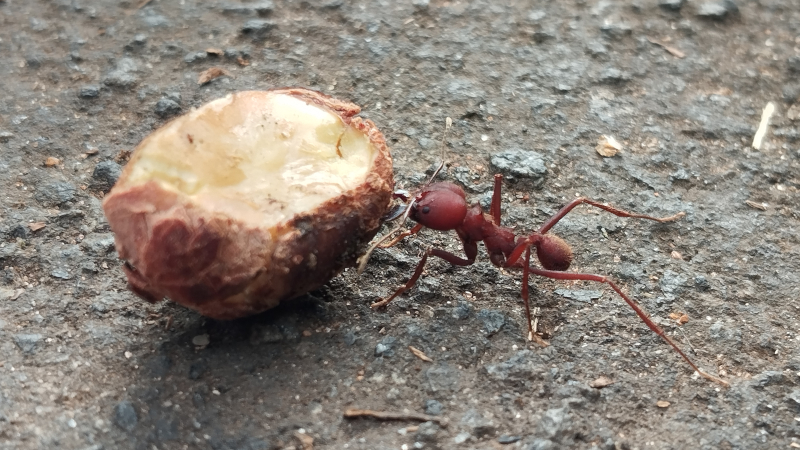
Leafcutter ant cutting a seed. Leafcutter ants carry plant parts to the colony, where they are digested by fungi and bacteria (photo: Mariana Barcoto/IB-UNESP)
By André Julião | Agência FAPESP – A colony of leafcutter ants is home to more than just one species. Each year, studies reveal new layers of complexity in these ecosystems, where various fungi and bacteria thrive alongside the ants, resulting in countless interactions and the production of unknown compounds.
In their latest study, researchers affiliated with São Paulo State University (UNESP) and the University of São Paulo (USP), supported by FAPESP, demonstrate how bacteria in the colonies respond to different diets provided by ants to the fungi they cultivate.
Published in the journal NPJ Biofilms and Microbiomes, the study paves the way for a better understanding of how colonies function and may lead to the discovery of new molecules for biotechnological use.
Leafcutter ants (tribe Attini) are known for cultivating a fungus in their colonies. The fungus digests organic matter and provides the ants with nutrients in exchange for food and protection (read more at agencia.fapesp.br/52936 and agencia.fapesp.br/54199).
“There’s a wealth of scientific research on how the human gut microbiota changes according to diet. We therefore sought to understand what happens to the microbiota of these superorganisms – the colonies – when we provide food with different fiber content,” explains Mariana de Oliveira Barcoto, the first author of the study. She conducted the research during her doctoral studies at the Institute of Biosciences (IB) at UNESP’s Rio Claro campus with a scholarship from FAPESP.
The work is part of a project supported by FAPESP under the FAPESP Research Program on Biodiversity Characterization, Conservation, Restoration and Sustainable Use (BIOTA-FAPESP). The project is coordinated by André Rodrigues, a professor at IB-UNESP and Barcoto’s doctoral advisor.
The researchers observed that a diet consisting exclusively of fruits and grains favors a bacterial community that is very different from that found in colonies fed the typical leafcutter ant diet of fresh and dry leaves.
In experiments conducted in Rio Claro, the symbiotic fungus ceased growing in colonies that received only fruits and grains because they contain simpler fibers that are easier to digest. Consequently, these colonies ceased producing food for the ants. This may have occurred because the symbiotic fungus and the bacteria associated with it in the ant nests are adapted to digest much more complex fibers, which provide more nutrients.
A total of 28 colonies of lemon leaf-cutter ants (Atta sexdens) were divided into four groups and fed different diets for 56 days. The control group received only leaves, replicating the species’ natural diet. Another group received only grains (oats and rice) and fruits (such as dehydrated papaya, banana, and apple). The generalist diet alternated between leaves, fruits, and grains. In the fourth treatment, the ants received only leaves for 20 days, then fruits and grains for 20 days, and finally returned to receiving only leaves for the last 16 days.
“Just as observed in the human gut, the microbiota of colonies responds to the diet and can return to their original composition when the previous diet is reintroduced,” notes Barcoto.
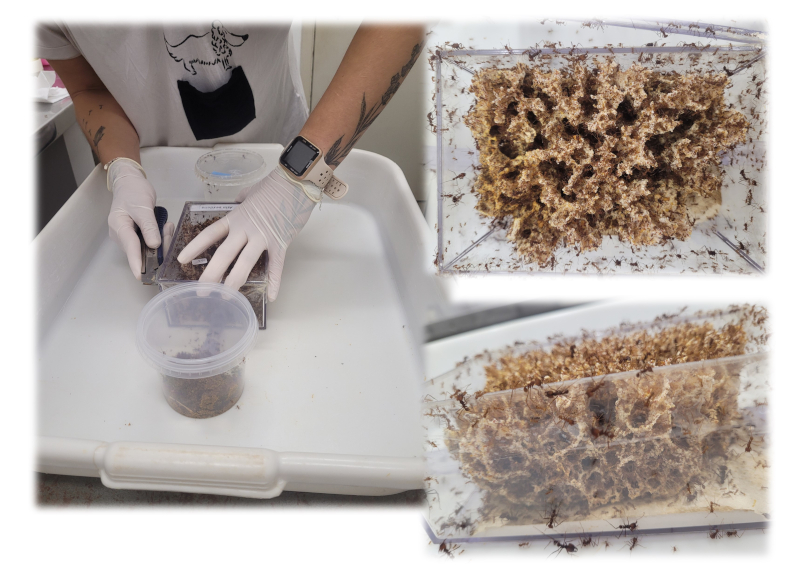
Colonies were cultured in the laboratory under conditions that allowed for dietary control (photos: Raquel Lima de Sousa/FFCLRP-USP)
Multidisciplinary
However, understanding how the microbiota of colonies works was no simple task. One can change the diet of a group of people or mice and observe the effects, as has been done in numerous studies. However, there were no protocols or experimental designs to analyze how the microbiota of leafcutter ant colonies would respond to diet changes.
For this reason, Barcoto reviewed the most recent scientific literature on this type of analysis in different organisms and assembled a multidisciplinary team of experts in the various fields required for the study.
Participants included Odair Correa Bueno from the Leafcutter Ant Laboratory at UNESP in Rio Claro and researchers from different USP units: Raquel Lima de Sousa from the Ribeirão Preto Faculty of Philosophy, Sciences, and Letters (FFCLRP) and Lucas William Mendes from the Center for Nuclear Energy in Agriculture (CENA) in Piracicaba. Three researchers from the São Carlos Institute of Physics (IFSC) also participated: Eduardo Ribeiro de Azevedo, Rodrigo Henrique dos Santos Garcia, and João Gabriel da Silva Soares.
After maintaining the colonies in the laboratory and formulating and administering the different diets, the researchers used solid-state magnetic resonance imaging, scanning electron microscopy, and genetic sequencing of colony samples.
“We needed different types of data to understand what was happening. Genetic sequencing, for example, when contextualized with the microscopy images, provides much greater certainty for interpretations,” says Rodrigues.
Promising waste
The analyses revealed that the colony is a longitudinal continuum of lignocellulose degradation. The ants deposit freshly collected leaves in an upper layer. This grayish-green region has sparse colonization by fungi and bacteria.
As the degradation of organic matter progresses, the density of these microorganisms gradually increases, forming whitish central regions containing gongylids – structures that provide the ants with many of the nutrients they need.
Undegraded plant parts remain in the oldest region of the garden, forming a brownish area at the bottom. Each of these regions has groups of bacteria that are predominant to varying degrees.
The worker ants, known for their cleanliness, remove parts of the garden that no longer have nutritional value and deposit them in a separate area: the trash pile. Dead ants and substrates that are dangerous to the colony are also discarded in this pile. Another group of bacteria continues to act on the discarded material.
“This waste has significant biotechnological potential for identifying microorganisms and the enzymes they produce that degrade organic matter, such as the lignocellulose in plants. These bacteria could be very promising for research into biofuels and bioremediation, for example,” says Barcoto.
Additionally, this study paves the way for new experiments by altering variables such as temperature and humidity and reevaluating microbiological responses.
“We altered just one variable – the diet – of a single ant species, and yet we observed major changes in the colonies. In future studies, we can explore other species and parameters and even try to predict their effect on the ecosystem in climate change scenarios, for example,” concludes Rodrigues, a researcher at the Center for Research on Biodiversity Dynamics and Climate Change (CBioClima), a FAPESP Research, Innovation, and Dissemination Center (RIDC).
The article “You are what your fungus eats: diet shapes the microbial garden of a fungus-growing ant” can be read at nature.com/articles/s41522-025-00876-7.
The Agency FAPESP licenses news via Creative Commons (CC-BY-NC-ND) so that they can be republished free of charge and in a simple way by other digital or printed vehicles. Agência FAPESP must be credited as the source of the content being republished and the name of the reporter (if any) must be attributed. Using the HMTL button below allows compliance with these rules, detailed in Digital Republishing Policy FAPESP.
