




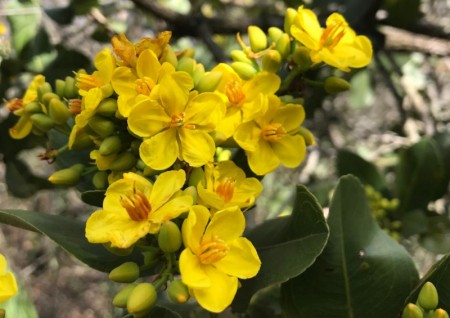
Ouratea spectabilis, a species native to the Cerrado (photo: Amanda Eburneo Martins/UNESP)
A study conducted at São Paulo State University evaluated 31 species of trees and shrubs in the Itirapina region, located in the central-eastern part of the state of São Paulo, Brazil.
A study conducted at São Paulo State University evaluated 31 species of trees and shrubs in the Itirapina region, located in the central-eastern part of the state of São Paulo, Brazil.
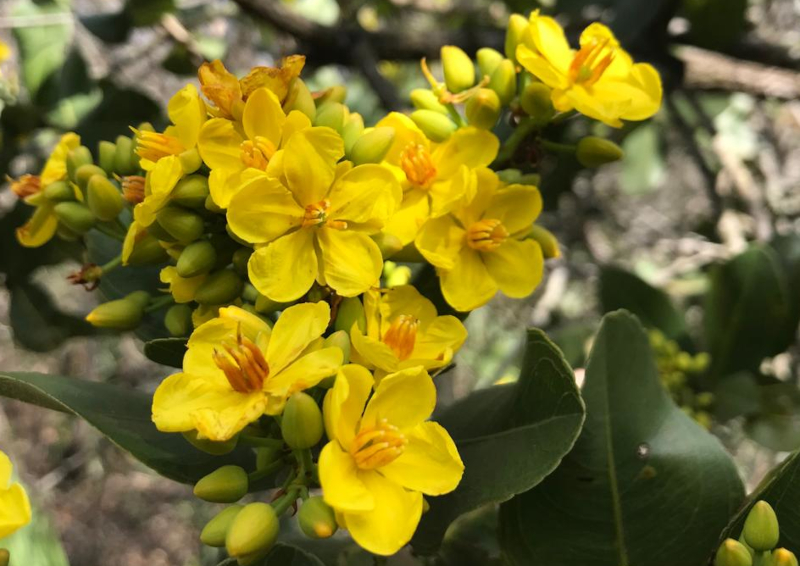
Ouratea spectabilis, a species native to the Cerrado (photo: Amanda Eburneo Martins/UNESP)
By Gabriela Andrietta | Agência FAPESP* – A study conducted by researchers at São Paulo State University (UNESP) in Brazil revealed that climate change is altering the reproductive rhythm of plants in the Cerrado, Brazil’s savanna-like biome. Over 15 years of monthly observations (2005–2019), the scientists found that the flowering and fruiting periods of many species have significantly shortened, particularly among those that depend on pollinators, primarily bees, to reproduce.
The study analyzed 31 species of trees and shrubs in an area of native vegetation in Itirapina, a municipality of São Paulo, and was published in the journal Functional Ecology. It is part of the Cerrado Long-Term Phenological Monitoring Program at the UNESP Phenology Laboratory in Rio Claro, coordinated by Patricia Morellato. The study is also part of Amanda Eburneo Martins’ doctoral thesis, supported by a scholarship from FAPESP.
According to Martins, the lead author of the article, species that depend on animals for pollination experienced a shorter flowering period over the 15-year study period due to decreased precipitation. The duration of the fruiting phase, during which fruits develop and ripen, decreased in both pollinator-dependent and pollinator-independent species due to rising average temperatures and lower relative humidity.
This decrease mainly occurred at the end of the reproductive period since the start and peak dates of flowering and fruiting remained stable. This suggests that although plants continue to begin their reproductive cycles at the same times of year, they are flowering and fruiting for shorter periods.
“With a shorter flowering period, there’s less availability of floral resources for the pollinators of these plant species, such as bees. Similarly, the reduction in fruiting duration may hinder the development of new plant individuals and reduce food resources for frugivorous species that feed on fruits and disperse seeds, which could impact plant regeneration and the equilibrium of the Cerrado ecosystem,” Martins explains.
Another relevant finding is the decline in co-flowering, or the overlap of flowering periods among different species. This pattern was observed in both pollinator-dependent and pollinator-independent plants. Since most of the species studied are pollinated by bees, the reduction in co-flowering may increase competition among pollinators for plants and among plants for pollinators, as fewer flowers are available simultaneously.
Despite these changes, the study found that the reproductive success of the community remained stable throughout the period analyzed, indicating that the Cerrado species studied have demonstrated resilience to recent climate change thus far. This resilience may be related to ancient evolutionary adaptations developed during past periods of extreme climate, such as the Pleistocene oscillations, a geological period spanning from approximately 2.6 million to 11,700 years ago marked by intense climate changes. These adaptations may confer an adaptive advantage in the face of current climate change.
Different methods
“The methodology we use in the tropics differs from that used in the Northern Hemisphere. There, they use what are called ‘first flower’ and ‘first leaf bud.’ They simply record these occurrences on a case-by-case basis, and in most cases, the individuals aren’t tagged. It’s merely a chronological observation throughout the year,” compares Morellato, director of the Center for Research on Biodiversity Dynamics and Climate Change (CBioClima) – one of FAPESP’s Research, Innovation, and Dissemination Centers (RIDCs).
“Obviously, they have data series spanning many decades, but the phenology we conduct here is much more detailed. We go into the field at least once a month and record all phenophases: first bud, open flower, first green fruit, ripe fruit, first leaf bud, proportion of new leaves, leaf production, and leaf fall. In other words, we observe many more phenophases and continuously monitor marked individuals. This brings greater detail and sophistication to the data, albeit, of course, in smaller areas. On the other hand, this type of monitoring allows for a more consistent analysis over the years,” the researcher explains.
The Cerrado is one of the regions most impacted by environmental changes, marked by intense agricultural expansion. “This expansion is moving northward, forming the so-called ‘arc of devastation,’ which represents the boundary between the Cerrado and the Amazon rainforest in central Brazil. That’s why it’s essential to understand what’s happening to the Cerrado and recognize its importance across its entire range,” says Morellato.
“We’re conducting similar analyses in other types of forests, such as the Amazon and native grasslands. We already have even longer Amazonian data series, and this will be extremely relevant for understanding the effects of climate change on different Brazilian biomes,” the researcher concludes.
The article “Climate-induced shifts in long-term tropical tree reproductive phenology: Insights from species dependent on and independent of biotic pollination” can be read at besjournals.onlinelibrary.wiley.com/doi/full/10.1111/1365-2435.70090.
* Gabriela Andrietta is a FAPESP Scientific Journalism scholarship recipient affiliated with CBioClima
The Agency FAPESP licenses news via Creative Commons (CC-BY-NC-ND) so that they can be republished free of charge and in a simple way by other digital or printed vehicles. Agência FAPESP must be credited as the source of the content being republished and the name of the reporter (if any) must be attributed. Using the HMTL button below allows compliance with these rules, detailed in Digital Republishing Policy FAPESP.
