




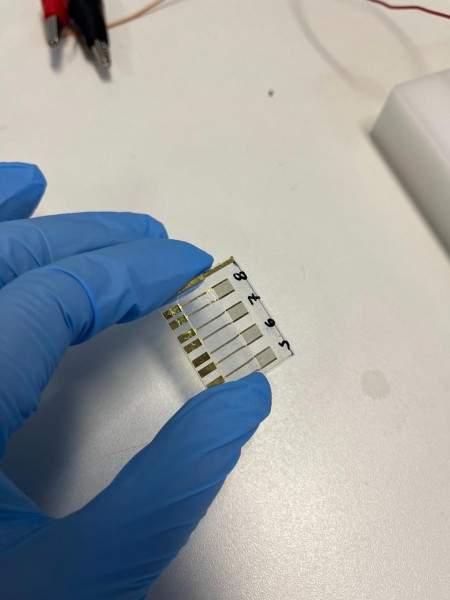
The device contains specific antibodies that capture the primary biomarker of pancreatic cancer. The binding of these antibodies alters the distribution of electrical charges on the electrode surface. The sensor then translates this variation into a measurable capacitance signal (image: Gabriella Soares)
Device developed at the University of São Paulo aims to enable rapid and accessible diagnosis of pancreatic cancer, thereby increasing the chances of effective treatment.
Device developed at the University of São Paulo aims to enable rapid and accessible diagnosis of pancreatic cancer, thereby increasing the chances of effective treatment.
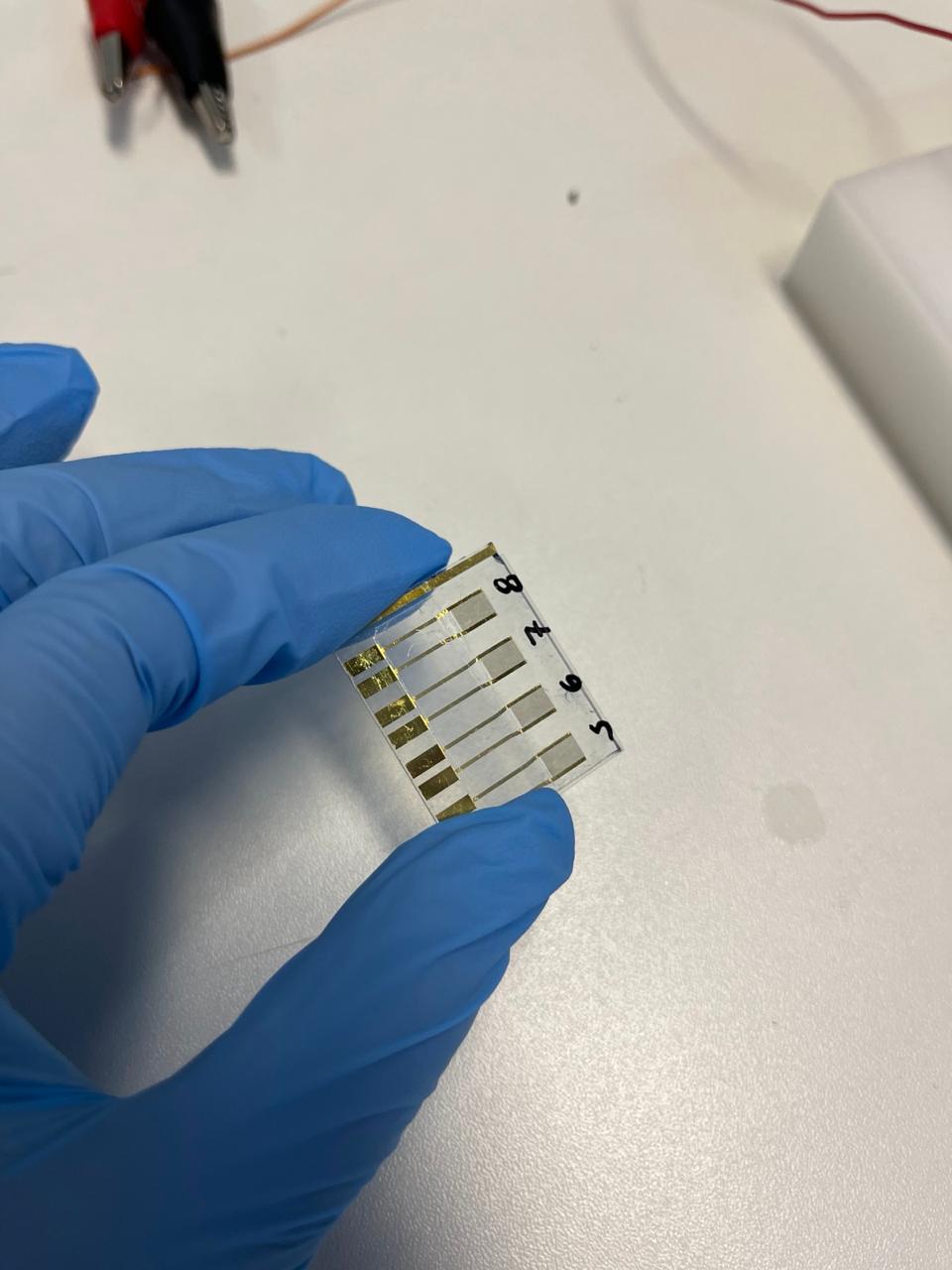
The device contains specific antibodies that capture the primary biomarker of pancreatic cancer. The binding of these antibodies alters the distribution of electrical charges on the electrode surface. The sensor then translates this variation into a measurable capacitance signal (image: Gabriella Soares)
By Maria Fernanda Ziegler | Agência FAPESP – Brazilian researchers have developed an electrochemical sensor that can detect pancreatic cancer in its early stages. The device identifies the biomarker molecule CA19-9, which is associated with the disease, at low concentrations in a patient’s blood. This offers a simpler, more affordable alternative to conventional tests, which are less accessible.
“In its early stages, pancreatic cancer is asymptomatic, which means the disease is often identified too late. That’s also why pancreatic cancer is one of the deadliest forms of cancer. So much so that in advanced cases, the five-year survival rate is only 3%. The idea of developing this cheap and simple biosensor stems from the principle of providing access to screening for the disease,” says Débora Gonçalves, a professor at the São Carlos Institute of Physics at the University of São Paulo (IFSC-USP) and project coordinator.
The study, published in the journal ACS Omega, describes how the sensor detects the CA19-9 protein, the main biological marker for pancreatic cancer. This protein is frequently used as a tumor marker to monitor the disease, but it can only be identified through more complex laboratory tests.
“In the tests we conducted using 24 blood samples from patients at different stages of the disease and from the control group, we obtained statistically similar results to those of traditional tests. The next step in our work is to increase the number of analyses and expand the types of samples by analyzing blood, saliva, and urine provided by the Hospital of Clinics of the Ribeirão Preto School of Medicine,” says Gabriella Soares, a doctoral student in materials engineering at USP, a FAPESP scholarship recipient, and the first author of the study.
Pancreatic cancer is typically identified through an enzyme-linked immunosorbent assay (ELISA), which requires well-equipped laboratories and skilled personnel and takes a long time to process compared to biosensors. “That’s why the goal of the research was to create a low-cost screening tool that facilitates the population’s access to early diagnosis, significantly increasing the chances of therapeutic success,” says Soares.
The new sensor measures the capacitance, or the ability to store electrical charges, in the presence of the CA19-9 glycoprotein in patients’ blood. It functions like a “lock and key” system. The surface of the device contains specific antibodies against the CA19-9 protein. When the patient’s blood comes into contact with the sensor, the antibodies recognize the biomarker molecules and capture the CA19-9 protein.
This binding alters the distribution of electrical charges on the electrode surface, and the sensor translates this variation into a measurable capacitance signal. “The higher the concentration of CA19-9, the greater the variation detected by the sensor. In about ten minutes, the system compares the result with a pre-established calibration curve, estimating the amount of the protein in the blood. This allows us to identify very low concentrations of CA19-9, enabling the early diagnosis of the disease in a fast and accessible way,” says Soares.
The researchers’ work to develop a fast, inexpensive solution for the early detection of pancreatic cancer doesn’t stop there. The team is developing two other sensors with different architectures and detection mechanisms. “Our goal is to combine the responses of these biosensors and analyze CA19-9 in patients’ blood, urine, and saliva. That will allow us to improve the accuracy and quality of the analyses to obtain a result that closely aligns with the ELISA technique,” the researcher explains.
The research group is also working with machine learning techniques to develop a tool called the “bioelectronic tongue,” which can analyze results from blood, urine, and saliva samples. “Since the volume of data generated is large, algorithms are used to identify patterns, make predictions, and correct reading errors,” says Soares.
The article “Supramolecular PDDA/PEDOT:PSS biosensor for early pancreatic cancer detection via CA19-9: clinical validation on human blood samples” can be read at pubs.acs.org/doi/10.1021/acsomega.5c11381.
The Agency FAPESP licenses news via Creative Commons (CC-BY-NC-ND) so that they can be republished free of charge and in a simple way by other digital or printed vehicles. Agência FAPESP must be credited as the source of the content being republished and the name of the reporter (if any) must be attributed. Using the HMTL button below allows compliance with these rules, detailed in Digital Republishing Policy FAPESP.
