




"Much of basic education is in the hands of municipal governments, which have fewer resources and less infrastructure, precisely during the most critical phase of human development," Siqueira emphasized (photo: Daniel Antônio/Agência FAPESP)
The assessment was made by the professor from the Federal University of Bahia during the 2nd FAPESP 2026 Conference. He also discussed the limitations of the current model, the need for objective criteria in educational policies, and the impact of artificial intelligence on teaching.
The assessment was made by the professor from the Federal University of Bahia during the 2nd FAPESP 2026 Conference. He also discussed the limitations of the current model, the need for objective criteria in educational policies, and the impact of artificial intelligence on teaching.
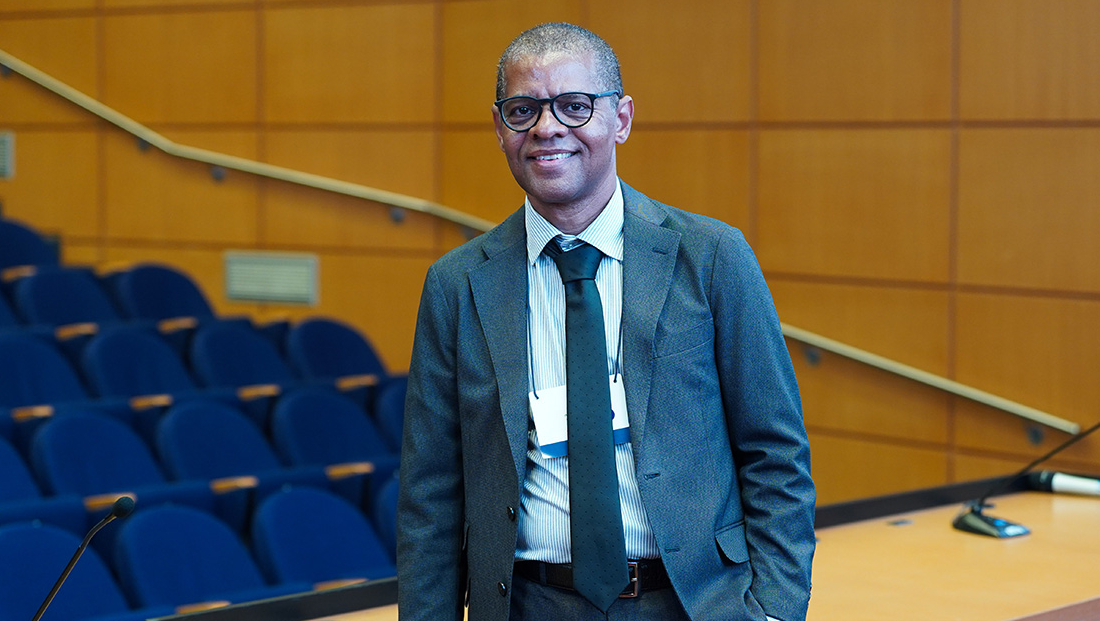
"Much of basic education is in the hands of municipal governments, which have fewer resources and less infrastructure, precisely during the most critical phase of human development," Siqueira emphasized (photo: Daniel Antônio/Agência FAPESP)
By José Tadeu Arantes | Agência FAPESP – Although Brazilian basic education has made significant strides in recent decades, it remains marked by deep inequalities and a disconnect between the teaching model and contemporary technological and social transformations. The researcher Ivan Siqueira, a full professor of interdisciplinarity at the Federal University of Bahia (UFBA), offered this assessment during the 2nd FAPESP 2026 Conference – "Basic Education in Brazil: Challenges and Opportunities".
According to Siqueira, the country has expanded access to schooling since the 1988 Constitution but still faces difficulties ensuring quality education commensurate with the investments made. "There's ample evidence that we've made progress. But when we consider the levels of inequality, we realize that we still need to do much more," he emphasized.
One of the central points of the presentation was the distinction between principles and criteria when defining public policies. According to Siqueira, Brazilian legislation has sound guidelines but lacks objective implementation mechanisms. The researcher analyzed Article 205 of the Constitution of the Federative Republic of Brazil specifically, which states: "Education, a right of all and a duty of the state and the family, shall be promoted and encouraged with the collaboration of society, aiming at the person's full development, their preparation for citizenship, and their qualification for work."
"The biggest problem with Article 205 is that it's a declaration of principle rather than a criterion. Principles are not binary; you can claim to be heading in a certain direction without ever getting there," he explained. "We need to transform principles into criteria because criteria are objective and allow for accountability."
This gap directly affects educational governance, especially in municipalities with limited administrative capacity. "Much of basic education is in the hands of municipal governments, which have fewer resources and less infrastructure, precisely during the most critical phase of human development," he said.
The professor also criticized the country's teacher training program. According to him, the system allows teachers to be trained without gaining practical experience in schools. "Brazil authorizes the training of people who have never set foot in a classroom. That doesn't happen in fields such as medicine," he noted. Another problem he highlighted was curricular fragmentation. "It's unrealistic to imagine that a student can learn thirteen different subjects with fewer than four hours of class per day," he emphasized. He believes that the model presupposes full-time schooling, which is not yet a reality in most of the country.
The impact of digital technologies
Siqueira emphasized that digital technologies have brought about a fundamental shift in the learning process, impacting attention, language, and modes of interaction. "The traditional lecture-based model is dead. It no longer works for the students we have today," he summarized. According to the researcher, students are having an increasingly difficult time concentrating and organizing their thoughts. "It's very difficult to keep a student focused for ten minutes today. To write, they need to think – and they aren't practicing that."
He also reported an increase in phenomena such as misinformation, social media dependency, and mental health issues. "At UFBA, 70% of medical students report mental health issues. In psychology, the percentage is even higher: 80%. So much so that the professors, my colleagues, say that people come to psychology to get treatment," he said.
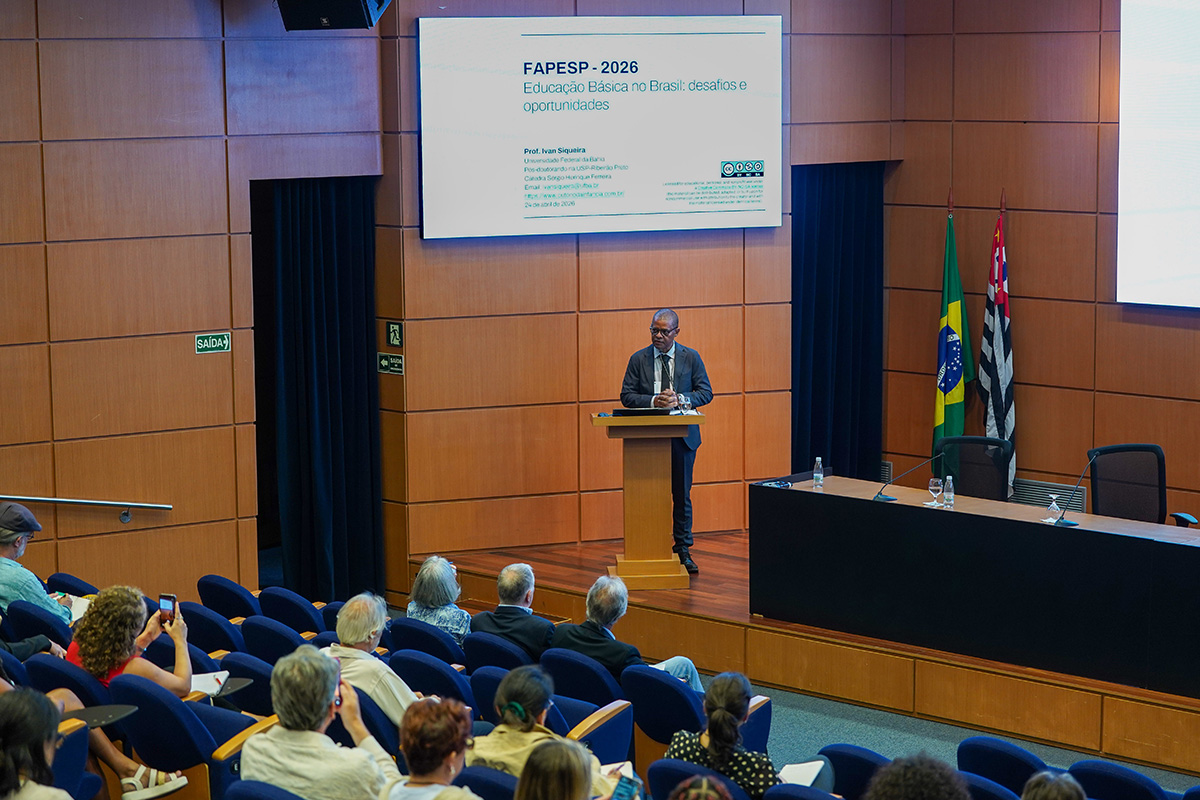
"Brazil authorizes the training of people who have never set foot in a classroom. That doesn't happen in fields such as medicine," said Siqueira (photo: Daniel Antônio/Agência FAPESP)
Artificial intelligence (AI) was presented as one of the main drivers of transformation in education and the job market. Siqueira cited recent layoffs in the financial sector to illustrate the impact of adopting new digital technologies. "In the last four months, the four largest U.S. banks laid off 15,000 employees while earning over $1 billion in profits. One person with AI does the work of ten. And that completely changes the market," he emphasized.
At the same time, he highlighted positive applications in the educational system. "Models based on the BNCC [the Brazilian Common Core Curriculum] can generate lesson plans tailored to different student profiles, greatly reducing the teacher's workload," he said. The BNCC defines what all Brazilian students are entitled to learn throughout basic education, including early childhood education, elementary school, and high school.
Furthermore, incorporating new digital technologies facilitates access to quality content and the formation of learning communities. It also enables the integration of the curriculum with local realities, such as in indigenous and quilombola communities (descendants of enslaved populations who formed villages after escaping captivity beginning in the 16th century). This expands the potential for more contextualized, collaborative education aligned with contemporary demands.
However, there are several obstacles to overcome. One is the assessment model. Siqueira argued that exams such as that of the Basic Education Assessment System (SAEB) are outdated and fail to capture essential competencies. He advocated for incorporating skills such as critical thinking, metacognition, and solving complex problems. "Students need to know how to apply knowledge in real-world situations. It isn't enough to simply repeat content," he said.
The burden of inequality
For the researcher, social inequality remains the main obstacle to quality education in the country. He cited internal differences within the city of São Paulo itself, where life expectancy can vary by up to 20 years between different districts. "This inequality begins in childhood and widens throughout one's school years," he stated. "If we don't reduce it, it'll be very difficult to improve the quality of education."
In conclusion, Siqueira referenced geographer Milton Santos to highlight the subjective nature of education. "Identity is the feeling of belonging to what belongs to us," he quoted. According to Siqueira, many students do not see themselves reflected in school. "There are students whose bodies are present, but who don't feel they belong. Without that, nothing makes sense," he stated.
Finally, the researcher advocated for greater university involvement in basic education. "If universities don't take on that role, we can expect a disaster, which is already underway," he warned.
Siqueira holds a Ph.D. in Letters from the University of São Paulo (USP). He has taught at USP's School of Communications and Arts (ECA) and in the São Paulo state public school system. He also taught as a visiting professor at Kyoto University of Foreign Studies in Japan. He has served as a member of the National Education Council and Mercosul Educacional. His research focuses on basic education, interdisciplinarity, digital technologies, and artificial intelligence applied to education. He has received additional training at institutions such as Stanford, Oxford, and MIT.
Attendees included Marta Arretche, FAPESP's general coordinator for Sciences, Humanities, and Arts; and Oswaldo Baffa Filho, coordinator of the FAPESP 2026 Conferences. Mozart Ramos, holder of the Sérgio Henrique Ferreira Chair at the Institute of Advanced Studies – Ribeirão Preto Campus (IEARP) of USP, moderated the discussion. Ramos emphasized the importance of discussing basic education in the country. "If we don't solve basic education, we won't solve the main problems in higher education," he said, noting that 59% of students drop out of college before completing their degree.
The full recording of the conference "Basic Education in Brazil: Challenges and Opportunities" is available at youtu.be/DV9snChIEho.
The Agency FAPESP licenses news via Creative Commons (CC-BY-NC-ND) so that they can be republished free of charge and in a simple way by other digital or printed vehicles. Agência FAPESP must be credited as the source of the content being republished and the name of the reporter (if any) must be attributed. Using the HMTL button below allows compliance with these rules, detailed in Digital Republishing Policy FAPESP.
