




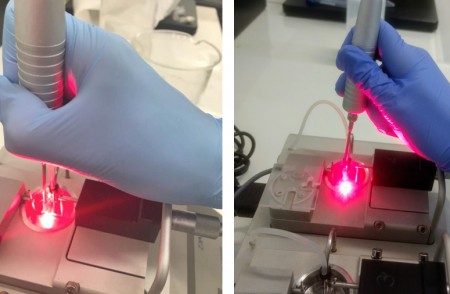
Photobiomodulation improved endothelial function, reduced oxidative stress, and increased levels of nitric oxide, a gas naturally produced by the body that acts as a vasodilator (photos: Luis Henrique Oliveira de Moraes / Tereza Cristina Buzinari)
An experiment conducted at the Federal University of São Carlos demonstrated that applying low-intensity light had a hypotensive effect on rats that became hypertensive due to a reduction in hormones, a process characteristic of aging in the female reproductive system.
An experiment conducted at the Federal University of São Carlos demonstrated that applying low-intensity light had a hypotensive effect on rats that became hypertensive due to a reduction in hormones, a process characteristic of aging in the female reproductive system.
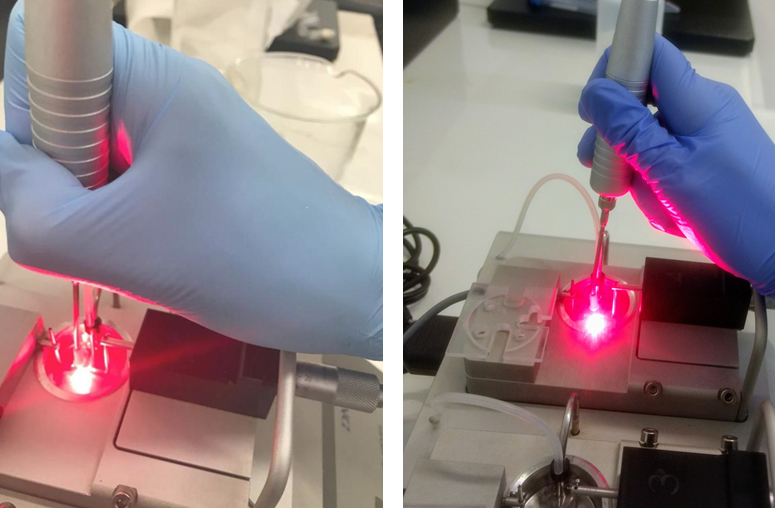
Photobiomodulation improved endothelial function, reduced oxidative stress, and increased levels of nitric oxide, a gas naturally produced by the body that acts as a vasodilator (photos: Luis Henrique Oliveira de Moraes / Tereza Cristina Buzinari)
By Thais Szegö | Agência FAPESP – In vivo research has revealed that applying lasers to the abdomen can combat hypertension caused by the natural decrease in female hormone production during menopause. The study was supported by FAPESP and conducted by researchers at the Federal University of São Carlos (UFSCar) in the state of São Paulo, Brazil. It involved 26 70-day-old female rats that were divided into three groups: a control group, an ovariectomized group (which underwent surgery to remove their ovaries), and an ovariectomized group that was treated with photobiomodulation twice a week for two weeks.
Photobiomodulation uses light of different wavelengths to promote therapeutic effects in cells and tissues (read more at agencia.fapesp.br/55570). The results of the investigation were published in the journal Lasers in Medical Science.
Removing the guinea pigs’ ovaries was a way of inducing menopause, a phase in which women’s reproductive systems age and there is a significant decrease in the production of hormones, mainly estrogen, that play an important role in protecting the cardiovascular system by helping to keep blood vessels healthy and regulate blood pressure. This decline can trigger the development of high blood pressure and other cardiovascular diseases.
The results showed that low-intensity red laser light reduced blood pressure, improved the function of the endothelium (the layer of cells lining blood vessels), and decreased oxidative stress in an animal model. “We also noticed that applying the light source increased the production of nitric oxide, a gas naturally produced by the body that plays a crucial role in regulating blood pressure by acting as a vasodilator, relaxing the vessels and facilitating blood flow, in addition to having other beneficial effects on the cardiovascular system,” explains Gerson Rodrigues, a professor at the Department of Physiological Sciences at UFSCar and the project coordinator.
The study was based on research conducted since 2013 in Rodrigues’s laboratory, which investigates nitric oxide release through photobiomodulation. “In previous research, our team had already demonstrated that the acute application of a red laser to the abdomen of hypertensive rats induced a hypotensive effect accompanied by the release of nitric oxide,” the researcher explains. “We were the first to construct the energy/response curve in blood pressure in an animal model.”
Rodrigues’s team is also involved in completing a clinical study with menopausal women to investigate the effects of red laser on symptoms related to cardiovascular disease in humans. The preliminary results are encouraging, especially in terms of symptom improvement, and the results will be published soon.
“We’re also investigating strategies that can enhance the therapeutic biological effects induced by red laser, such as the use of certain herbal medicines and phytopharmaceuticals that have shown promise in enhancing the effects induced by the light source,” says Rodrigues.
The work was part of Nayara Formenton da Silva’s thesis for the Interinstitutional Graduate Program in Physiological Sciences at UFSCar/UNESP. Silva, Luis Henrique Oliveira de Moraes, and Camila Pereira Sabadini performed the data collection, and Rita Cristina Cotta Alcântara and Patricia Corrêa Dias contributed to the experimental design and correction.
The article “Chronic treatment with photobiomodulation decreases blood pressure and improves endothelial function in ovariectomized rats” can be read at link.springer.com/article/10.1007/s10103-025-04404-z.
The Agency FAPESP licenses news via Creative Commons (CC-BY-NC-ND) so that they can be republished free of charge and in a simple way by other digital or printed vehicles. Agência FAPESP must be credited as the source of the content being republished and the name of the reporter (if any) must be attributed. Using the HMTL button below allows compliance with these rules, detailed in Digital Republishing Policy FAPESP.
