





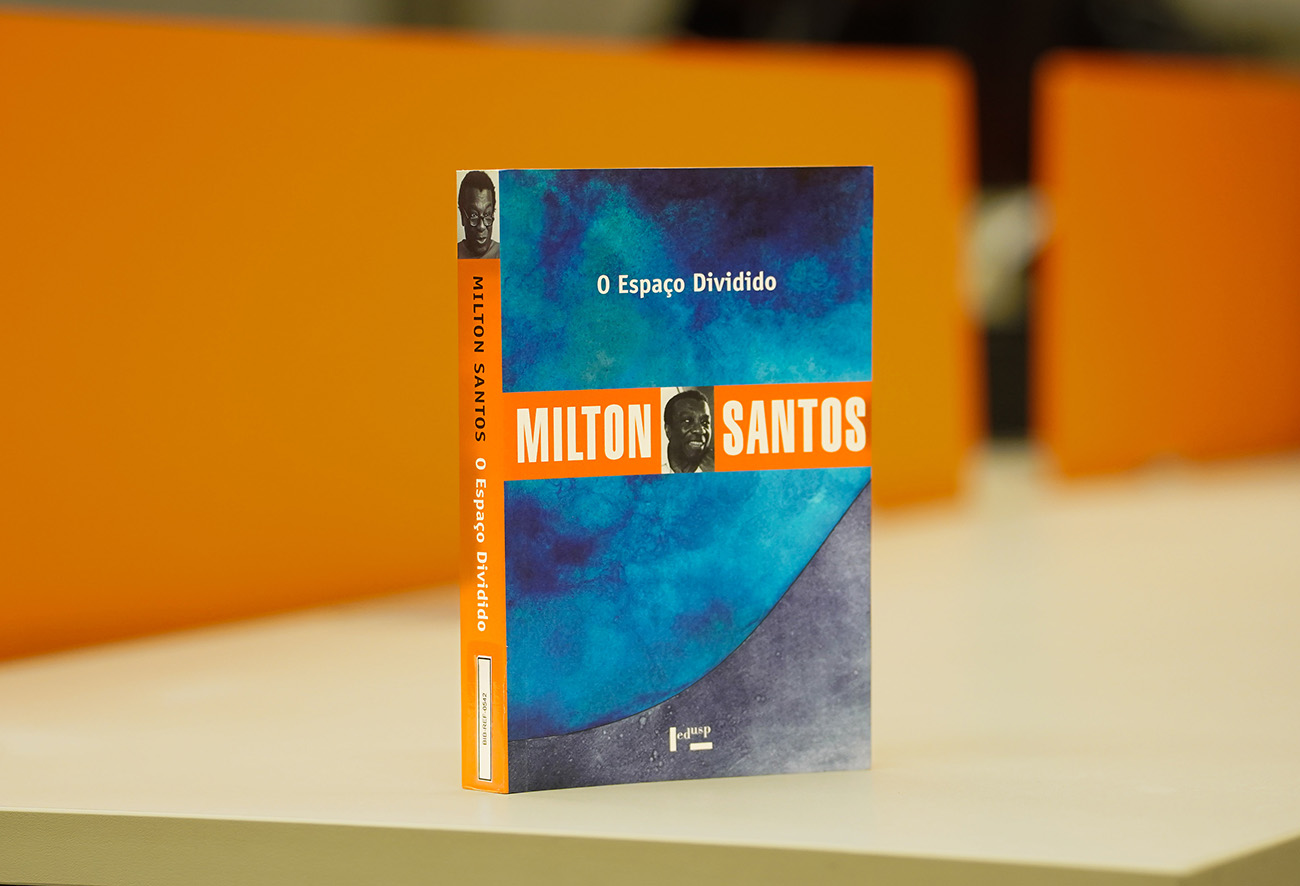
By José Tadeu Arantes | Agência FAPESP – Originally published in the 1970s, The Divided Space represents one of Milton Santos’s most original contributions to geographical and social theory. The book begins with a critique of the dominant interpretations of urbanization in the so-called Third World. According to Santos, these interpretations reproduce analytical frameworks derived from European and North American experience without capturing the historical specificity of these societies.
For Santos, understanding underdevelopment requires a holistic approach. Without an effort to grasp underdevelopment as a whole, solving specific problems is impossible. This position leads Santos to reject the uncritical use of imported models and advocate for constructing a new theoretical framework capable of capturing the unique dynamics of peripheral countries.
One of the central points of his argument is his rejection of the idea that these societies are merely in an earlier stage of development. Instead, he asserts that they are a distinct reality – not a developing world, but an underdeveloped world with its own characteristics and fundamental mechanisms. This distinction has decisive implications, as it shifts the analysis from the notion of backwardness to that of structure.
Spatially, this structure manifests itself through profoundly unequal and selective organization. Santos observes that the spaces of underdeveloped countries are organized and reorganized according to distant interests, most often on a global scale, and are affected unequally by the forces of modernization. The result is an unstable, fragmented configuration marked by sharp internal contrasts.
It is in this context that the author formulates his best-known contribution: the theory of the two circuits of the urban economy. Two economic circuits are created that are responsible for both the economic and spatial organization processes. The upper and lower circuits coexist and interrelate under profoundly asymmetrical conditions.
The upper circuit, associated with technological modernization, is integrated into broad flows of capital and information that are often external to the city, or even the country. In contrast, the lower circuit consists of small-scale activities that are deeply rooted and maintain privileged relationships with their regions. These activities serve as a basis for survival for large segments of the population.
In highlighting this duality, Santos criticizes the tradition of urban studies that focuses solely on the modern sector, ignoring the city as a whole. He observes that most studies are not conducted on the entire city, but rather on a part of it. According to Santos, this limitation prevents the formulation of an adequate theory of urbanization in underdeveloped countries.
The interpretive key proposed by the author lies in the idea of spatial selectivity. Production tends to concentrate in certain parts of the territory, while consumption is unevenly dispersed and conditioned by income disparities. This dynamic simultaneously unifies the space through global flows and fragments it through local inequalities.
In this context, The Divided Space does not limit itself to analysis, but rather points to the need for a broader theoretical renewal. According to the author, this constitutes a new paradigm, as defined by philosopher of science Thomas Kuhn (1922–1996), capable of guiding research and action. By placing space back at the center of reflection on development, Milton Santos offers a crucial perspective for understanding contemporary cities.
Republish
The Agency FAPESP licenses news via Creative Commons (CC-BY-NC-ND) so that they can be republished free of charge and in a simple way by other digital or printed vehicles. Agência FAPESP must be credited as the source of the content being republished and the name of the reporter (if any) must be attributed. Using the HMTL button below allows compliance with these rules, detailed in Digital Republishing Policy FAPESP.
